Artist · 1919–1998
Lee Mullican
American
San Francisco, California, United States · Los Angeles, California, United States · Taos, New Mexico, United States
Lee Mullican (1919–1998) was an American painter, sculptor and educator associated with the Dynaton group in postwar California. His rhythmic fields of color and fine linear marks connected abstraction with landscape, cosmology and inward experience. In the mid-1980s, he extended this established practice into computer drawing, exploring the expressive possibilities of digital painting tools at UCLA.
In the collection
2 works
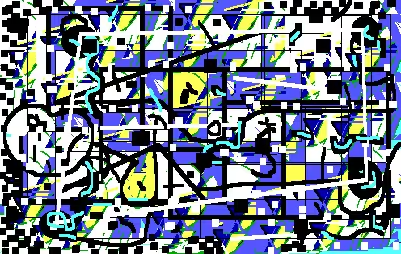
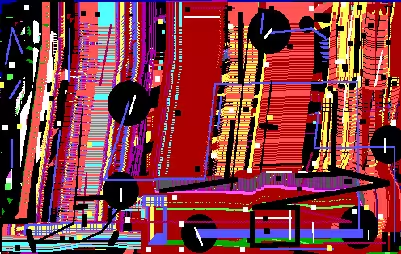
Lee Mullican approached abstraction as a way to connect the visible world with an imagined, inward space. His paintings gather small linear marks into fields that can suggest vegetation, woven surfaces, radiant bodies or maps of an unfamiliar terrain. When he began working with computers in the mid-1980s, he brought these longstanding concerns with color, rhythm and pattern into a new medium.
Born in Chickasha, Oklahoma, in 1919, Mullican studied at the Kansas City Art Institute and served as a topographical draftsman in the United States Army during the Second World War. He settled in the San Francisco Bay Area after the war. With Wolfgang Paalen and Gordon Onslow Ford, he participated in the Dynaton group, whose 1951 exhibition at the San Francisco Museum of Art proposed an expansive approach to abstraction informed by Surrealism and explorations of perception.
Paul Klee was an important early point of reference. Mullican encountered his work in a 1942 memorial exhibition, and the relationship between rhythmic pattern, nature and cosmic imagery remained significant. His own compositions moved between suggestion and abstraction: forms might resemble plants, figures or celestial structures without resolving into a conventional scene. The 2021–22 SFMOMA exhibition Outward Sight and Inner Vision placed his early paintings alongside Klee’s.
Mullican developed a distinctive method of applying paint with the edge of a printer’s ink knife. Repeated narrow marks built luminous surfaces and gave the image a pulse. Painting was part of a wider practice that included drawing, sculpture and teaching. A Guggenheim Fellowship took him to Rome in 1959; he joined UCLA’s art faculty in 1961 and taught there for nearly three decades. He later divided his time between Los Angeles and Taos.
In 1986 he joined UCLA’s Program for Technology in the Arts. He worked with an IBM 5170 computer, a Truevision TARGA graphics adapter and a Summagraphics Summasketch stylus. Mouse and stylus offered different ways to make and repeat marks, while the illuminated screen opened another field of color. His computer work grew from the concerns of an experienced painter investigating new tools.
The digital compositions retain the density and improvisation of his paintings. Mullican valued the unexpected results that could arise while using the software, connecting this process to Surrealist automatism. The image could be revised quickly, and familiar signs could emerge within an otherwise abstract arrangement. The computer became a place to continue an artistic inquiry already decades in development.
Mullican died in 1998. His work is held by museums including MoMA, SFMOMA, the Metropolitan Museum of Art and LACMA. The LACMA-organized retrospective An Abundant Harvest of Sun opened in 2005 and travelled to New York’s Grey Art Gallery in 2006. Later presentations, including Computer Joy in 2021 and LeeMullican.PCX on Feral File in 2023, returned attention to his digital experiments. These posthumous editions make surviving computer works accessible while preserving their place within his broader career.
Exhibitions
- 1951 - Dynaton, San Francisco Museum of Art, San Francisco.
- 1980 - Lee Mullican: Retrospective, Los Angeles Municipal Art Gallery, Barnsdall Park.
- 2005–06 - Lee Mullican: An Abundant Harvest of Sun, Los Angeles County Museum of Art, 10 November 2005–20 February 2006.
- 2006 - Lee Mullican: An Abundant Harvest of Sun, Grey Art Gallery, New York University, 25 April–15 July.
- 2021 - Lee Mullican: Computer Joy, Marc Selwyn Fine Art, Los Angeles.
- 2021–22 - Outward Sight and Inner Vision: Paul Klee and Lee Mullican, SFMOMA, 18 December 2021–26 June 2022.
- 2023 - LeeMullican.PCX, Feral File, curated by Anika Meier, released 23 March.
- 2024–25 - Digital Capture: Southern California and the Pixel-Based Image World, California Museum of Photography and Culver Center of the Arts, Riverside, 21 September 2024–2 February 2025.