

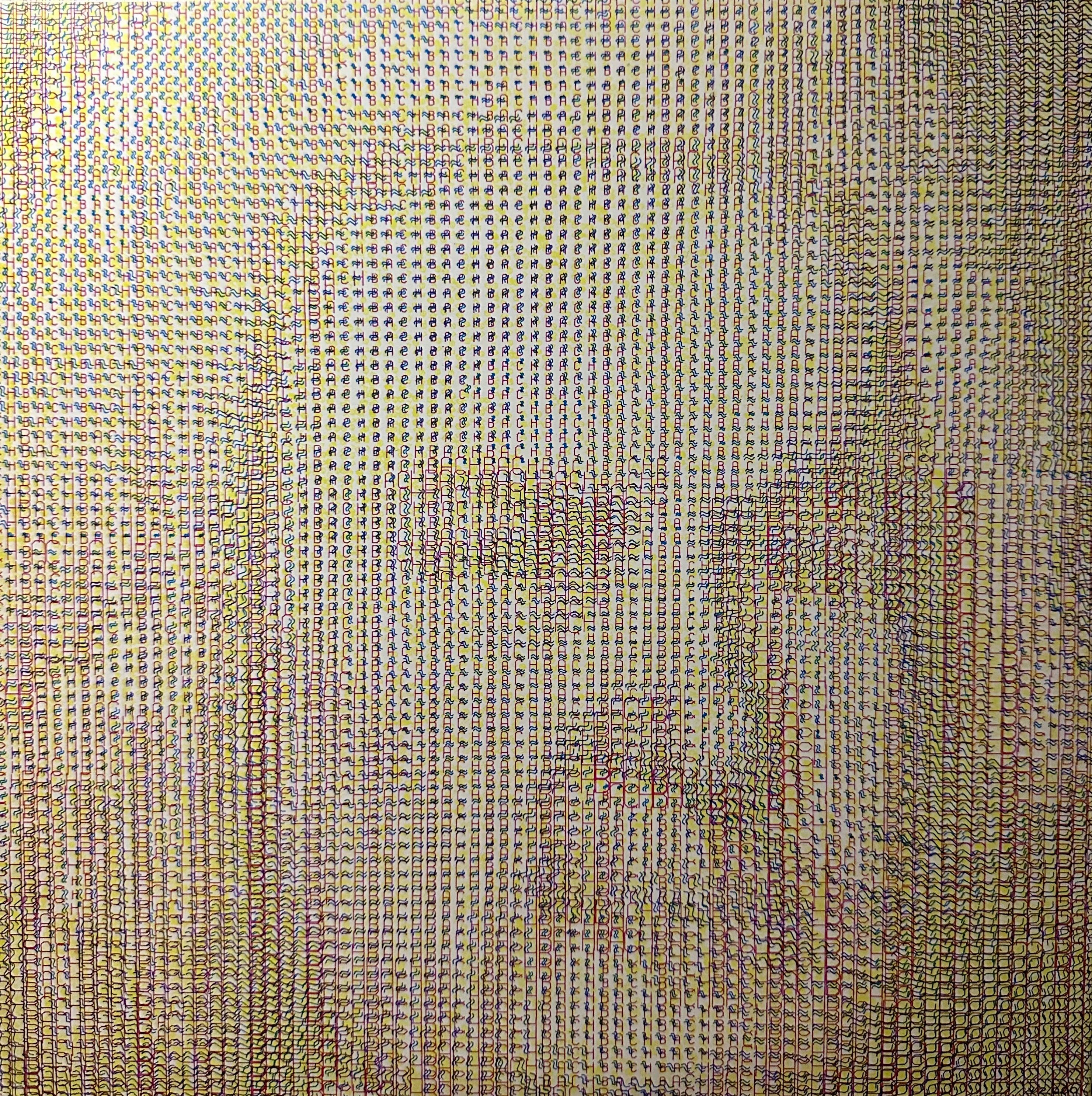
01 / 04Computer Technique Group, Plot Bach, on the back cover of the Japanese pressing of Switched-On Bach.
Open full-size image ↗LP or sound recording
Switched-On Bach スイッチト・オン・バッハ
1969The back of this 1969 Japanese pressing contains a rare documented late work by Computer Technique Group, created in the final year of CTG's existence. The work features a raster-sampled digital transformation of a photographic image, in which tonal values were quantized and represented by plotted graphic symbols. Unlike most early computer graphics, its production is unusually well documented: the liner credits CTG and describes the IBM 360/75 computer, CalComp plotter, FORTRAN IV program, 80 x 90 sampling grid, ten tonal levels, and symbol-based reconstruction of Bach's portrait.
- Author / editor
- Walter Carlos (Wendy Carlos)
- Publisher
- CBS/Sony / CBS・ソニーレコード
Japan - Format
- LP Vinyl Record
- Language
- Japanese
Translated from Japanese:
About the design and production of the back jacket
Masao Komura / CTG
The printing process for a full-color plate would normally be as follows:
color original → four-color separation → four color plates → four-color printing.
The theme of “Plot Bach” was to insert computer graphics into this process.
Only the face portion of Bach’s portrait was cropped, then separated into four colors on an 80 × 90 mesh, and a photographic print was made. Each resulting point was represented as one of ten density levels, from 0 to 9, and this became the data. That data was then converted into various symbols.
For the yellow plate, two kinds of symbols representing transistors are scattered in quantities proportional to the density.
For the red plate, the letters BACH are written in sizes proportional to the density.
For the blue plate, in order to express the image of a fugue, symbols were rotated so that an overall flow would emerge.
Computer used: IBM 360/75
Plotter: CALCOMP 763/780
IBM Scientific Data Center
Programming language: FORTRAN IV
Design and production: Computer Technique Group (CTG)
The IBM 360/75 computer was used courtesy of IBM Japan, Ltd.