

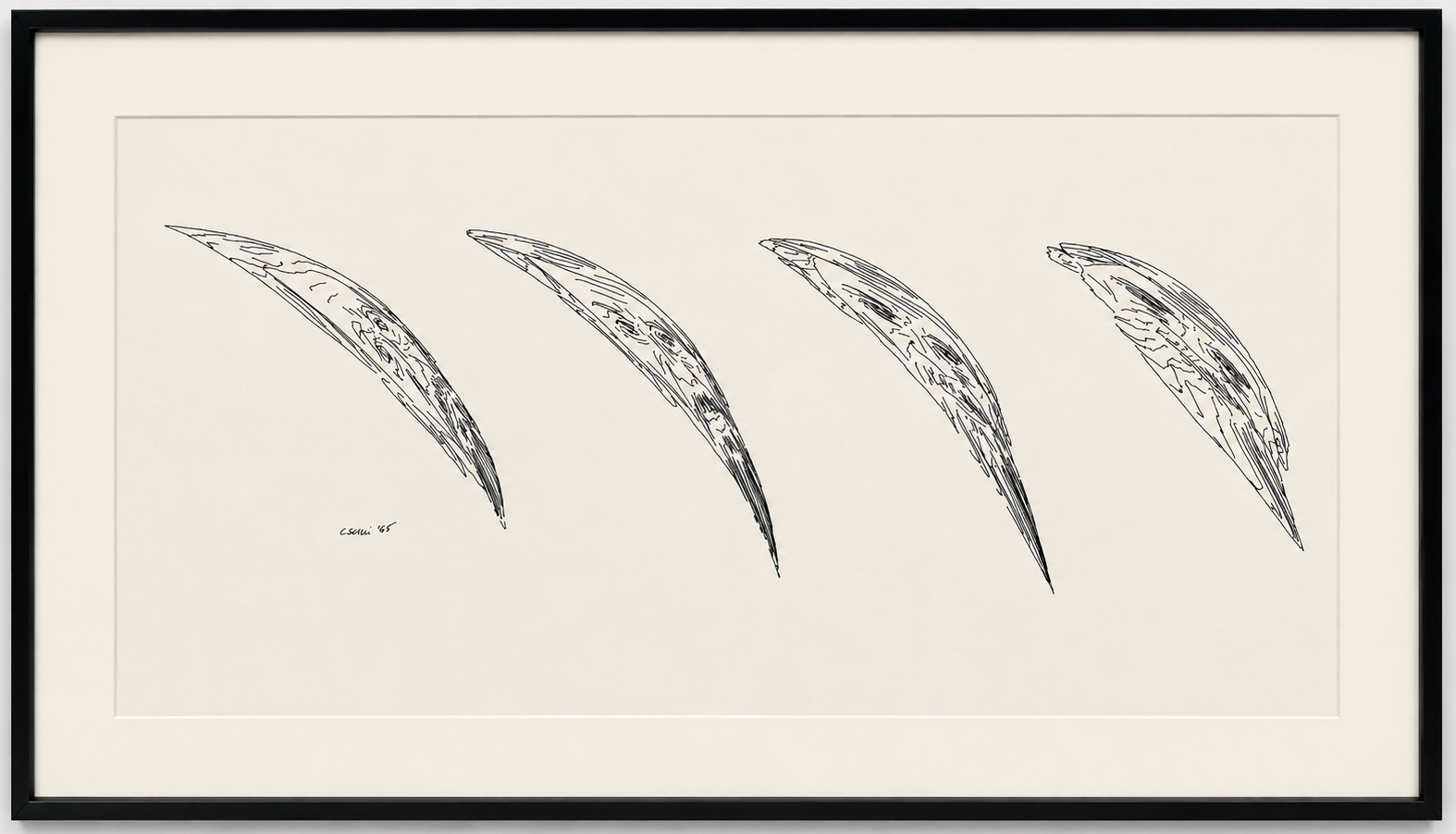
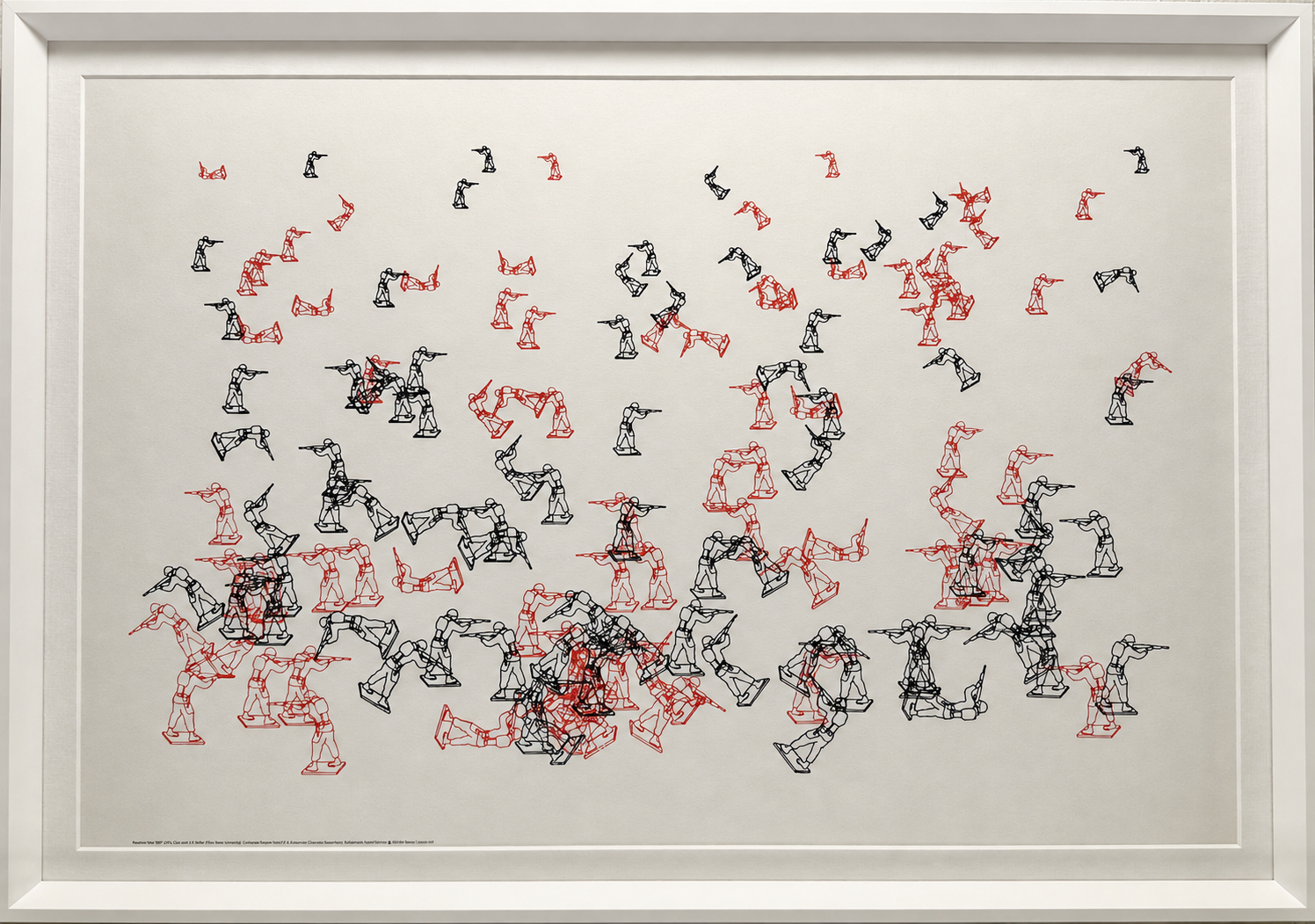
Four BSpline Men is one of the earliest known computer-generated figurative artworks. The Charles Csuri Estate recognizes the work as the earliest known example of an artist using a B-spline function and randomization to transform an image. Created in 1965, the work predates Csuri's Bearded Man, Five Faces, and Leonardo transformations of 1966 and his canonical Sine Curve Man, Hummingbird, and Random War of 1967.
Provenance
Acquired directly from the Charles Csuri Estate
References
Christie’s. “Charles Csuri (1922–2022), Bspline Men, 1966.” Augmented Intelligence, Lot 13, 2025. Christie’s — Bspline Men, 1966 Documents the other known unique work from Csuri’s early B-spline experiments. Signed “Csuri ’66” and executed in 1966, the drawing was produced in ink using an IBM 7094 and Calcomp drum plotter. Christie’s describes the work as “historic and revolutionary,” emphasizing Csuri’s use of the B-spline to transform a figurative image and his departure from the predominantly geometric language of early generative computer art. Provenance: Charles Csuri Estate.
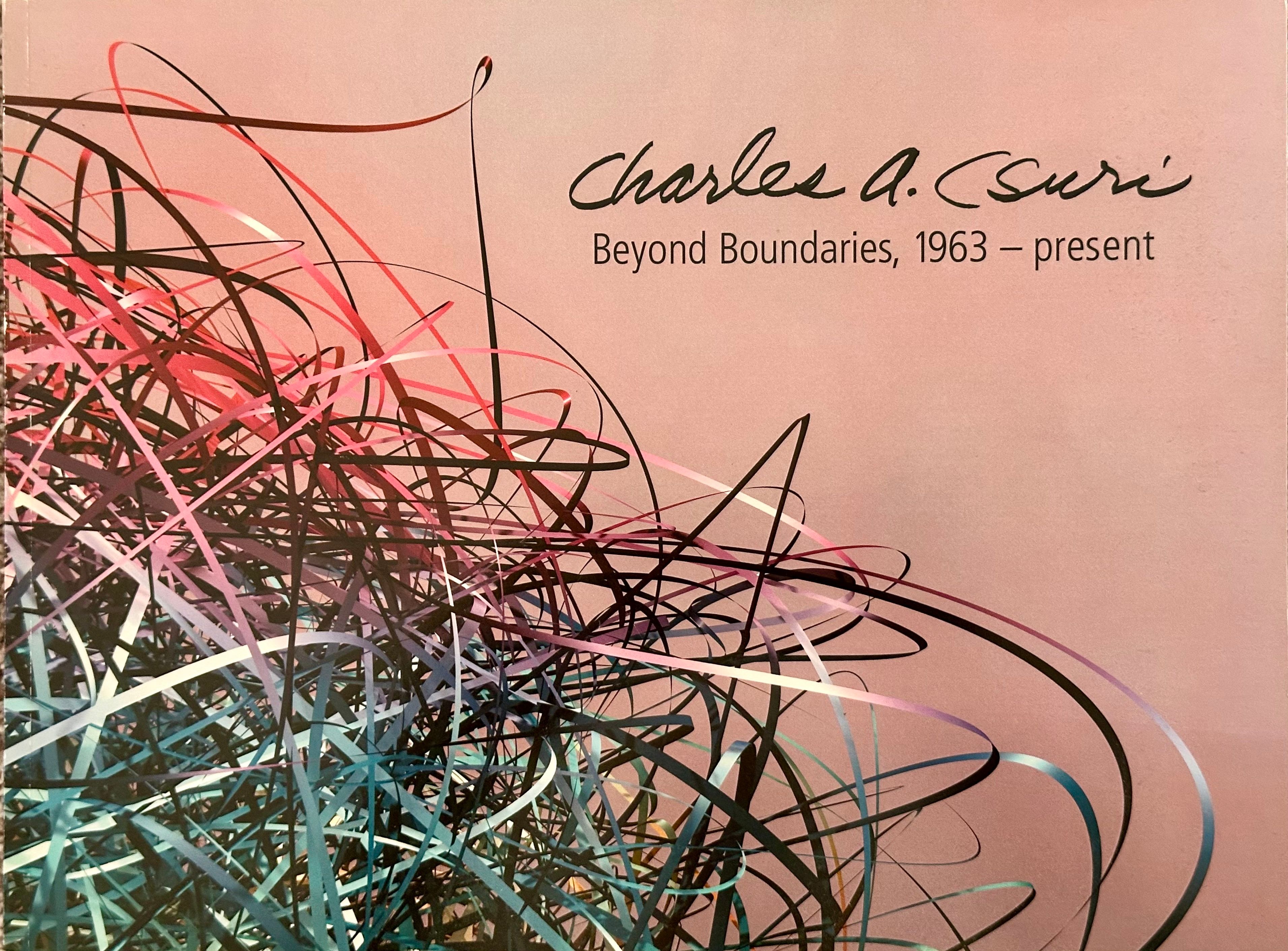
Rosen, Margit, et al. Charles A. Csuri: Beyond Boundaries, 1963–present. ACM SIGGRAPH, 2006. ACM SIGGRAPH — Charles A. Csuri: Beyond Boundaries, 1963–present The major retrospective study of Csuri’s early work. The catalogue documents Dignified Lady as a 1964–65 IBM 7094 drum-plotter drawing, followed by Five Faces, Bearded Man in a Circle, and the Leonardo da Vinci Series in 1966. Rosen also records that in 1965 Csuri began working with programmer James Shaffer and mathematician Leslie Miller to develop mathematical functions for the transformations he envisioned, placing Four BSpline Men directly within this formative moment in Csuri’s computer practice.
Charles Csuri Estate. “Early Period: 1963–1988.” Charles Csuri Estate — Early Period Estate overview of Csuri’s earliest procedural and computer-generated works. It identifies Dignified Lady as Csuri’s first plotter drawing and documents the progression toward increasingly complex figurative transformations produced with the IBM 7094 and Calcomp drum plotter, including Bearded Man, Bearded Men, Old Man Transformation, SineScape, and Bspline Men.
Whitney Museum of American Art. “Charles Csuri, Sine Curve Man, 1967.” Whitney Museum — Sine Curve Man Museum record for one of Csuri’s canonical later figurative computer drawings. Sine Curve Man demonstrates the continuation of the image-transformation approach already present in Four BSpline Men: a figurative source is subjected to a mathematical function and rendered by plotter. The Whitney acquired the work in 2018 for its permanent collection.
Whitney Museum of American Art. “Charles Csuri, Sine Curve Man, 1967,” in Programmed: Rules, Codes, and Choreographies in Art, 1965–2018. Whitney — Programmed: Rules, Codes, and Choreographies in Art Discusses Sine Curve Man within the history of rule-based and computational art and describes Csuri’s use of a digitized human figure stored in an IBM 7094 and mathematically transformed through a sine-curve function. The work provides an important later comparison for Csuri’s experiments with algorithmically transformed figuration begun in the mid-1960s.
Computer History Museum. “Technology + Art.” Computer History Museum — Technology + Art Places Csuri within the first generation of artists working with digital computers. The Computer History Museum notes that Csuri began creating two-dimensional computer imagery by 1964 and describes his use of FORTRAN programs, the IBM 7094 mainframe, and Calcomp output to transform digitized drawings.
Advanced Computing Center for the Arts and Design, The Ohio State University. “ACCAD History.” Ohio State University — ACCAD History Institutional history tracing Csuri’s pioneering computer-graphics research at Ohio State to 1963 and documenting his early experiments in mathematically modifying figurative drawings with mainframe computers and plotters.
Four BSpline Men begins the history of computer-generated figuration. The computer ceases merely to record or reproduce a human image and begins actively to transform it.
Csuri had already experimented with putting figurative information into a digital system. His tiny Dignified Lady of 1964–65, regarded as his first plotter drawing, translated the outline of a woman's face into computer-readable coordinates and plotted it back onto paper. Four BSpline Men represents a further conceptual advance. Here the human figure becomes data that can be mathematically altered. Using an IBM 7094 mainframe, Csuri applied a B-spline function together with random-number generation to change the figure's curvature and form, producing four related transformations from a common source.
That distinction places Four BSpline Men at the origin of generative figuration in art. Most publicly visible computer art in 1965 was geometric and abstract. William Fetter’s Human Figure, traditionally dated 1964 but first securely documented publicly in 1966, was an industrial model developed to study pilot ergonomics at Boeing rather than a work of fine art. Other early figurative experiments, such as H. Philip Peterson’s Mona by the Numbers of 1965, digitized and reconstructed an existing image. Four BSpline Men is therefore not just an early computer image of a person, but possibly the earliest known work to use computation to transform the human figure as art.
The Charles Csuri Estate recognizes Four BSpline Men as the earliest known example of an artist using a mathematical B-spline function and random-number generator to organically distort and transform imagery. Its 1965 date makes that claim particularly consequential. B-splines, introduced within twentieth-century approximation mathematics, had not yet become the familiar tools of computer graphics and computer-aided design they would become in subsequent decades. Csuri was applying this mathematical language to artistic form at the threshold of its computational history.
The work also significantly revises the familiar chronology of Csuri's own art. His celebrated Sine Curve Man of 1967 is frequently described as the first figurative computer drawing made in the United States. Four BSpline Men, created two years earlier, demonstrates that Csuri was already using a digital computer to mathematically transform the human figure in 1965. A separate Bspline Men, signed and dated 1966, confirms that the B-spline experiment developed into a small series; the present work is the earlier of the two unique variations identified by the Estate.
At a moment when computers were almost entirely institutional machines devoted to science, engineering, military research, and data processing, Csuri treated the IBM 7094 as a medium for inventing forms that neither artist nor machine would have produced independently. Four BSpline Men is an exceptionally early surviving artifact of that shift and a landmark in the emergence of generative art.