Artist · 1922–2022
Charles Csuri
American
Columbus, Ohio, USA
Charles Csuri was the first major fine artist to make figuration a sustained language of computer art and he was a foundational figure in computer animation. Beginning in 1964, he transformed his own drawings of people and animals through code, created one of the earliest computer-animated films, pioneered algorithmic narrative and simulation, and built institutions at Ohio State that helped establish computer graphics as an artistic, academic and commercial field.
Charles Csuri was the first major fine artist to make figuration a sustained language of computer art. The Museum of Modern Art has credited him with introducing figuration into computer graphics, a field then dominated by abstract mathematical forms. Csuri treated people and animals as expressive subjects that could be animated, multiplied, distorted, randomized and placed inside narrative and moral systems.
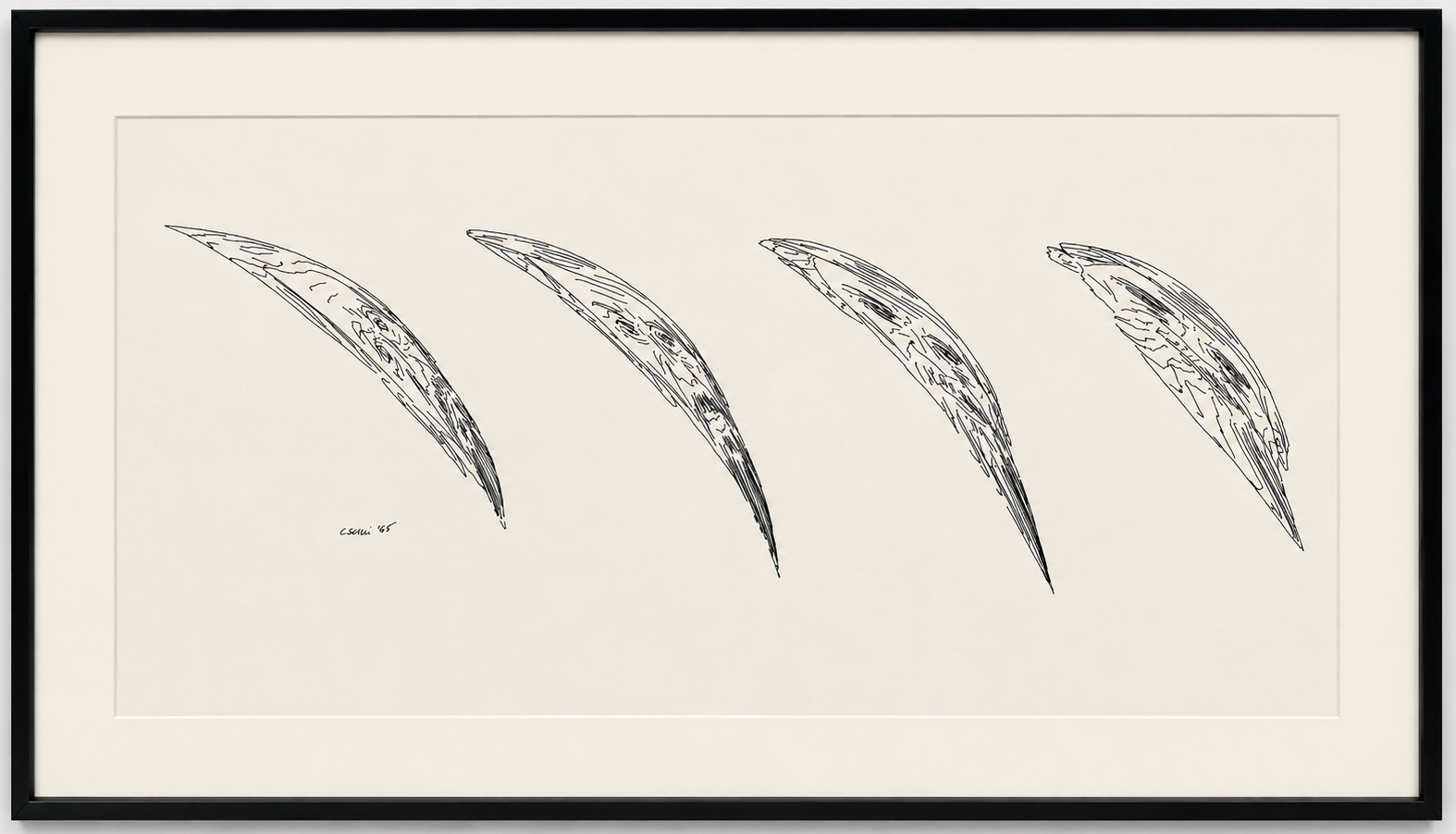
Csuri entered computing as an established painter rather than as an engineer searching for visual applications. He began experimenting with computers in 1964 to convert his drawings into digital data and subject them to mathematical operations. Early works such as Dignified Lady, the Bearded Man transformations, Flies, Sine Curve Man, Hummingbird and Random War established a vocabulary of transformation, repetition, chance and hierarchical control that anticipated later generative art.
In Hummingbird (1967), more than 30,000 computer-generated images were drawn directly onto film using a microfilm plotter. The bird dissolves, multiplies and reconstitutes itself through programmed transformations, moving continuously between recognizable figuration and abstraction. The film received an award at the Fourth International Experimental Film Competition in Brussels and was acquired by the Museum of Modern Art soon after its completion, becoming the first computer-generated artwork to enter MoMA’s collection.
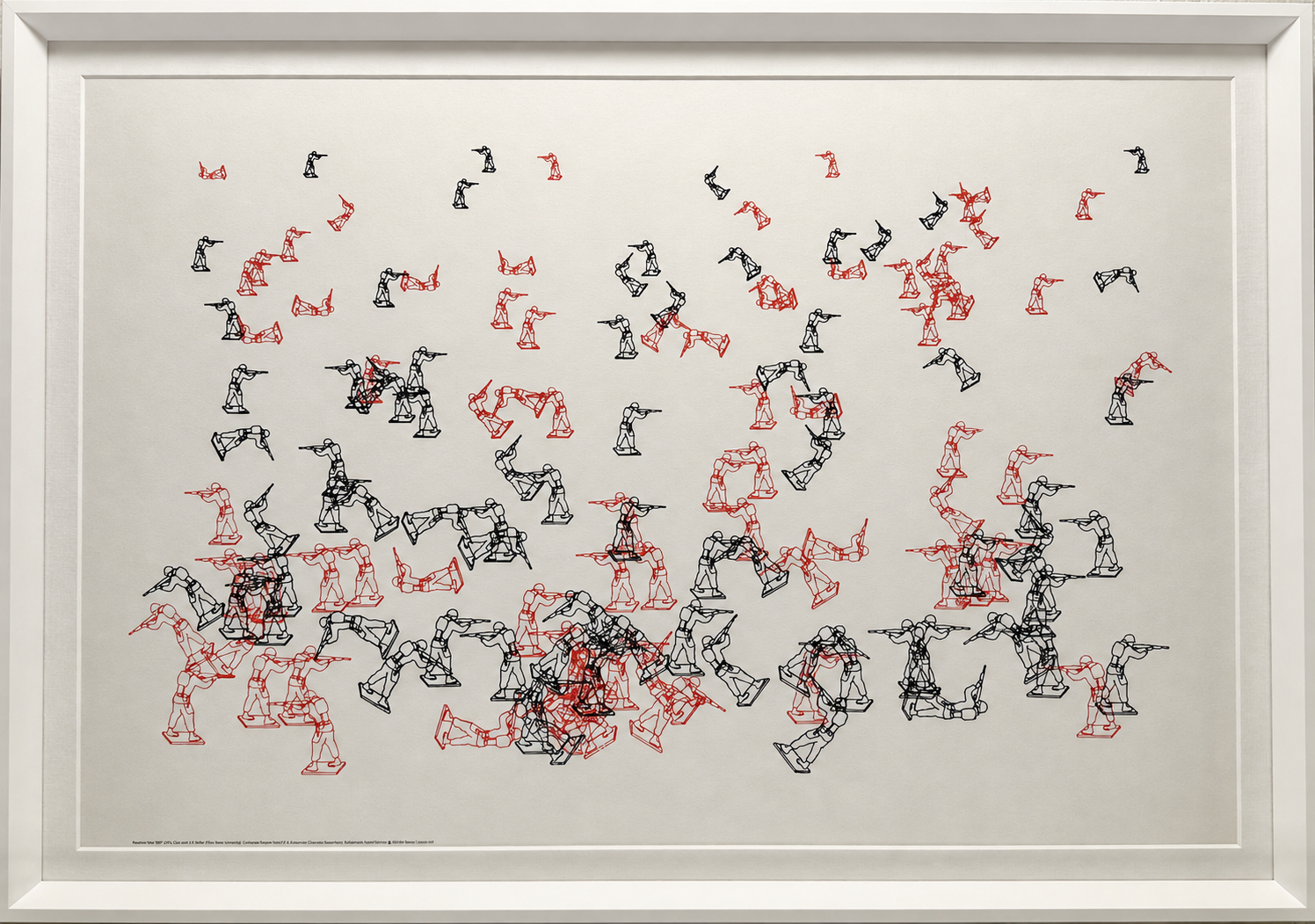
Random War (1967) expanded computer art from image transformation into simulation and political commentary. A pseudorandom program positioned two armies of toy soldiers, assigned real names and military ranks, and calculated casualties, survivors and medals. Csuri’s own experience as a decorated veteran of the Battle of the Bulge in World War II gave the work unusual moral force: the computer’s impersonal operations became a model of the arbitrary distribution of death. The work also foreshadowed generative world-building, computer games and agent-based simulation.
Csuri’s influence extended far beyond his own artworks. In 1969 he became the first artist in the United States to receive funding from the National Science Foundation. He used this support to establish the Computer Graphics Research Group at Ohio State, bringing artists, designers, programmers, mathematicians and scientists into a shared research environment. The group developed tools and techniques for computer animation, modeling, rendering, procedural effects and scientific visualization. Its research found applications in flight simulation, computer-aided design, medical imaging, architecture, education and film and television effects.
In 1981 Csuri co-founded Cranston/Csuri Productions, one of the world’s first commercial computer-animation companies. It translated research developed at Ohio State into hundreds of broadcast, advertising, medical and scientific projects for clients that included the major American television networks and the BBC. Its productions included animation for The Living Body, a twenty-four-program series distributed internationally by the BBC. The company became an important bridge between university computer-graphics research and the emerging commercial CGI industry.
In 1987 Csuri founded the Advanced Computing Center for the Arts and Design at Ohio State, the successor to his earlier research group. ACCAD institutionalized his conviction that artists and scientists should develop digital tools together rather than treating artists merely as end users of technology. Its students and researchers went on to influential careers at Pixar, Walt Disney Animation Studios, Industrial Light & Magic and other major centers of animation and visual-effects production. Csuri also co-founded the Ohio Supercomputer Center, helping establish Ohio as a significant center for advanced visualization.
His achievements outside art were equally extraordinary. Csuri was an All-American tackle and the most valuable player on Ohio State’s first national-championship football team in 1942. The Chicago Cardinals selected him in the 1944 NFL Draft, but his professional career was displaced by military service. He served in the U.S. Army from 1943 to 1946, fought in the Battle of the Bulge and received the Bronze Star for heroism.
After the war, Csuri completed undergraduate and master’s degrees in art at Ohio State in 1947 and 1948, having also earned an engineering certificate from Newark College of Engineering during his military service. At Ohio State, Csuri studied alongside Roy Lichtenstein, who became a close friend. Both later joined the university’s art faculty, and Lichtenstein served as best man at Csuri’s wedding. The relationship situates Csuri within the generation that transformed postwar American art. Csuri taught at Ohio State for more than forty years, ultimately holding appointments in both art education and computer and information science.
Csuri received Ohio State’s Distinguished Research Award in 1983, the Ohio Governor’s Award for the Arts and the university’s Joseph Sullivant Medal in 2000, ACM SIGGRAPH’s Award for Lifetime Achievement in Digital Art in 2011, and Ohio State’s Distinguished Alumni Achievement Award in 2014. His work is held by institutions including the Museum of Modern Art, the Victoria and Albert Museum, the Whitney Museum of American Art, the Museum of Contemporary Art Zagreb and ZKM. Across art, software research, education and industry, Csuri helped make computation not simply a tool for producing images but a medium through which artists could construct new visual worlds.
Art also shaped Csuri’s family life. His wife of seventy years, Lee Csuri, was a professional painter and sculptor. Their daughter, Caroline Csuri, became a digital artist, worked closely with her father for three decades in the realization of his art objects, and now leads CsuriVision, preserving and advancing his artistic legacy.
Exhibitions
- 1967 - Fourth International Experimental Film Competition, Brussels, Belgium. Hummingbird received the prize for animation. https://siggrapharts.hosting.acm.org/wp/charles-csuri/biography/
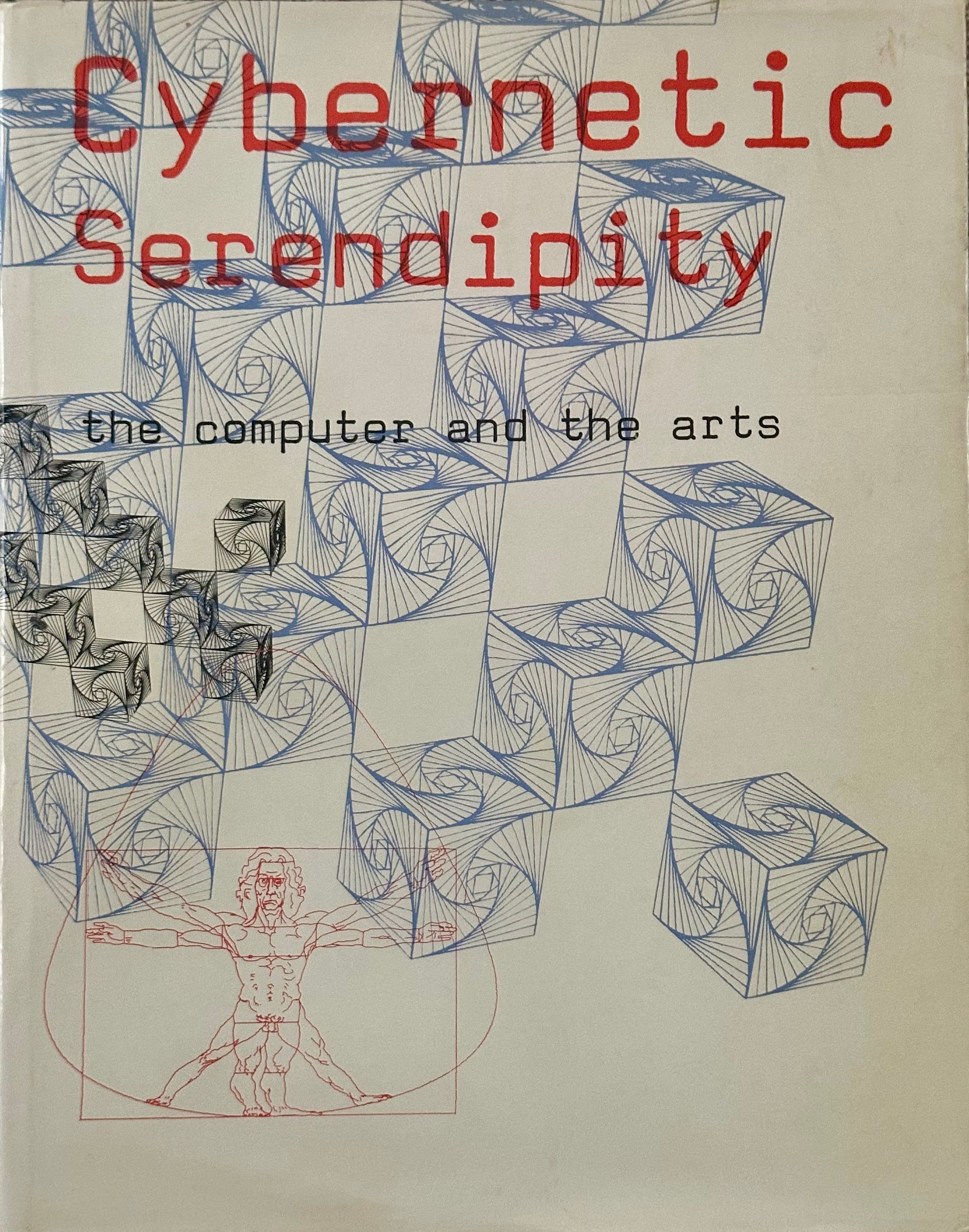
- 1968 - Cybernetic Serendipity: The Computer and the Arts, Institute of Contemporary Arts, London. https://archive.studiointernational.com/SICS1968/StudioInternationalCyberneticSerendipity-1968.html
- 1968–69 - The Machine as Seen at the End of the Mechanical Age, Museum of Modern Art, New York; associated computer-film program.
- 1969 - Tendencies 4: Computers and Visual Research, Gallery of Contemporary Art, Zagreb.
- 1986 - 42nd Venice Biennale, Venice.
- 1996 - ACM SIGGRAPH Art Show, New Orleans.
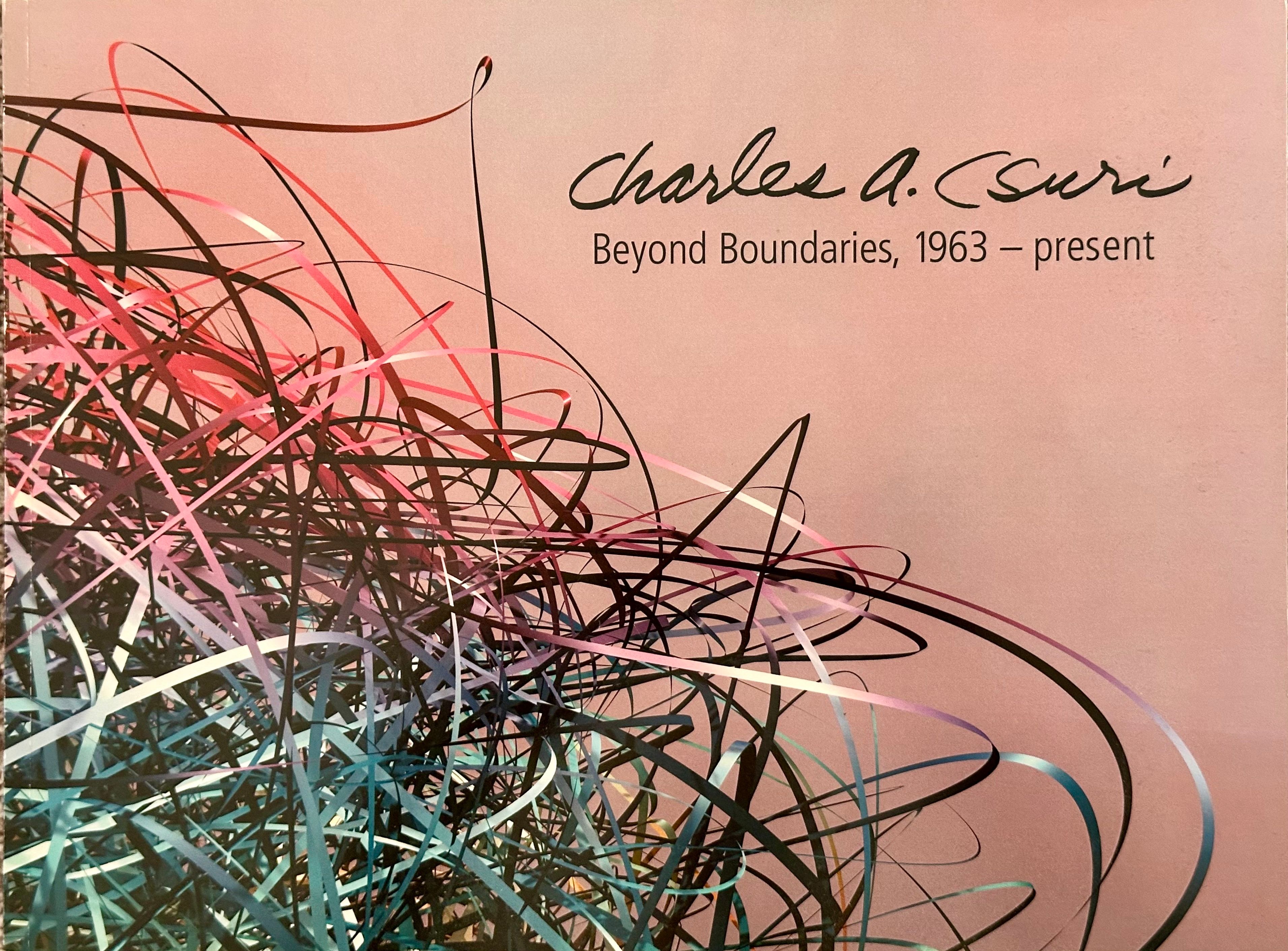
- 2006–10 - Beyond Boundaries: Charles A. Csuri, 1963–Present, ACM SIGGRAPH, Boston; Urban Arts Space, Columbus; Kaohsiung Museum of Fine Arts, Taiwan; subsequent international venues.
- 2008–09 - bit international: [Nove] tendencije, ZKM | Center for Art and Media, Karlsruhe. https://zkm.de/en/exhibition/2008/02/bit-international-nove-tendencije
- 2011 - Dislocations, Museum of Contemporary Art Zagreb media façade, presented with the 12th Istanbul Biennial and ISEA Istanbul.
- 2018 - Thinking Machines: Art and Design in the Computer Age, 1959–1989, Museum of Modern Art, New York. https://www.moma.org/calendar/exhibitions/3863
- 2018–19 - Programmed: Rules, Codes, and Choreographies in Art, 1965–2018, Whitney Museum of American Art, New York. https://whitney.org/exhibitions/programmed
- 2019 - Writing the History of the Future, ZKM | Center for Art and Media, Karlsruhe.
- 2023 - Coded: Art Enters the Computer Age, 1952–1982, Los Angeles County Museum of Art. https://www.lacma.org/art/exhibition/coded-art-enters-computer-age-1952-1982
- 2023 - Charles Csuri: Art and Research, a Memorial Exhibition in Three Acts, The Ohio State University, Columbus. https://uas.osu.edu/charles-csuri
- 2024–25 - Electric Dreams: Art and Technology Before the Internet, Tate Modern, London. https://www.tate.org.uk/whats-on/tate-modern/electric-dreams
In the collection
2 works
In the library
8 items