Artist · 1906–2006
Heinrich Heidersberger
German
Paris, France · Braunschweig, Germany · Wolfsburg, Germany
Heinrich Heidersberger (1906–2006) was a photographer and pioneer of generative image-making. He developed the Rhythmograph, a mechanical apparatus that translated the movement of pendulums into intricate photographic light drawings. His rhythmograms connect experimental photography with the history of analog computation and algorithmic art.
In the collection
1 work
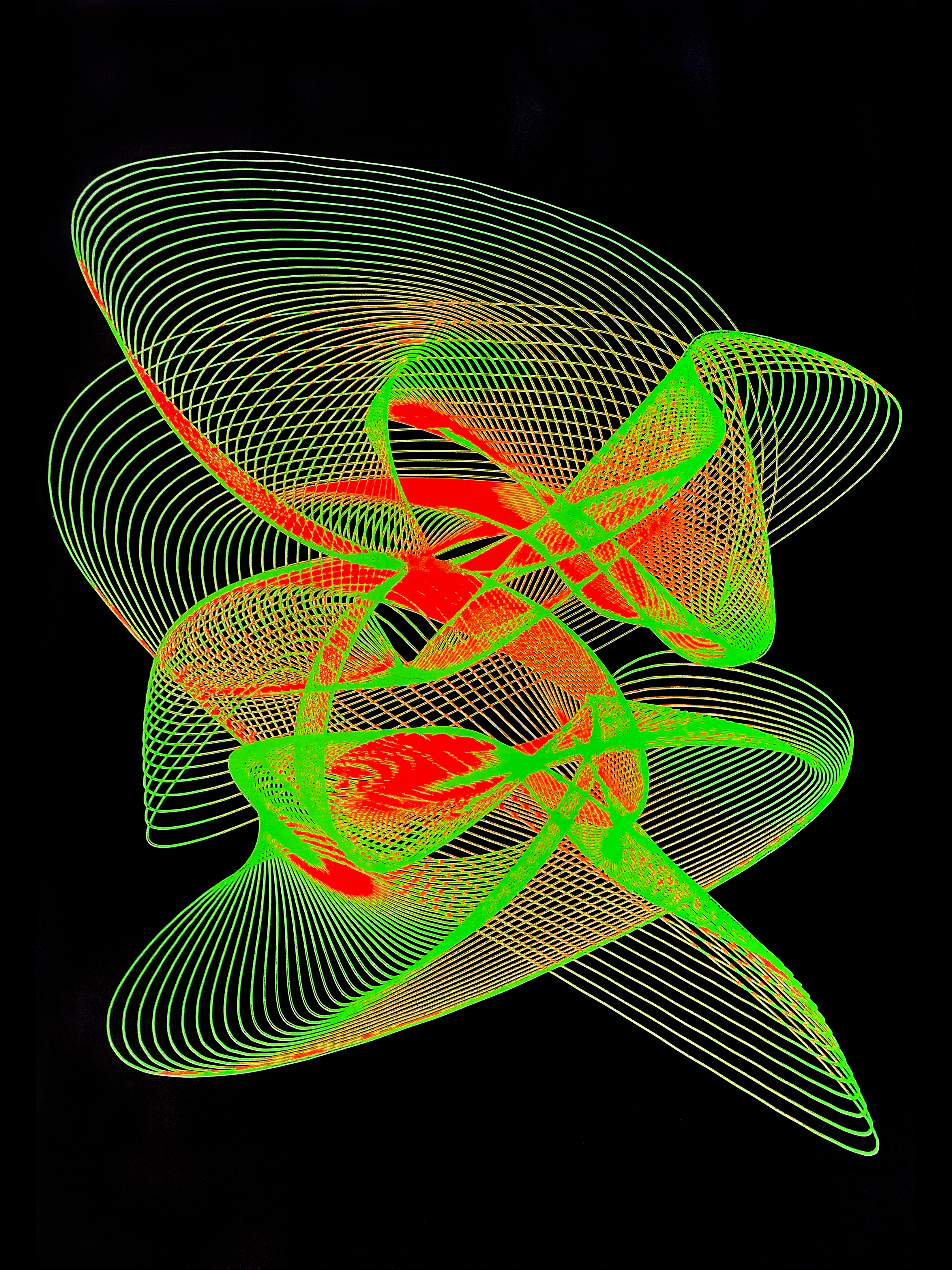
Heinrich Heidersberger’s rhythmograms belong to the early history of generative art: compositions produced through the controlled operation of a system, with the artist shaping both the apparatus and the resulting image.
Born in Ingolstadt in 1906 and raised partly in Linz, Heidersberger studied architecture briefly in Graz before moving to Paris in 1928 to attend Fernand Léger’s painting school. Photography became his principal medium. The rhythmograms, developed in the 1950s, extended his interest in light into abstraction.
The Rhythmograph used four pendulums, a mechanically coupled mirror and a point light source. Their combined oscillations traced lines onto photographic material during an exposure. Adjusting the motion changed the relationships among the curves, producing dense meshes and volumes that appear to twist in space. The apparatus performed operations that could be described mathematically and its results were recorded as photographs. This places Heidersberger’s work within a mechanical and optical strand of generative art.
His son Benjamin describes the Rhythmograph as a mechanical analog computer whose initial conditions could be set precisely enough to repeat an image. This connection to computation was later explored in exhibitions alongside the work of Herbert W. Franke, Frieder Nake and Georg Nees.
He also transformed the light drawings through photographic processes and color. Existing rhythmogram forms became the basis of Andromeda and Energy, two screenprinted posters made in 1973 with fluorescent colors responsive to ultraviolet light.
A rhythmogram received a silver medal at the 1957 Milan Triennale. In 2006, his centenary year, Lentos Kunstmuseum Linz presented a focused survey, while Kunstverein Wolfsburg placed the rhythmograms in dialogue with drawing machines and early computer graphics. The Institut Heidersberger preserves his archive and apparatus; subsequent exhibitions and digital editions have brought these experiments to new audiences.
Exhibitions
- 1957 - XI Triennale di Milano, Milan. Silver medal for a rhythmogram.
- 1998 - Alvar Aalto: Between Humanism and Materialism, Museum of Modern Art, New York. Architectural photographs.
- 2006 - Heinrich Heidersberger: Work in Focus, Lentos Kunstmuseum Linz, 9 January–30 June.
- 2006 - Der Traum von der Zeichenmaschine: Heinrich Heidersbergers Rhythmogramme und die Computergrafik ihrer Zeit, Kunstverein Wolfsburg, 13 May–25 June.
- 2023 - The Thinking Machine: Presenting Pioneers, 1953–2023, EXPANDED.ART, Berlin.
- 2023 - Escape the Darkness: Rhythmograms, 1953–1965, EXPANDED.ART, Berlin.