
Artist · 1927–2022
Herbert W. Franke
Austrian; active in Germany
Erlangen, Germany · Munich, Germany · Egling, Germany
Herbert W. Franke (1927–2022) was an Austrian artist, physicist and writer whose work helped establish computer art as an artistic and intellectual field. From experimental photography and analog electronic images to plotter drawings, Math Art and interactive programs, he investigated how mathematical rules could generate visual form. As the author of Computer Graphics – Computer Art, a curator of early computer-art exhibitions and a co-founder of Ars Electronica, he also helped document, circulate and sustain the work of an international generation of artists.
Herbert W. Franke was a central figure in the development of computer art: an artist who explored the visual possibilities of electronic systems, and a writer, curator and institution builder who helped establish the field’s history and public identity. His practice extended from experimental photography and analog electronics to plotter drawings, mathematical images, interactive programs and virtual environments. Across these different media, he treated scientific instruments and mathematical procedures as means of artistic invention.
Born in Vienna in 1927, Franke studied physics and received his doctorate in 1950, with research in electron optics. He worked at Siemens in Erlangen before becoming a freelance writer in 1957. His early photographic experiments investigated light, movement and structures made visible through technical apparatus. By the mid-1950s, he was also working with an analog computer constructed by the physicist Franz Raimann. In the oscillograms, electrical signals generated curves on a cathode-ray screen; photographing the display, sometimes with a moving camera, transformed these transient traces into layered compositions.
The 1959 exhibition Experimentelle Ästhetik at Vienna’s Museum of Applied Arts brought his experimental photographs and oscillograms into a museum setting. These works established a recurring relationship between a rule-governed system and the artist’s control of its visual effects. Electronic equipment could generate a form, while adjustments to its parameters and the photographic process shaped the resulting image.
By the late 1960s, Franke was working with digital computers and plotters. Quadrate makes this transition particularly clear: ZKM’s 1970 screenprint derives from a drawing produced with a Siemens 4004 computer and a Calcomp drum plotter in 1969–70. The composition reached audiences through a printed edition, and was shown at the 1970 Venice Biennale. Subsequent series tested other technical possibilities. Color Grids (1973) used the Sicograph, a system developed for medical image processing, while Rotations/Projections (1974) explored spatial movement through an early program for real-time three-dimensional graphics.
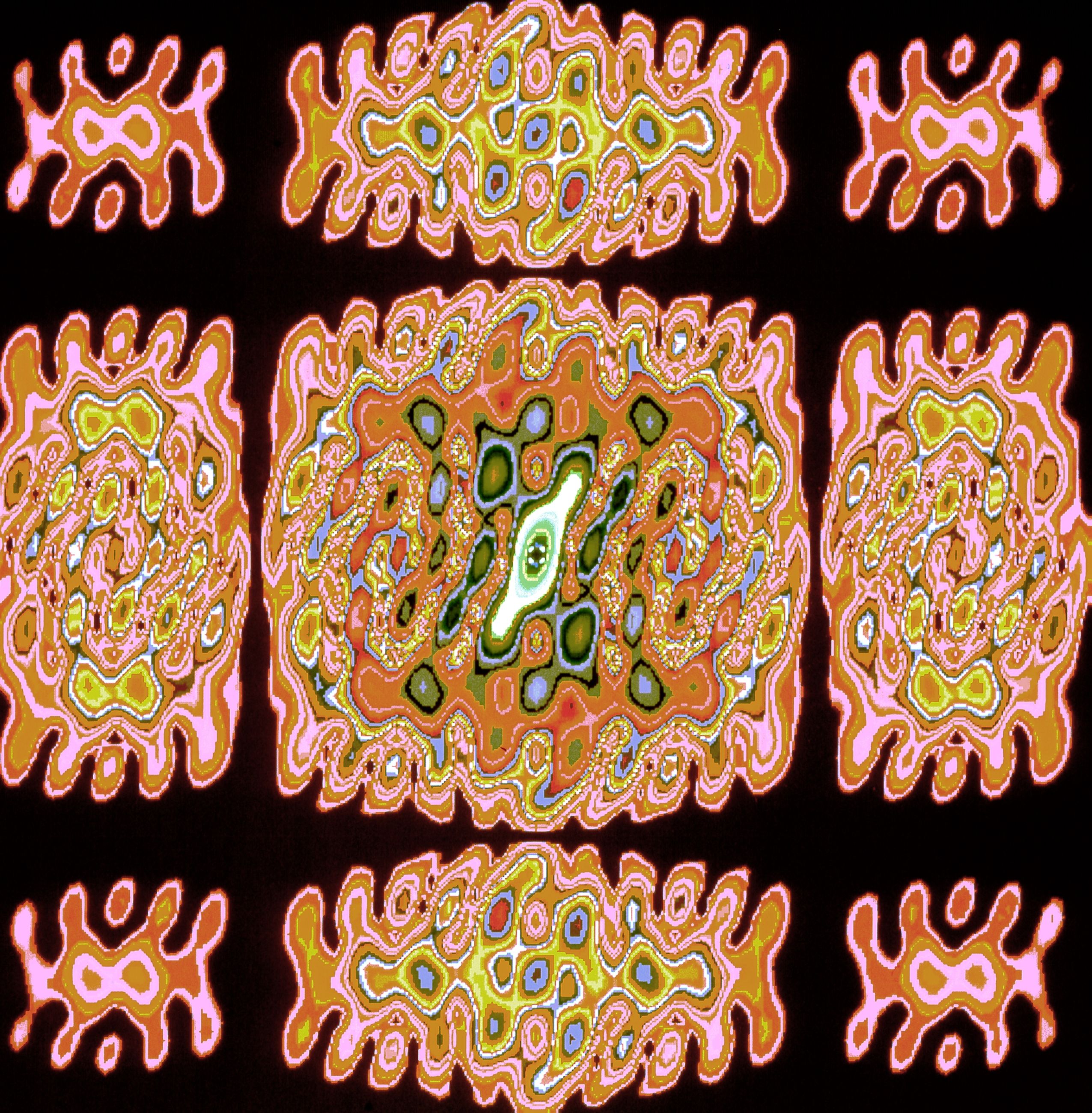
The Math Art experiments of 1979–95 expanded this investigation through a sustained collaboration with physicist and software engineer Horst Helbig at the German aerospace research center in Oberpfaffenhofen. Fourier transforms, algebra, fractals, fields and chance processes became sources of visual structure. Working with a Comtal image-processing system and DIBIAS software, they developed both images and new graphical routines. The project examined how mathematical relationships could become compositions with color, depth and apparent movement, extending Franke’s vocabulary beyond the linear marks of his earlier work.
Personal computers opened a parallel route toward moving and interactive art. MONDRIAN, conceived in 1979, joined programmed graphics and sound. After acquiring an Apple II in 1980, Franke wrote programs in BASIC that could run continuously, with chance producing variations and keyboard input allowing changes while the image evolved. These home-computer works made duration and participation part of the composition. Later experiments extended into Mathematica-generated forms and the online three-dimensional environment Z-Galaxy.
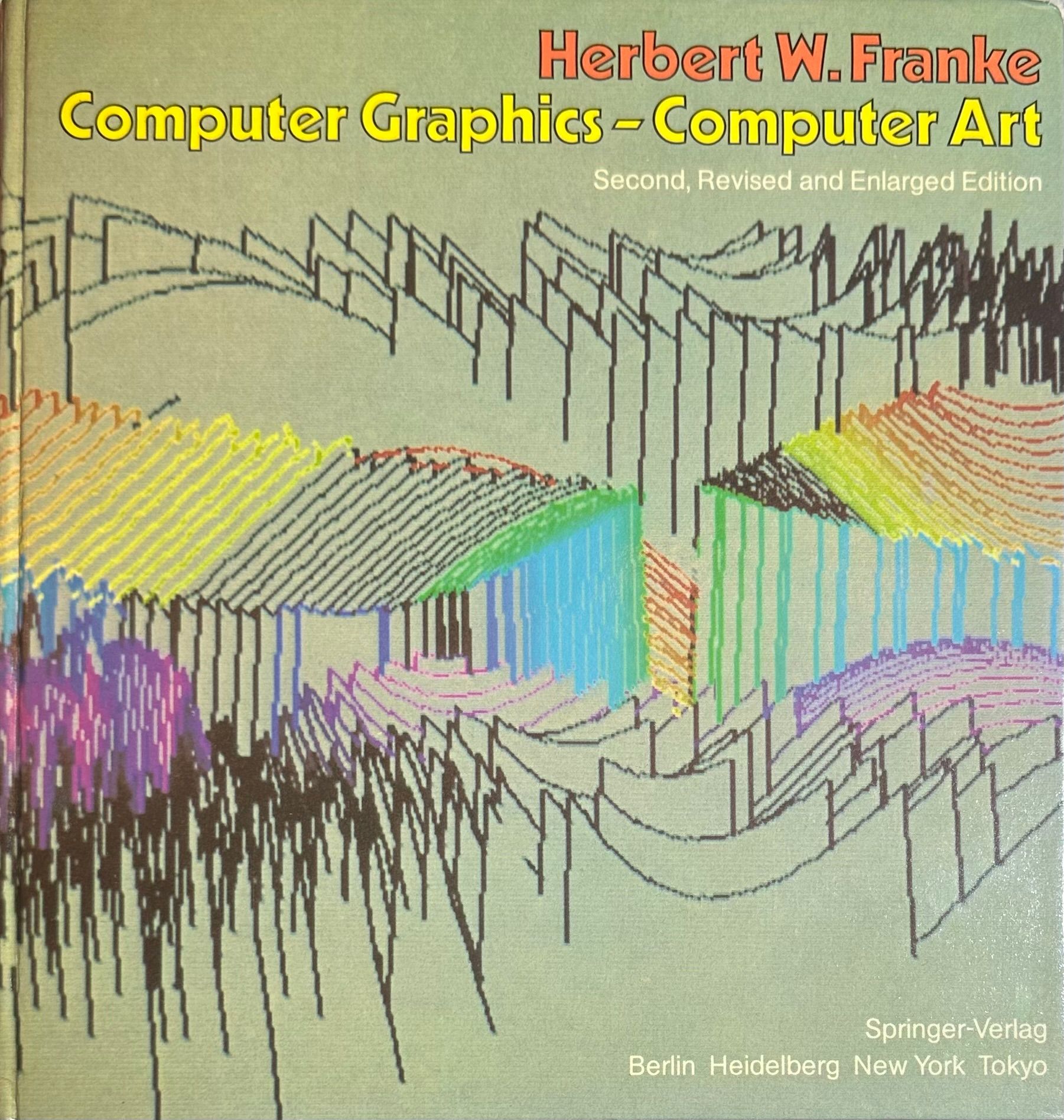
Franke also gave computer art a historical and theoretical framework. His 1971 Computergraphik–Computerkunst, published in English as Computer Graphics – Computer Art, was an early substantial survey of the field. Guerita’s Library holds the expanded 1985 edition, whose discussion connects artistic experiments with scientific imaging, animation and design. Its accounts of Charles Csuri, CTG and the Argentine artists associated with Arte y Cibernética also connect Franke’s scholarship to other artists represented in the collection. His theoretical writing drew on cybernetics and information theory to examine how viewers perceive and respond to art.
Exhibition-making was another part of this work. He curated Kunst aus dem Computer in Berlin in 1968, followed by the touring Wege zur Computerkunst, which developed through presentations and collaborations with the Goethe-Institut. In 1979 he co-founded Ars Electronica in Linz, helping establish a continuing forum for art, technology and society. His later exhibition 25 Jahre Computerkunst – Grafik, Animation und Technik (1989) brought together artists including Csuri, Vera Molnár, Frieder Nake, Georg Nees and A. Michael Noll.
Alongside art, Franke pursued science-fiction writing and cave research. His fiction considered the philosophical and ethical consequences of possible futures, while his scientific work examined natural structures and their formation. These activities shared his interest in systems whose underlying rules could be investigated through observation, calculation or an imagined world. He also taught in Munich, bringing his research in computer graphics and aesthetics into university and art-academy settings.
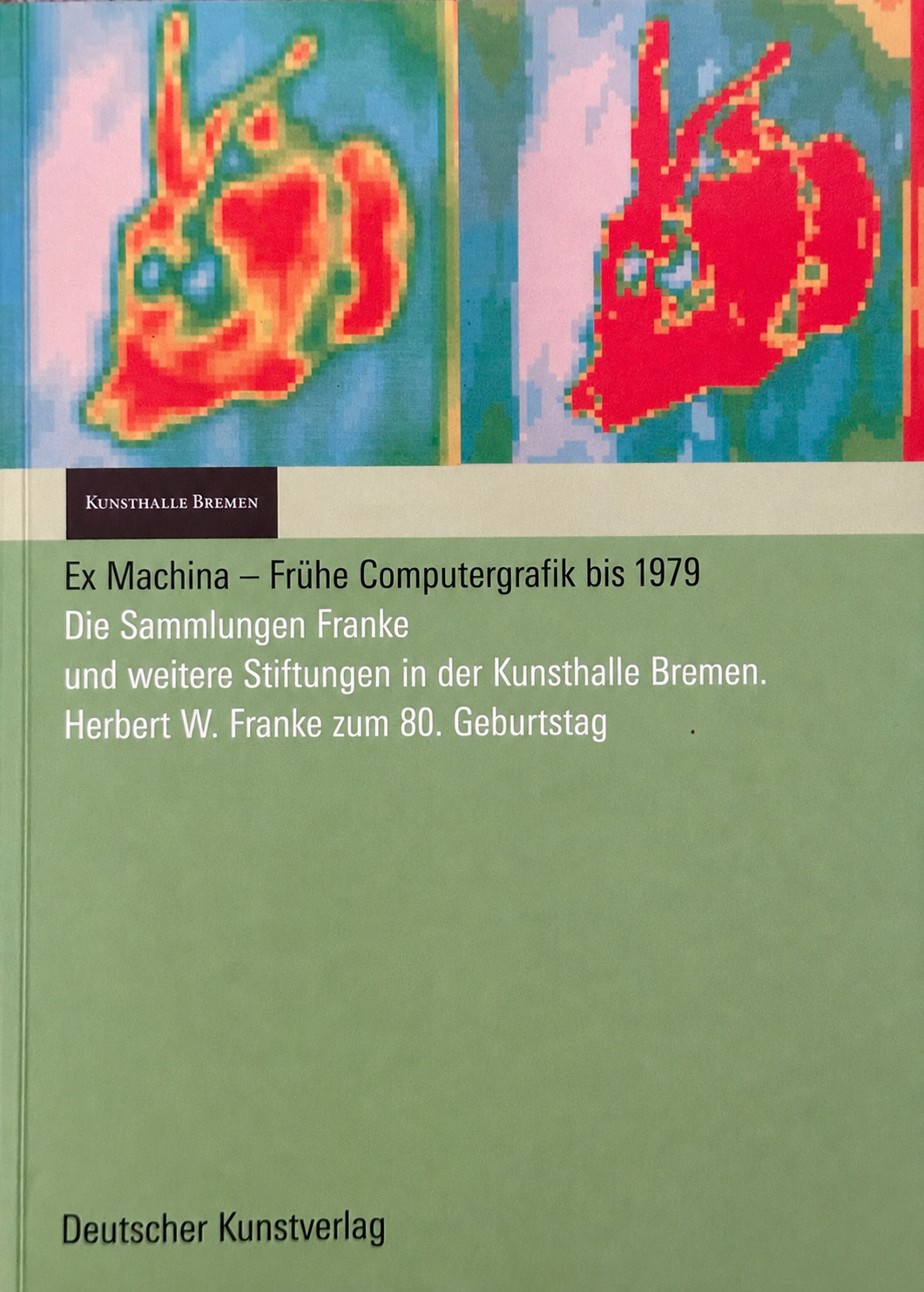
Franke’s historical collection of computer art entered the Kunsthalle Bremen, and his archive was transferred to ZKM in 2017. ZKM presented a retrospective in 2010–11. Near the end of his life, Franke selected 100 Math Art images for an NFT release in 2022, bringing work developed decades earlier into a new context of digital collecting. He died that year. The posthumous exhibition Illuminating the Invisible at KÖNIG GALERIE in 2024 surveyed the connections between his photographic, computational and interactive work.
Exhibitions
- 1959 – Experimentelle Ästhetik, Museum of Applied Arts, Vienna; subsequently presented in Zurich, London and Munich.
- 1968 – Kunst aus dem Computer, Technische Universität Berlin, accompanying the MIT/TU Berlin conference The Computer in the University. Curated by Franke.
- From 1969 – Wege zur Computerkunst, touring exhibition developed by Franke; expanded in 1975 for the Goethe-Institut and circulated internationally through 1986. Curatorial project.
- 1970 – 35th Venice Biennale, Venice. Franke’s computer-generated work appeared in the experimental exhibition on art and technology.
- 1989 – 25 Jahre Computerkunst – Grafik, Animation und Technik, BMW Pavilion, Munich. Curated by Franke.
- 2010–11 – Herbert W. Franke: Wanderer zwischen den Welten, ZKM, Karlsruhe. Retrospective, October 16, 2010–January 9, 2011.
- 2024 – Illuminating the Invisible, KÖNIG GALERIE, Berlin. Posthumous survey, July 5–September 1.
In the collection
1 work
In the library
6 items

In the Journal