Artist · ?–present
Helena Sarin
Russian-born, based in the United States
Moscow, Russia · Israel · New Jersey, United States
Helena Sarin is an early practitioner of art made with generative adversarial networks (GANs). Working as Neural Bricolage, she trains models on her own drawings, paintings and photographs, combining machine learning with collage, code, artist books and ceramics. Her work makes the construction of a dataset and the selection of an image central acts of artistic authorship.
In the collection
2 works
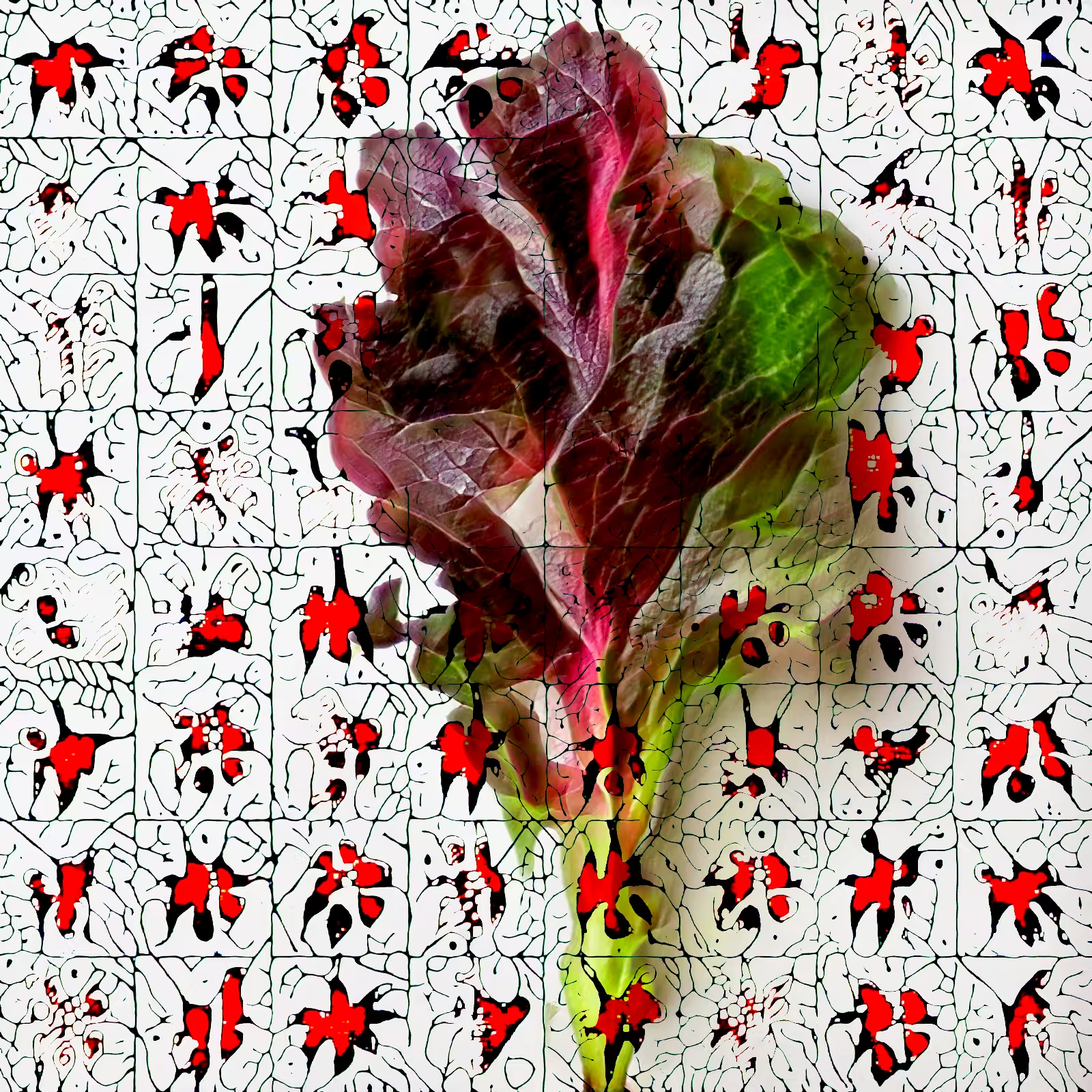

Helena Sarin is a visual artist and software engineer whose practice helped establish GANs as a medium for personal, materially informed image-making. Born in Moscow and based in New Jersey, she worked in telecommunications at Bell Labs and later in computer vision, while maintaining a parallel practice in drawing, watercolor, photography, fashion and food styling. She began working artistically with GANs in 2017, bringing these activities together under the name Neural Bricolage.
A generative adversarial network learns through competition between a generator that produces images and a discriminator that evaluates them. Sarin makes the training material itself part of her art: small datasets of her own sketches, paintings and photographs supply the visual vocabulary. Her early process combined SNGAN image generation with CycleGAN image-to-image translation, followed by selection, collage and custom scripts. She deliberately retained unstable forms, odd textures and imperfect transitions, treating the limitations of the model as expressive possibilities.
Her significance within the first wave of GAN art lies in this insistence on an individual visual language. In her 2018 essay on neural bricolage, she argued that limited computing resources and personally assembled datasets could encourage invention. Still lifes, plants, figures and domestic objects give her work a connection to painting, printmaking and craft, while its transformations expose the unfamiliar forms a machine-learned model can produce. Her contribution includes explaining these methods to other artists and demonstrating that technical scale alone does not determine artistic ambition.
Sarin has extended this approach through artist books, including The Book of GANesis (2019) and GANcommedia Erudita (2020). Her gen2GAN collaboration with Dmitri Cherniak, begun in 2020, used images produced by his generative software as material for her AI system. Since 2021, potteryGAN has taken generated designs back into physical making, including ceramics developed through digital modeling, molds and hand-applied decoration. This movement between handmade source material, computation and crafted objects is a defining continuity in her work.
Recognition spans art venues and research institutions. Sarin spoke at MIT’s GANocracy workshop in 2019 and visited Carnegie Mellon’s School of Art through its Steiner Speaker Series in 2020. Her exhibitions include Automat und Mensch at Kate Vass Galerie (2019), VisionarIAs at Etopia in Zaragoza (2021), and Convergence: AI and Art at the Seattle NFT Museum (2023). Bright Moments commissioned her Kogei Kats series for its Tokyo AI Collection in 2023. In 2024 she participated in Gazelli Art House’s Awaken, Metamagical Hands, curated by John Maeda and Robert Norton, placing her work alongside several generations of computational artists.
Exhibitions
- 2019 – Automat und Mensch, Kate Vass Galerie, Zürich.
- 2021 – VisionarIAs, Etopia Centro de Arte y Tecnología, Zaragoza.
- 2023 – Tokyo AI Collection, Bright Moments, Tokyo.
- 2023 – Convergence: AI and Art, Seattle NFT Museum, Seattle.
- 2024 – Awaken, Metamagical Hands, Gazelli Art House, London.
In the library
2 items