Research article
The Ribbon Worlds of Charles Csuri
From figures and flowers to the luminous abstractions of Ordo, a painter explores line, color and computation
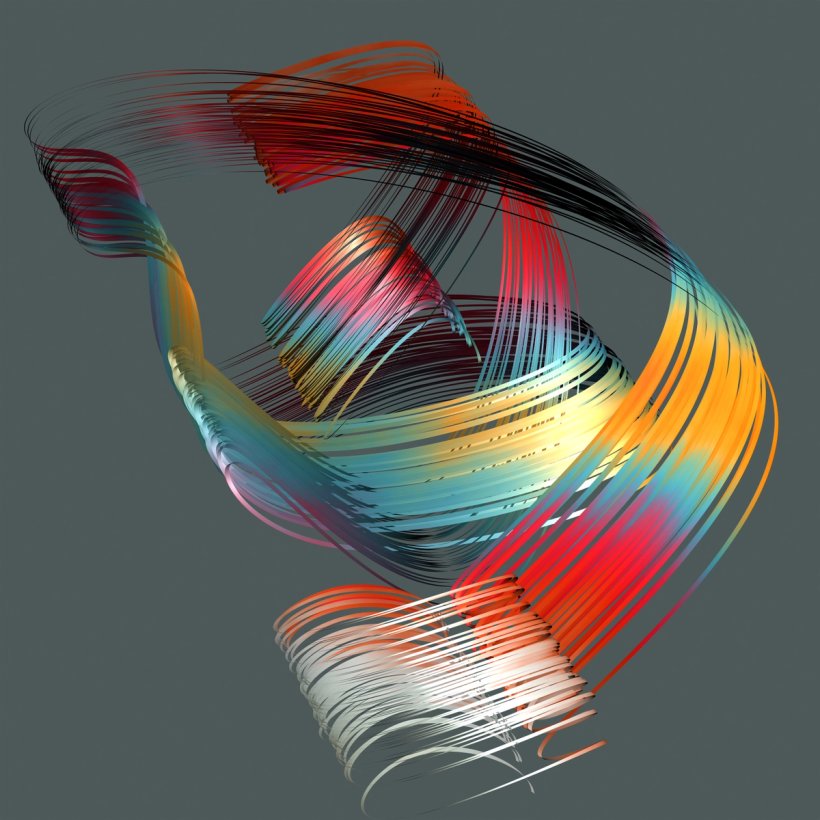
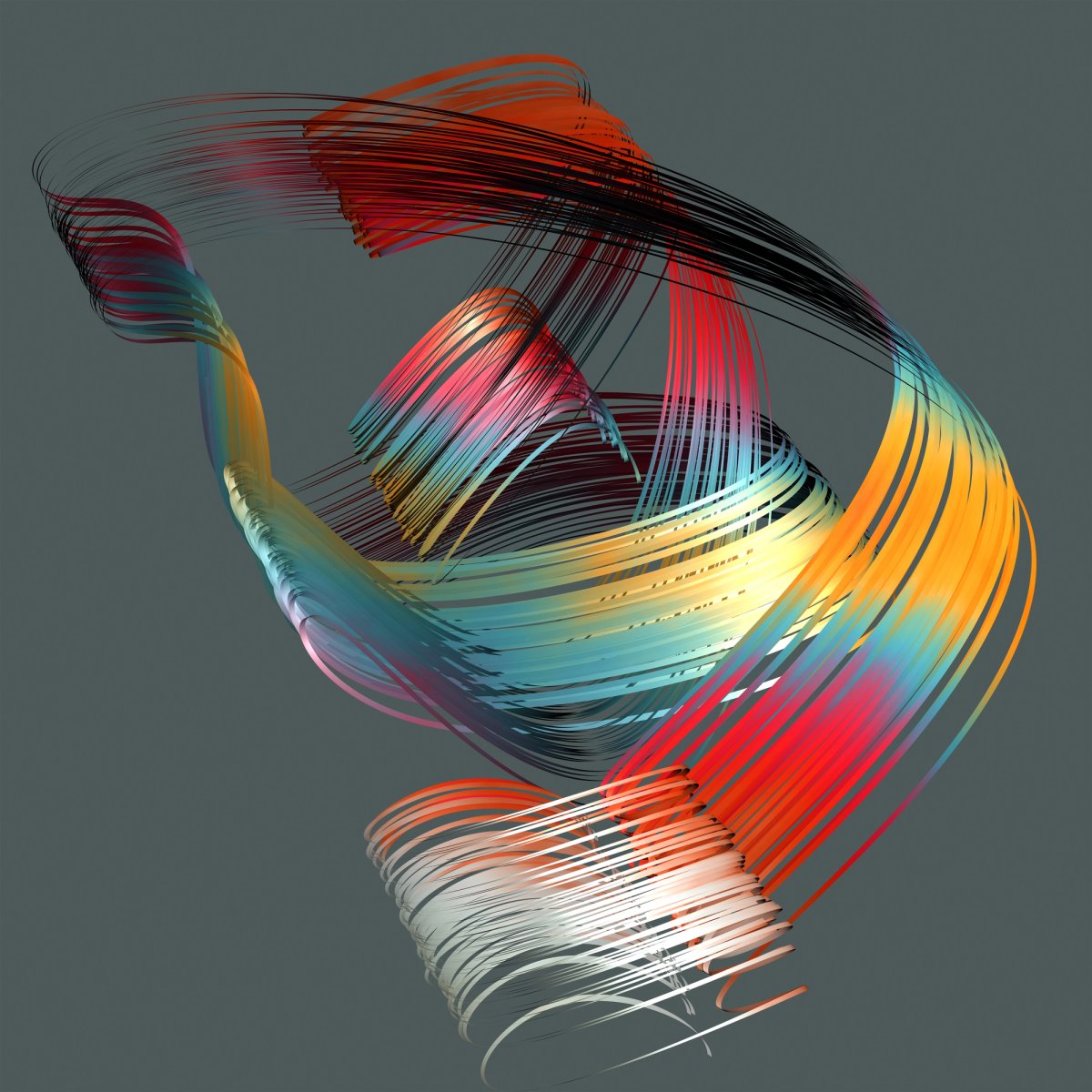
In one of Charles Csuri’s Ordo images in the Güerita collection, ribbons of turquoise, gold, coral and white curl around an open center. Their overlapping edges suggest depth; their changing widths suggest a form turning in space. The image can resemble a bird, a piece of fabric or a brushstroke given volume, without settling into any of them. It was created in 2017, but the questions behind it had occupied Csuri for five decades. [12]
How could a drawn line become an object? What would happen if it had a surface, caught the light and cast a shadow? Following those questions through Csuri’s work reveals a sustained exchange between the habits of a painter and the capabilities of a powerful computer.
Return to the studio
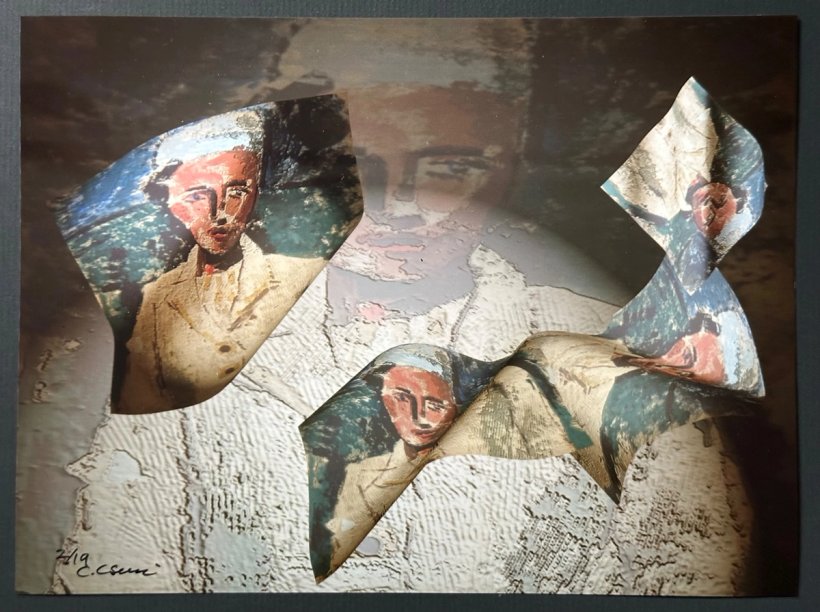
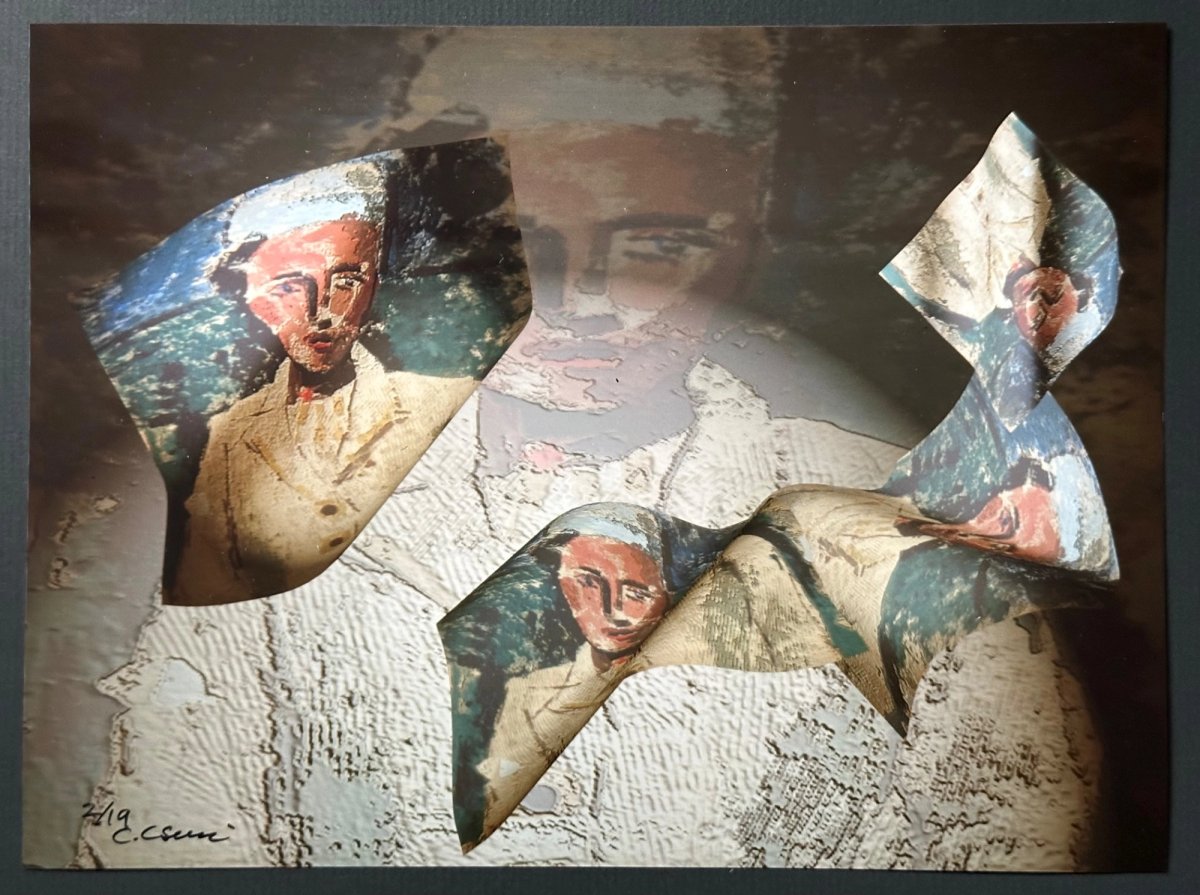
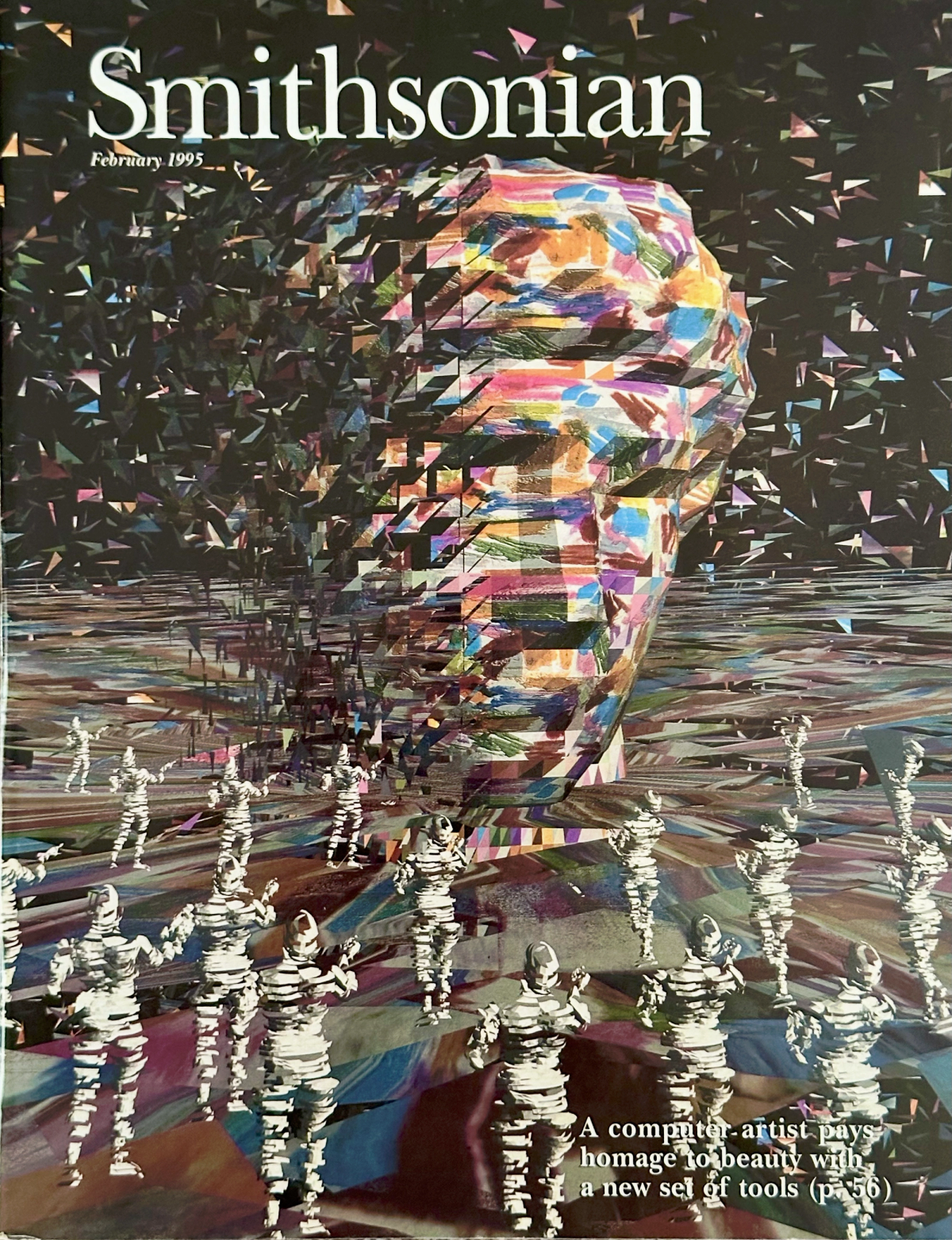
In 1990, Csuri stepped back from his academic responsibilities at Ohio State University (OSU) and returned to sustained art making. Janice Glowski’s account emphasizes the encouragement of his wife, Lee, a renewed engagement with painting and drawing, and the creation of a set of computer tools suited to his artistic interests. In works of the late 1980s and early 1990s, Csuri scanned his paintings and drawings and wrapped them around modeled forms as textures. [1] Long Ago and Far Away (1989), in the Güerita collection, is one such work.
Csuri’s fascination with fluid, calligraphic brushstrokes led him to collaborate with Steve May, then a graduate student and research assistant at OSU's Advanced Computing Center for the Arts and Design who would later become Chief Technology Officer at Pixar. Inspired in part by the sweeping lines of Japanese printmaker Kitagawa Utamaro, Csuri wanted something flat lines on paper could never achieve: strokes with physical width, curvature, and depth that could catch light and cast shadows in three-dimensional virtual space. May developed the algorithms to generate these volumetric paths, which Csuri christened the Ribbon Tool. [2, p. 87]
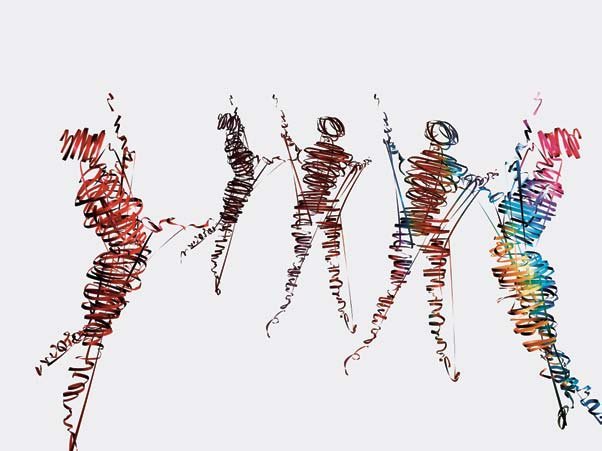
A Happy Time (1996) is an early example of what this made possible. Its figures seem to spring upward, their bodies assembled from loops, streaks and small coils. The playful subject and the technical experiment are inseparable: the ribbons give the figures their buoyancy. [2, p. 126]
A line with a surface
Horse Play (1999) makes the relationship between an underlying object and its ribbon drawing especially clear. Two horses face one another in a quiet, gray space. Their bodies are open networks of lines, while broader, translucent loops drift overhead. Shadows gather beneath them, giving these apparently weightless drawings a place to stand.
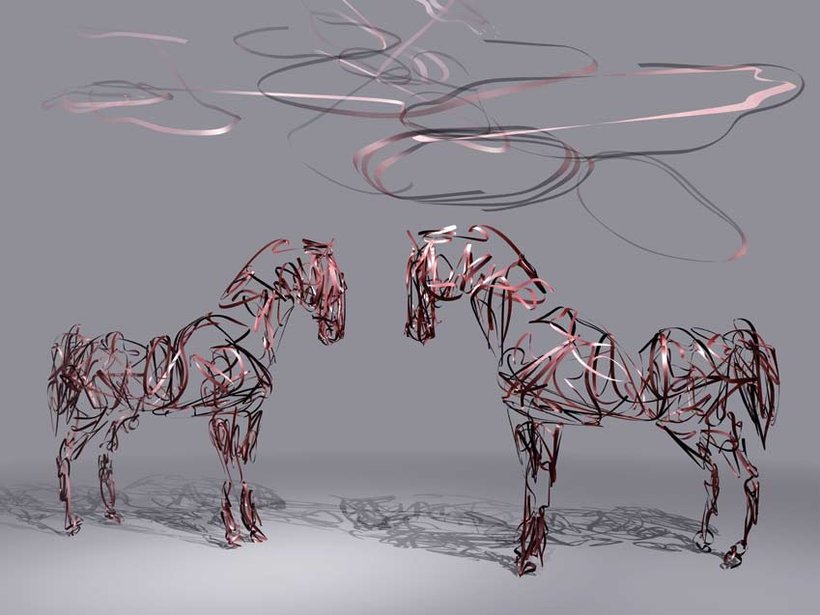
Csuri explained that a mathematical function guided the lines through points on a three-dimensional horse model. He could skip points, interrupt a line and alter its thickness. Spotlights illuminated the resulting surfaces and produced shadows. The floating element above the horses came from a section he cut out, enlarged in line thickness and made partly transparent. [3]
This is a useful way to understand the tool. A recognizable figure becomes a starting point for a much freer composition.
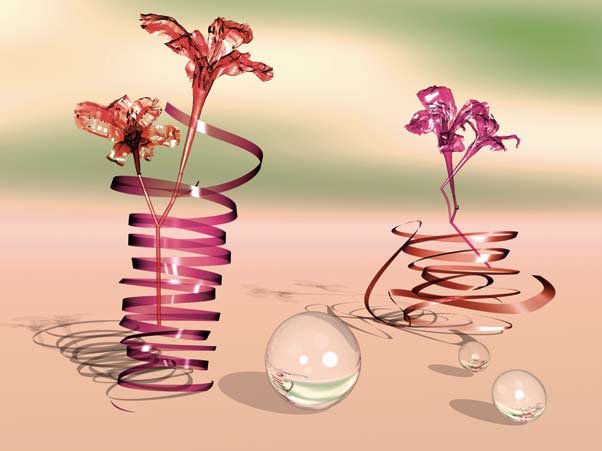
In ribbonVASES (1999), the same vocabulary enters a still life. Spiraling bands describe two vessels, with flowers rising from their open mouths. The archive identifies ribbon, Color Mix and glass-shading procedures together, showing how Csuri combined tools to explore different appearances within one image. [7]
Creating these worlds was far removed from today's point-and-click graphics software or prompting AI models. It was an act of painting by typing using a particular Unix computing environment. AL, an animation and modeling language built on the programming language Scheme, allowed Csuri to assemble scripts and change their parameters. The catalog describes workstations from Sun and Silicon Graphics and access to Ohio State’s rendering resources. [2, pp. 2, 95]
Steve May provided code templates and frameworks that Csuri adapted to his own artistic vision. To convert those mathematical models into finished pictures, they relied on Pixar’s RenderMan software, using custom "shaders", mini-programs that simulate how light bounces off glass, matte ribbons, or translucent film. While Csuri had some interactive visual aids, building an image remained an iterative cycle of adjusting numbers, executing code, and waiting for the render to reveal how the light fell. [4]
Drawing becomes an object
At the turn of the millennium, Csuri started using ribbons to build expansive abstract compositions. This was a direction he would continue to explore for two decades.
In doodleFourteen (2001), a broad, tangled mass seems to balance above a smaller one. Fine lines sweep across and through the forms. The shadow beneath them encourages a sculptural reading, even as their open construction keeps returning the eye to drawing.
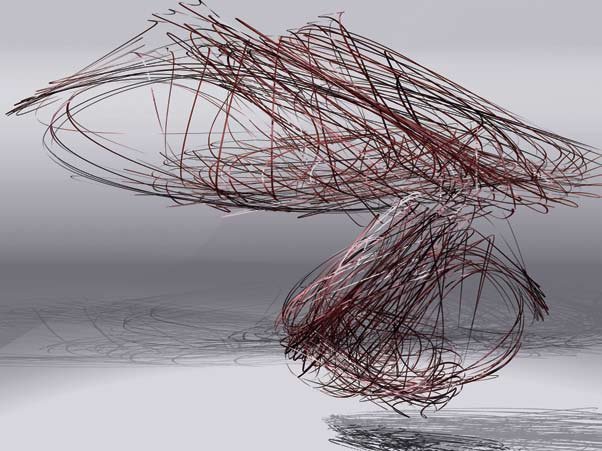
The casual title conceals an ambitious physical scale: a laminated Lightjet print measuring six by eight feet. [2, p. 144] Seen at that size, a doodle could become something the viewer confronted with the body, rather than a small mark examined on a page.
In his 2008 blog post Scribbles, Csuri recalled imagining, as early as 1966, flying through and around a drawing in three dimensions. Later graphics technologies made that imagined space more convincing. He described invisible 3D models whose vertices served as anchor points, using mathematical smoothing curves (B-splines) to bend the lines smoothly through space while virtual lighting supplied depth cues. [5]
Color in space
Line alone does not account for the character of these works. Color could also be organized spatially. Csuri’s Color Mix tool allowed a modeled form to encounter different colors according to its position. [2, p. 95] In World Space as Color, he described partitioning the virtual 3D environment into colored spatial bands. Rather than painting a surface directly, any ribbon moving through a specific coordinate band would take on that zone's hue. By shifting these color boundaries independently of the geometry, Csuri could alter the palette of a form simply by repositioning it within the scene. [6]
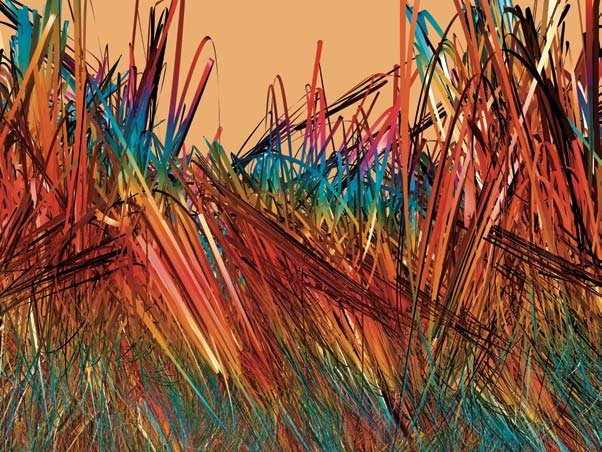
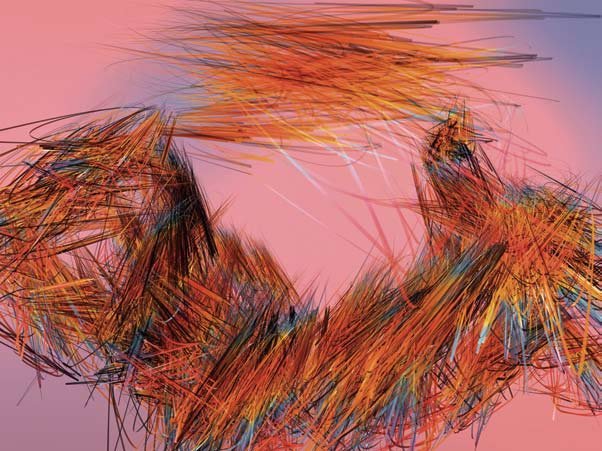
texturePERHAPS and Strawscape, both from 2002, show the resulting visual language. The archive records both Ribbon Tool and Colormix Shader for each work. [8] In the first, sharp bands crowd together like a stand of reeds, with blue and green cutting through an orange-red field. In the second, ribbon masses stretch across pink space, suggesting a landscape that is coming apart or being assembled. A passage can suggest vegetation, then resolve into crossings of colored surfaces. Color helps distinguish one region from another while also binding the image together.
Entanglement
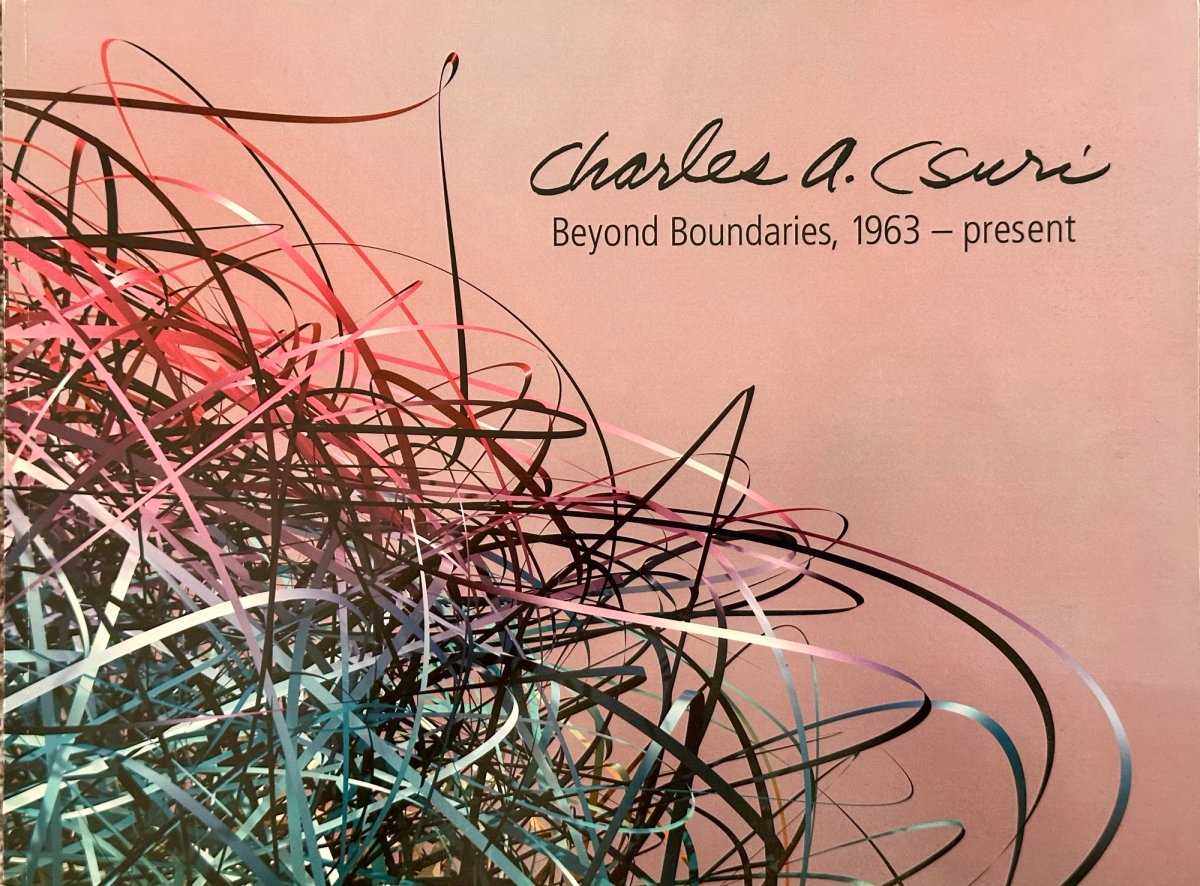
Entanglement (2002) gives this interplay a particularly concentrated form. A knot of ribbons occupies the center, with warm colors gathering below and cooler passages threading through its middle. Loops escape around the edges and their shadows spread across the ground. A detail of the work appears on the cover of Beyond Boundaries.
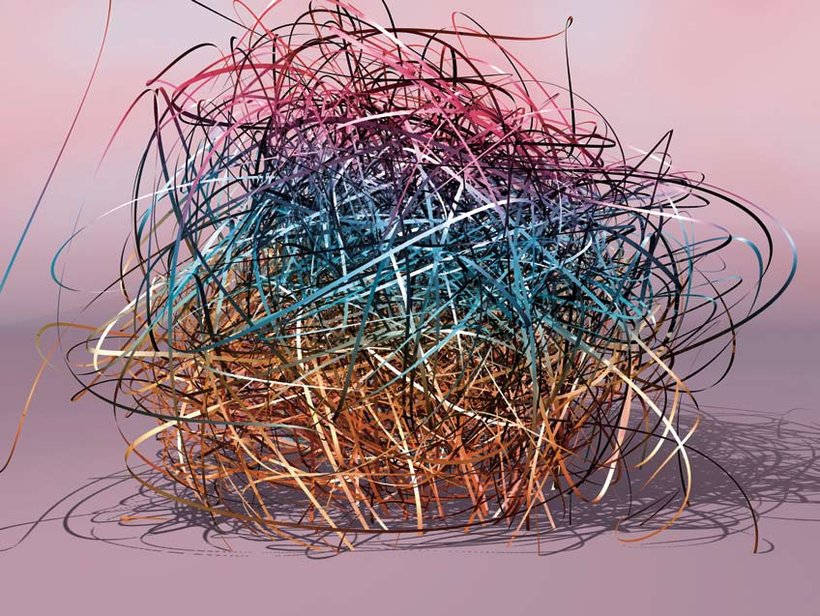
Like doodleFourteen, it was recorded as a six-by-eight-foot laminated Lightjet print. [2, pp. 2, 158–159] That physical presentation belongs to the story. These images circulated as photographs and prints on canvas as well as digital files. Their color, scale and surface were part of how they were encountered as part of the Beyond Boundaries retrospective exhibition, which brought this later practice into the same history as Csuri’s early computer work. [15]
Generative scribbles
The Ohio State archive preserves more related images than appear as major plates in the catalog. Among them, Frame 0026, SCRIB series, dated circa 2003, offers a particularly close visual comparison with Ordo. Broad black, yellow and red loops hold a compact form together, while finer lines continue into the surrounding space. The archive explicitly identifies the Ribbon Tool. [9]
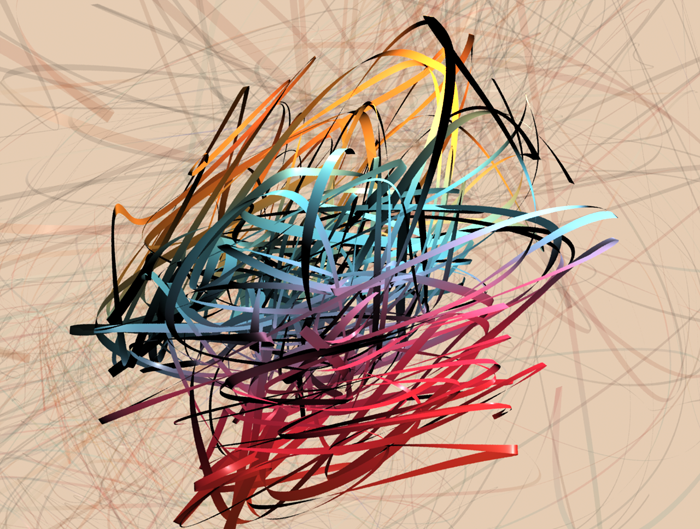
Its frame number points toward Csuri’s way of working. In Search Engine Art, he described setting initial generative rules and asking for as many as 500 variations. “Most of the results are very bad,” he noted, “but some reveal solutions I ordinarily would not think of.” He would evaluate the batch, select the most compelling composition, and refine its parameters by hand. [10]
Selection was an active part of making the work. A generative procedure opened a range of possibilities, and Csuri’s artistic judgment gave particular results their significance. He had already described this relationship in his 1996 essay Complexity: a changing process could become an animation, while one instance could become a print. [11] A still image could carry the history of many trials without showing them all.
Emily’s Scribbles
The question of gesture becomes especially personal in Emily’s Scribbles Frame 300 (2005). Terry Barrett’s account describes Csuri watching his two-year-old granddaughter draw with crayons. Her absorption and freedom reminded him of the physical pleasure of painting. That encounter inspired the work; Emily’s marks themselves were not simply scanned into the image. [2, p. 168]
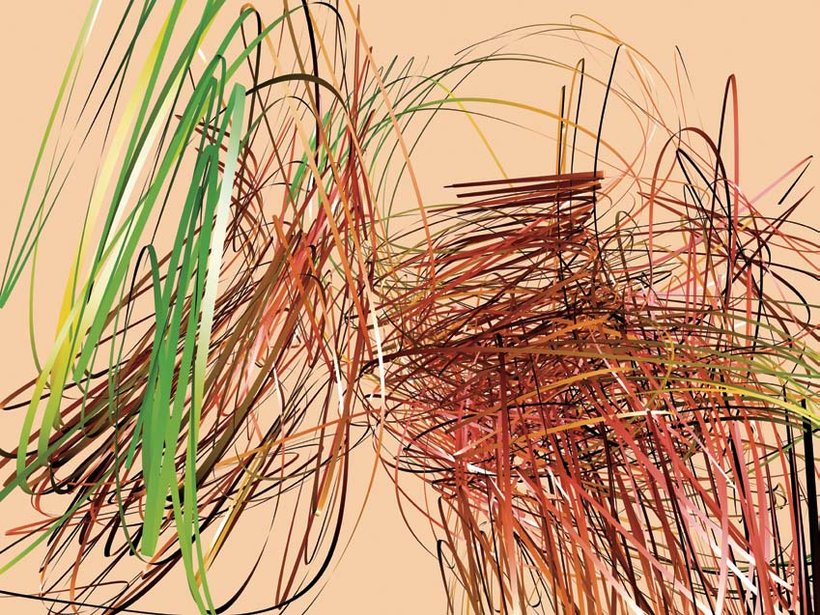
Long green curves rise beside an agitated accumulation of reddish lines. The image feels quick and exuberant, yet its depth depends on a constructed scene, a chosen viewpoint and the calculation of light. Its apparent spontaneity and its deliberate making exist together.
Csuri had considered this problem explicitly in Tactile-Kinesthesis, an essay from 1998. Familiarity with parameters, transformations and the computer language had given him a new working rhythm. He could think through patterns of light and color while setting numerical values. The expressive act took place throughout that process: “The spontaneity of expression is in my mind and not in my fingers.” [13]
Returning to Ordo
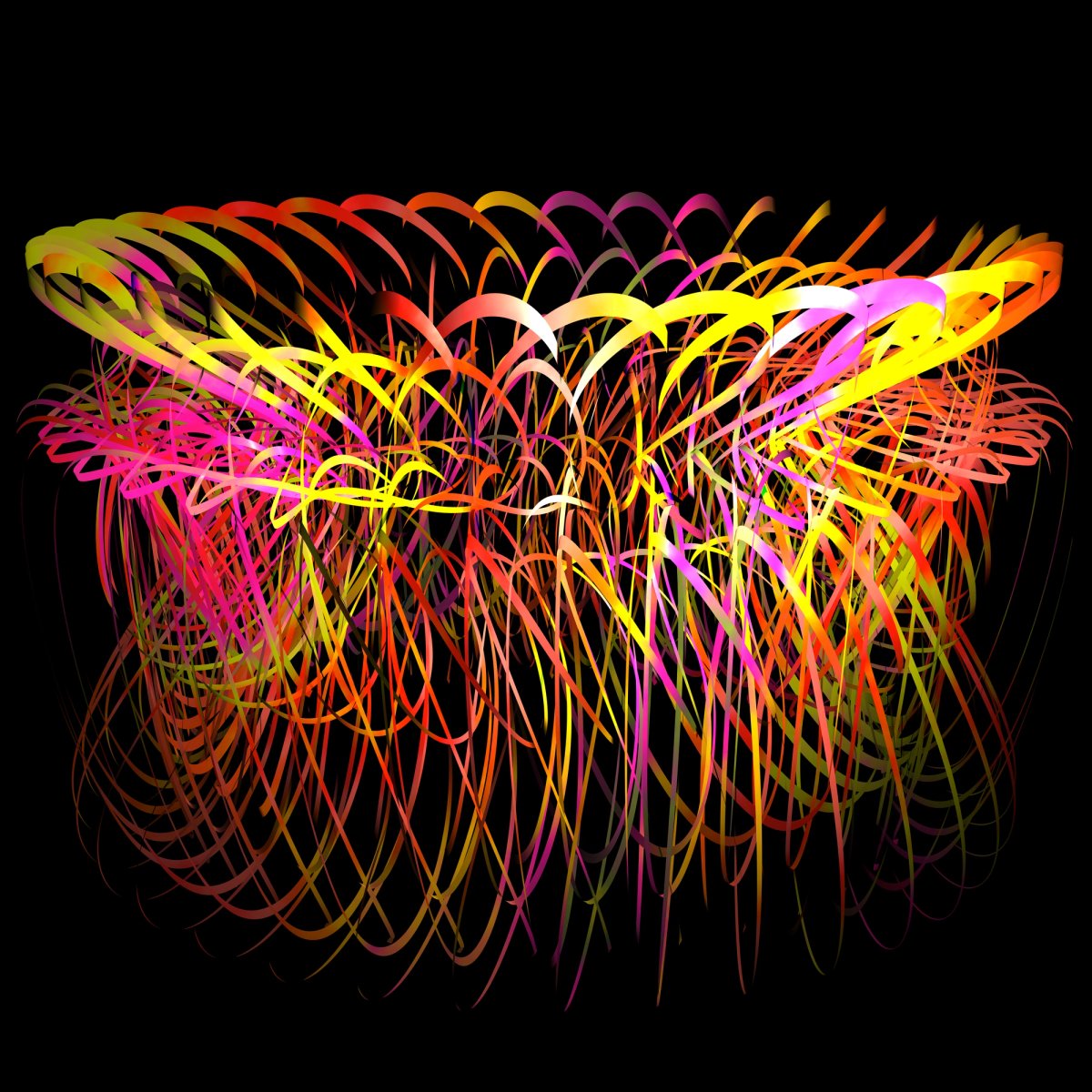
Seen against this artistic lineage, the Ordo images from 2017 are not a departure from the earlier work, but the distillation of a quarter-century spent investigating line in space. The two works in the Güerita collection illustrate how far that investigation had evolved beyond the energetic tangles of doodleFourteen or Emily's Scribbles. The opening image (6Korder34_0094SQ) curls brushstrokes dynamically around a void, while the luminous spread of 6Korder199_0002SQ radiates in rhythmic symmetry, each establishing a very distinct balance of volume, light, and empty space. [12]
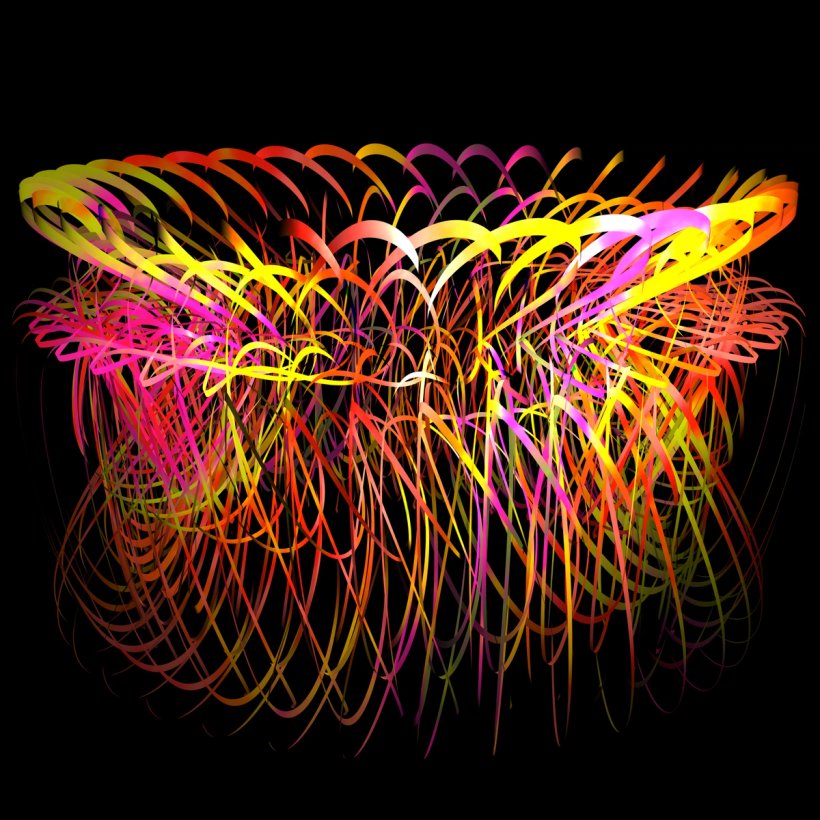
Ordo had already entered the historical record before its digital release. In 2018, the National Academies reproduced Ordo 211 in Branches from the Same Tree, citing Csuri’s practice as a benchmark for integrating fine art, computer science research, and technology. [14, p. 242] The estate’s 2026 presentation through SOLOS and Verse subsequently brought these 2017 creations into a digital context built for the circulation and preservation of algorithmic art. [12, 16]
For viewers steeped in contemporary generative art, Ordo brings to mind works like Snowfro’s Chromie Squiggle (2020), which is another exploration of undulating lines, procedural color gradients, and algorithmic variation. Yet Ordo arrived through a different historical trajectory.
Over two decades, Csuri carried the ribbon tool through an artistic migration: from figurative wireframes in the late 1990s, across the expressive, chaotic scribbles of the 2000s, to the self-contained spatial geometry of 2017. He treated the computer as a 3D studio by refining parameters, calculating simulated light, and curating the most compelling outcomes. In Ordo, those decisions give the ribbons their peculiar presence: part brushstroke, part sculpture, existing as an illuminated structure in space.
References and bibliography
[1] Janice M. Glowski. “Art History.” Charles A. Csuri Project, The Ohio State University. See “Middle Period (1989–1995)” and “Establishment of core artistic tools.” Archive essay
[2] Janice M. Glowski, ed. Charles A. Csuri: Beyond Boundaries, 1963–present. College of the Arts, The Ohio State University, 2006. Includes Wayne Carlson, pp. 85–91; Maria Palazzi, pp. 93–96; Matthew Lewis, pp. 147–153; Anu Vedagiri, p. 158; and Terry Barrett, p. 168. Citations use printed page numbers. Güerita Library · Full catalog PDF
[3] Charles Csuri. “Algorithmic Paintings.” Artist statements preserved by ACM SIGGRAPH; see “Horse Play.” Undated webpage. Artist’s statements
[4] Brian Boucher. “The Faces of Csuri Auction: An Interview with Pixar CTO Steve May.” Tribul, 19 November 2023. Interview
[5] Charles Csuri. “Scribbles.” CsuriVision, 2 October 2008. Artist’s blog
[6] Charles Csuri. “World Space as Color.” CsuriVision, 19 October 2008. Artist’s blog
[7] Charles A. Csuri Project. ribbonVASES (1999), C06.00257. Technical metadata lists AL, Unix, Colormix Shader, Ribbon Tool and Voglass Shader. Archive record
[8] Charles A. Csuri Project. Strawscape (2002), C06.00262, and texturePERHAPS (2002), C06.00264. Both records list Ribbon Tool and Colormix Shader. Strawscape · texturePERHAPS
[9] Charles A. Csuri Project. Frame 0026, SCRIB series, circa 2003, C06.00148. Algorithm: Ribbon Tool. Archive record
[10] Charles Csuri. “Search Engine Art.” CsuriVision, 7 November 2008. Artist’s blog
[11] Charles Csuri. Complexity. 1996. Charles A. Csuri Project, C07.14001. Two-page essay, especially p. 2. Archive and downloadable essay
[12] Güerita Art. Collection records for 6Korder34_0094SQ and 6Korder199_0002SQ, from Ordo, 2017; issued as NFTs in 2026. The records link to token metadata. Directory numbers and token IDs are different identifiers. 6Korder34_0094SQ · token 7 · 6Korder199_0002SQ · token 1
[13] Charles Csuri. Tactile-Kinesthesis. Cataloged as 1998. Charles A. Csuri Project, C07.14006. Also published on CsuriVision on 12 February 2012. Archive and downloadable essay · 2012 blog publication
[14] National Academies of Sciences, Engineering, and Medicine. The Integration of the Humanities and Arts with Sciences, Engineering, and Medicine in Higher Education: Branches from the Same Tree. Washington, DC: National Academies Press, 2018. “Pioneering Integration and the Creation of New Industries,” p. 242, reproduction captioned Ordo 211. DOI: 10.17226/24988. Publication and image
[15] Ohio State Urban Arts Space. Charles A. Csuri: Beyond Boundaries, 1963–present. Exhibition record, 29 June–9 October 2010; describes the expanded retrospective and earlier presentations in Boston and Taiwan. Exhibition record
[16] SOLOS. Ordo. Charles Csuri Estate presentation, October 2026. Release presentation
Related in the collection
Charles Csuri, 1989
Charles Csuri, 2017
Charles Csuri, 2017
Paul Trachtman, 1995
Janice M. Glowski, editor, 2006