Artist · 1912–1992
John Cage
American
Los Angeles, USA · Seattle, USA · New York, USA
John Cage (1912–1992) was an American composer, writer, visual artist, and one of the most influential figures of the postwar avant-garde. Through prepared instruments, chance operations, indeterminate scores, and an expanded understanding of environmental sound, Cage challenged conventional distinctions between music, noise, silence, performance, and everyday life. His collaboration with Lejaren Hiller on HPSCHD brought these ideas into computer-assisted composition and large-scale multimedia performance.
Formation and Experimental Music
Born in Los Angeles in 1912, John Cage studied with Richard Buhlig, Henry Cowell, Adolph Weiss, and Arnold Schoenberg. In 1938 he moved to Seattle, where he worked as an accompanist and teacher at the Cornish School of the Arts and began his lifelong collaboration with choreographer Merce Cunningham. His experiments with percussion ensembles and altered instruments led to the prepared piano: an ordinary piano transformed by placing objects between or upon its strings.
After moving to New York in the early 1940s, Cage became closely connected to an interdisciplinary avant-garde that included Cunningham, Marcel Duchamp, Robert Rauschenberg, and Jasper Johns. His compositions increasingly treated sound, movement, visual art, and theatrical action as independent but simultaneously experienced elements.
Chance, Indeterminacy, and Listening
During the early 1950s Cage began using the I Ching to introduce chance operations into composition. Rather than expressing a predetermined musical intention, these procedures allowed sounds and silences to occur according to systems partly removed from the composer’s personal taste. In works such as Music of Changes (1951) and 4′33″ (1952), Cage redirected attention from conventional musical structure toward duration, ambient sound, and the listener’s immediate environment.
Cage’s scores frequently function as frameworks for variable realization rather than fixed instructions for a single authoritative performance. This procedural openness made his work an important precedent for algorithmic, generative, participatory, and systems-based art.
Computation and HPSCHD
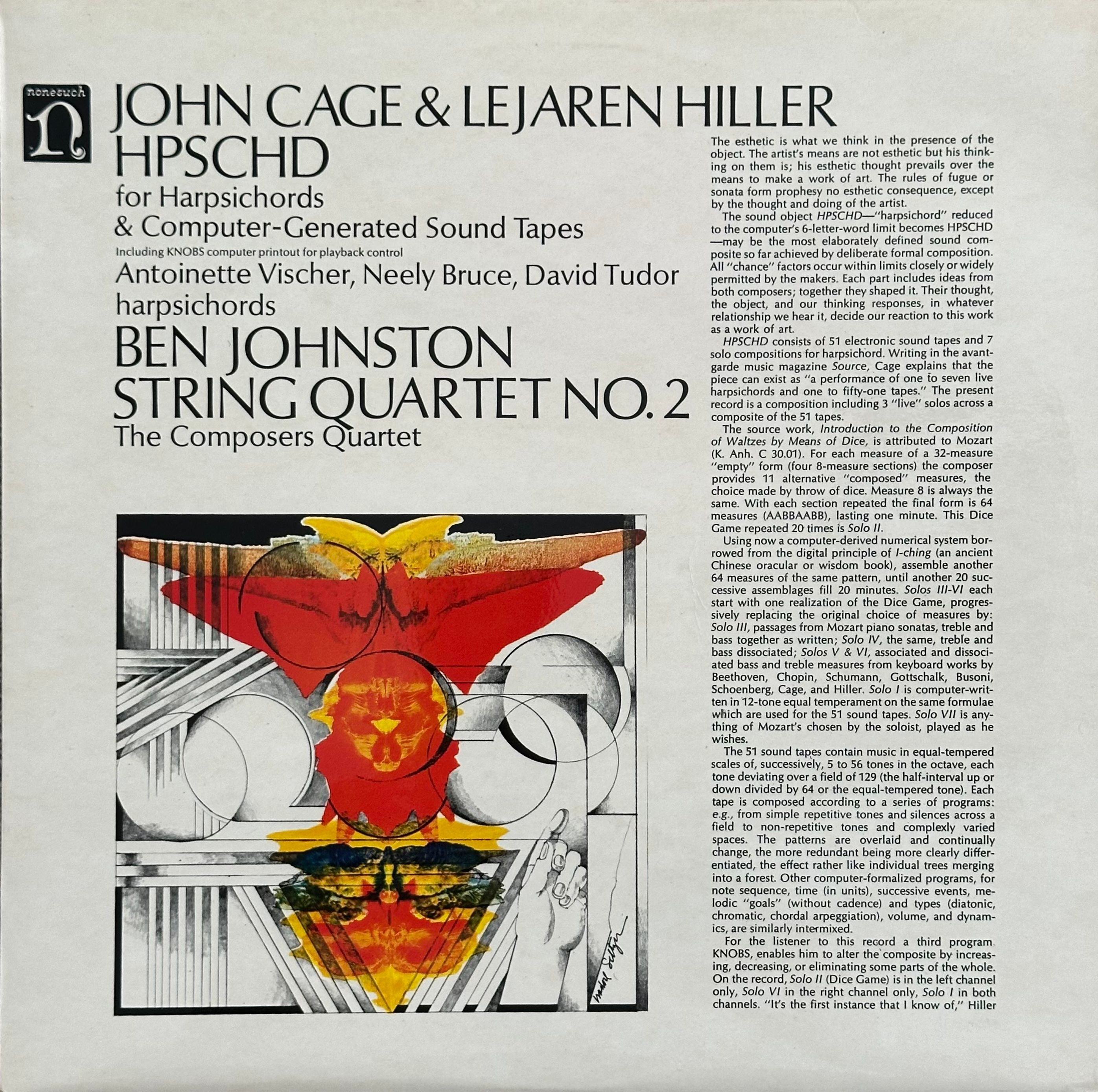
From 1967 to 1969, while associated with the University of Illinois at Urbana-Champaign, Cage collaborated with composer and computer-music pioneer Lejaren Hiller on HPSCHD. The work combined Cage’s use of chance with Hiller’s experience in computational composition. Its materials drew upon a dice-game composition attributed to Mozart and music by Beethoven, Chopin, Schumann, Gottschalk, Busoni, Schoenberg, Cage, and Hiller, processed through computer-assisted procedures.
HPSCHD premiered on May 16, 1969, at the University of Illinois Assembly Hall. Conceived as an immersive and deliberately decentralized environment, it involved seven amplified harpsichords, fifty-two channels of computer-generated sound, thousands of projected slides, and dozens of films. Listeners were free to move through the space and construct their own experience from the overlapping music and images.
The 1969 Nonesuch LP translated this indeterminate structure into a domestic format. Each of the first 10,000 copies included a different computer-generated KNOBS printout prescribing changing volume, bass, and treble settings during playback. Every purchaser therefore received a distinct configuration through which to realize the recording—an important precursor to personalized, long-form generative art.
Writing, Visual Art, and Legacy
Cage extended his ideas into lectures, poetry, printmaking, drawing, watercolor, and exhibition making. His influential books, beginning with Silence in 1961, use typography, spacing, repetition, and procedural structures as compositional materials in their own right. From the late 1970s onward, he developed an extensive visual-art practice in which chance operations determined such elements as the placement of stones, marks, colors, and impressions.
Cage died in New York in 1992. His work remains foundational to experimental music, sound art, performance, conceptual art, and computational culture because it shifted creative authority away from a single fixed object and toward rules, contingencies, environments, and acts of attention.
Exhibitions
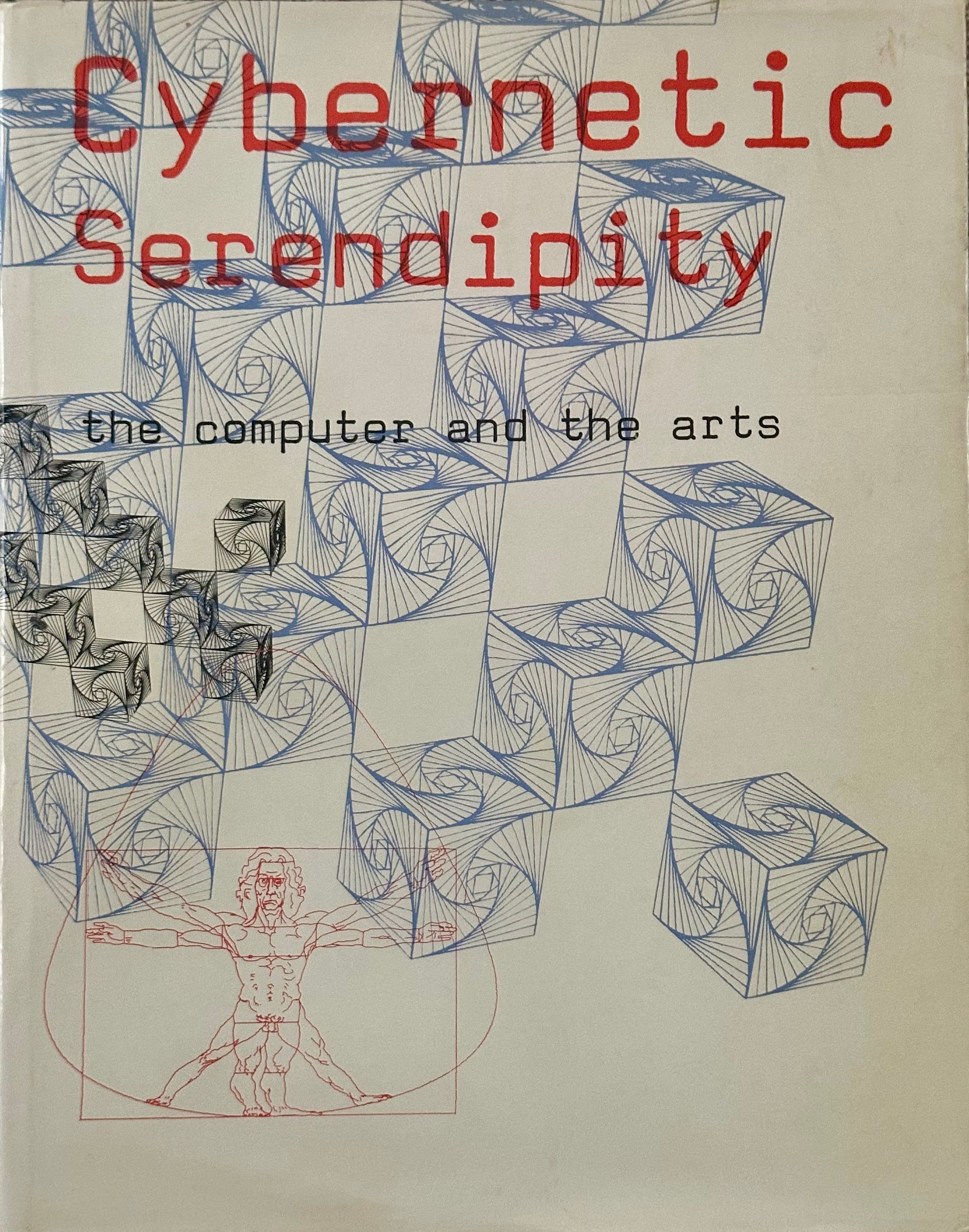
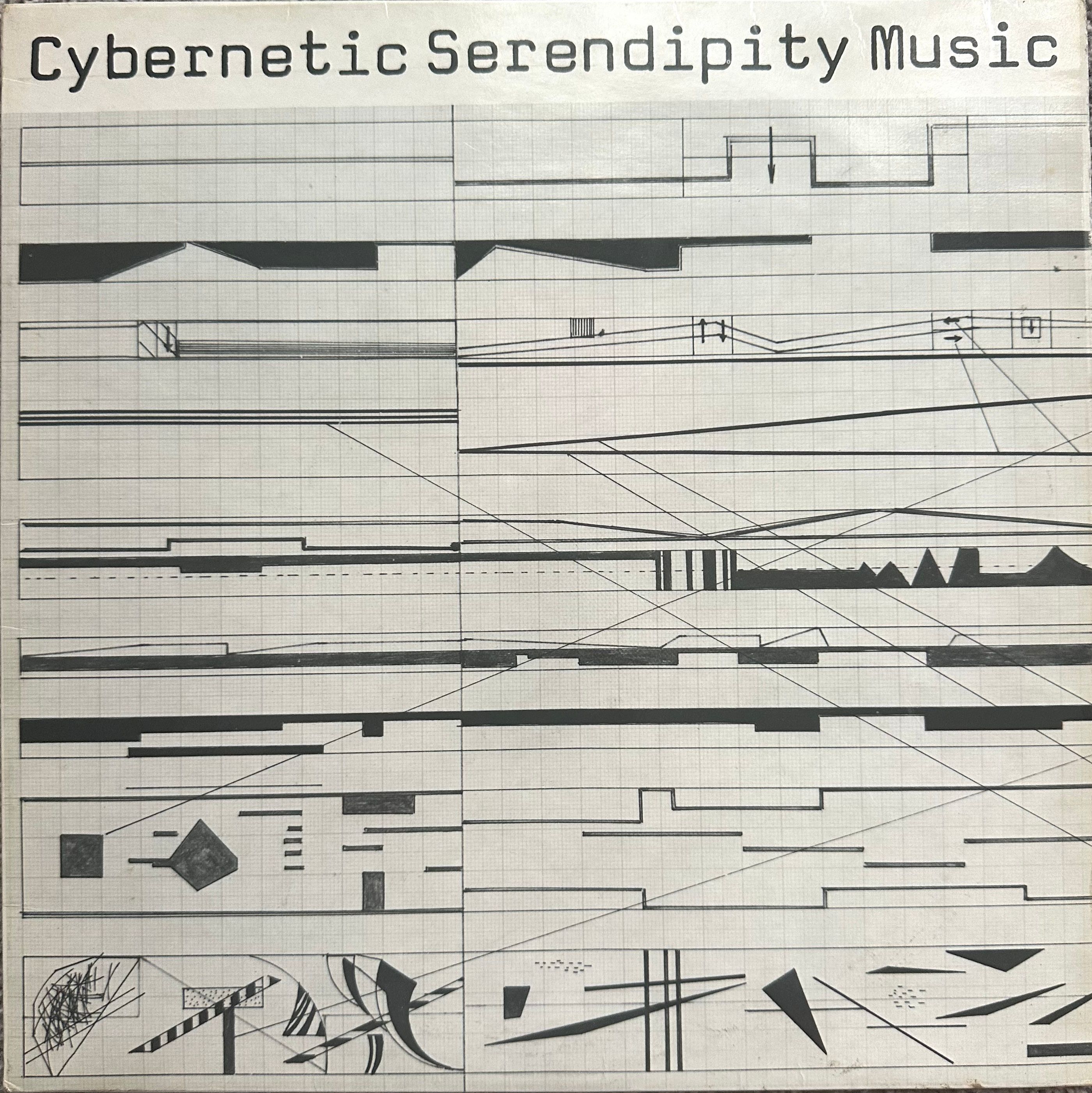
Cybernetic Serendipity - Institute of Contemporary Arts, London, 2 August–20 October 1968. Cage was represented in the exhibition’s music program and companion LP by an excerpt from Cartridge Music (1960). The exhibition catalogue also included an extract from his book A Year from Monday.
In the library
3 items