Artist · 1925–1973
Waldemar Cordeiro
Brazilian, born Italy
São Paulo, Brazil
Waldemar Cordeiro (1925–1973) was a central theorist of Brazilian Concrete art and, beginning in 1968, a pioneer of computer art in Brazil and Latin America. From Grupo Ruptura to his late “arteônica” works made with physicist Giorgio Moscati, he treated computation as a continuation of his lifelong investigation into structure, perception, information and the social function of art.
Waldemar Cordeiro was one of the defining figures of Brazil’s postwar avant-garde and one of the earliest established artists anywhere to make computation a central part of an already mature artistic practice. Over a career cut short by his death at forty-eight, he moved from geometric abstraction and Concrete art through participatory and politically charged work to what he called arteônica: an art transformed by electronic information and computation.
Born in Rome in 1925 to an Italian mother and Brazilian father, Cordeiro trained at the Academy of Fine Arts in Rome before settling in São Paulo in the late 1940s. There he became an artist, critic, journalist, designer and landscape architect. In 1952 he co-founded Grupo Ruptura with Geraldo de Barros, Luiz Sacilotto, Lothar Charoux and others, becoming its principal theorist. Ruptura rejected naturalistic representation in favor of an objective visual language of line, color and structure and became a foundational force in the development of Brazilian Concrete art.
During the 1960s his work moved through intuitive geometry, assemblage, photographic imagery and popcreto, bringing mass culture, semantics and political experience into the rigorous structures of his earlier practice. Computation did not represent a break with his previous work so much as another radical redefinition of what a constructive art could become.
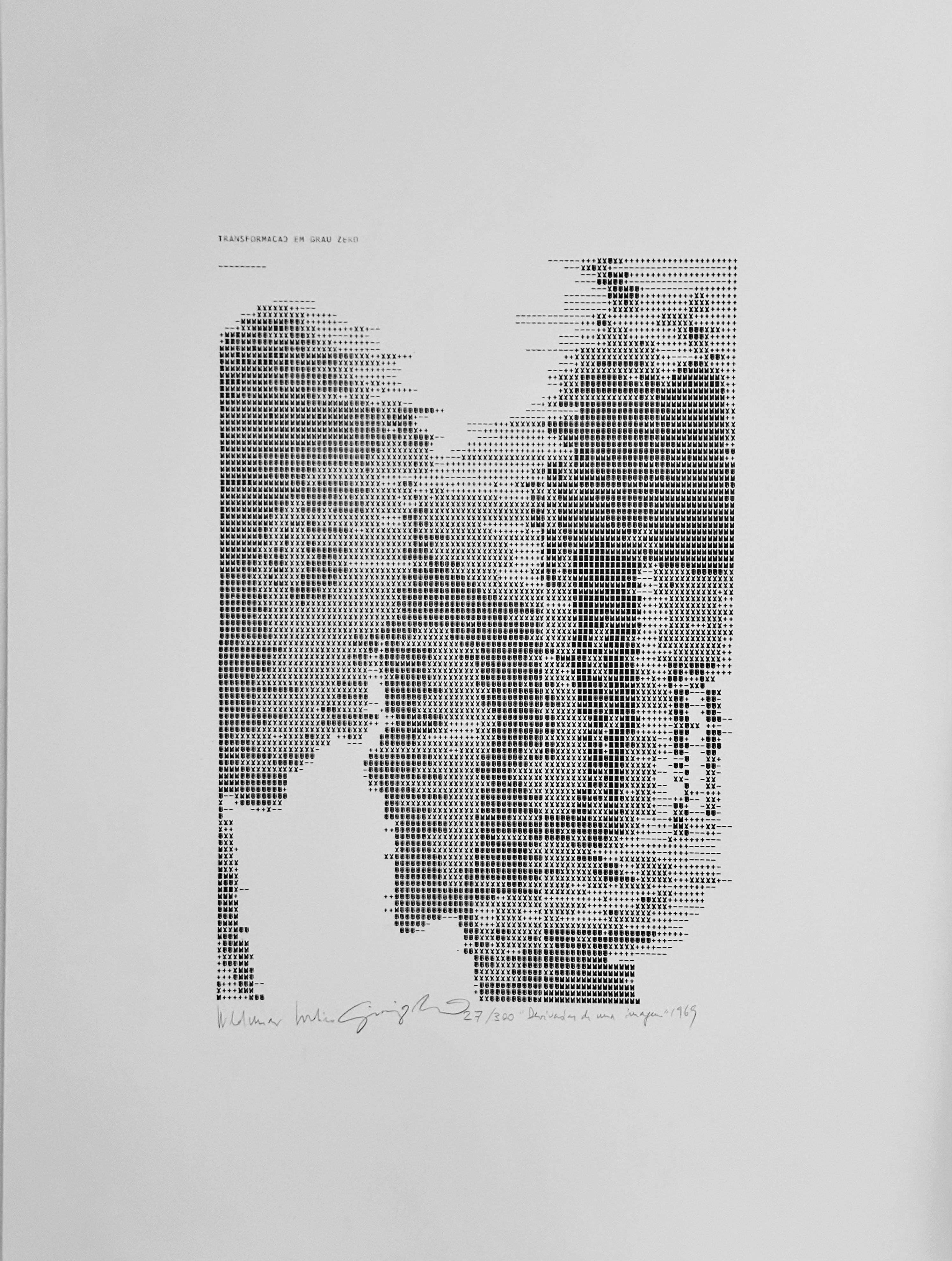
In 1968, Cordeiro began working at the University of São Paulo with Giorgio Moscati, a physicist, engineer and professor who had access to the university’s IBM 360/44 mainframe. The first result of their collaboration, Beabá (1968), generated probabilistic combinations of letters. The following year they produced Derivadas de uma imagem, manually digitizing a photograph and using computation to transform it through successive mathematical derivatives. The project is widely regarded as a foundational moment in Brazilian computer art and has been described as inaugurating computer-generated image-making in the country.
Cordeiro understood the computer as more than an efficient drawing machine. He saw electronic media as capable of changing how art was produced, distributed and understood. In his formulation of arteônica, the reproducibility and communicative reach of electronic systems offered an alternative to the scarcity and exclusivity of the traditional art object. His computational works therefore extend concerns already present in his Concrete practice: rational structure, perception, seriality and communication, now joined to questions of mass media and social experience.
That social dimension became increasingly explicit in works such as A Mulher que Não É B.B. (1971), based on a newspaper image of a Vietnamese woman rather than the celebrity Brigitte Bardot invoked by the title, and the Genteworks derived from photographs of crowds.
The computer did not remove human or political content from the image; Cordeiro used its abstraction and degradation of information to reconsider what an image communicates and what survives its transformation. This distinguishes his computer work from most early computer graphics devoted principally to geometry or technical demonstration.
Cordeiro was also instrumental in building an institutional context for the new medium. He participated in the international New Tendencies network and in 1971 organized Arteônica at FAAP in São Paulo, an early international exhibition devoted to electronic and computer art. The following year he established and directed the Centro de Processamento de Imagens at the newly created Institute of Arts at the Universidade Estadual de Campinas. MoMA has described it as the first laboratory for computer-based image production in Latin America.
Cordeiro died suddenly in São Paulo in 1973. His compressed trajectory joins several histories that are often told separately: European and Brazilian Concrete art, the emergence of technologically mediated and participatory art, Latin American responses to mass communication and political repression, and the beginnings of computer art. His importance lies not merely in being early. He recognized computation as a new cultural medium and brought to it an unusually developed theory of visual information, artistic communication and social purpose.
Exhibitions
1949 - Do figurativismo ao abstracionismo, inaugural exhibition, Museu de Arte Moderna de São Paulo
1951 - 1st Bienal de São Paulo
1952 - Ruptura, Museu de Arte Moderna de São Paulo
1956–57 - 1st Exposição Nacional de Arte Concreta, São Paulo / Rio de Janeiro
1965 - New Tendencies, Zagreb
1969 - Computers and Visual Research, Tendencies 4, Zagreb
1970 - Computer Plotter Art, Minigaleria USIS, São Paulo
1971 - Arteônica, FAAP, São Paulo — organized by Cordeiro
1972 - Arte de Sistemas II, Centro de Arte y Comunicación (CAyC), Buenos Aires
1973 - Special tribute room, 12th Bienal de São Paulo
1986 - Waldemar Cordeiro: Uma Aventura da Razão, MAC USP
2013–14 - Waldemar Cordeiro: Fantasia Exata, Itaú Cultural, São Paulo / Paço Imperial, Rio de Janeiro
2017–18 - Thinking Machines: Art and Design in the Computer Age, 1959–1989, MoMA, New York
2018 - Writing New Codes: Cordeiro / Mallary / Molnar, Mayor Gallery, London
2019–20 - Sur moderno: Journeys of Abstraction—The Patricia Phelps de Cisneros Gift, MoMA, New York
2024 - Venice Biennale
2024 - Waldemar Cordeiro: A Singular Constellation, Mayor Gallery, London
2024 - Arteônica: Art, Science and Technology in Latin America Today, MOLAA, Long Beach
2025 - Waldemar Cordeiro: Constellations, ZKM, Karlsruhe
In the collection
1 work
In the library