

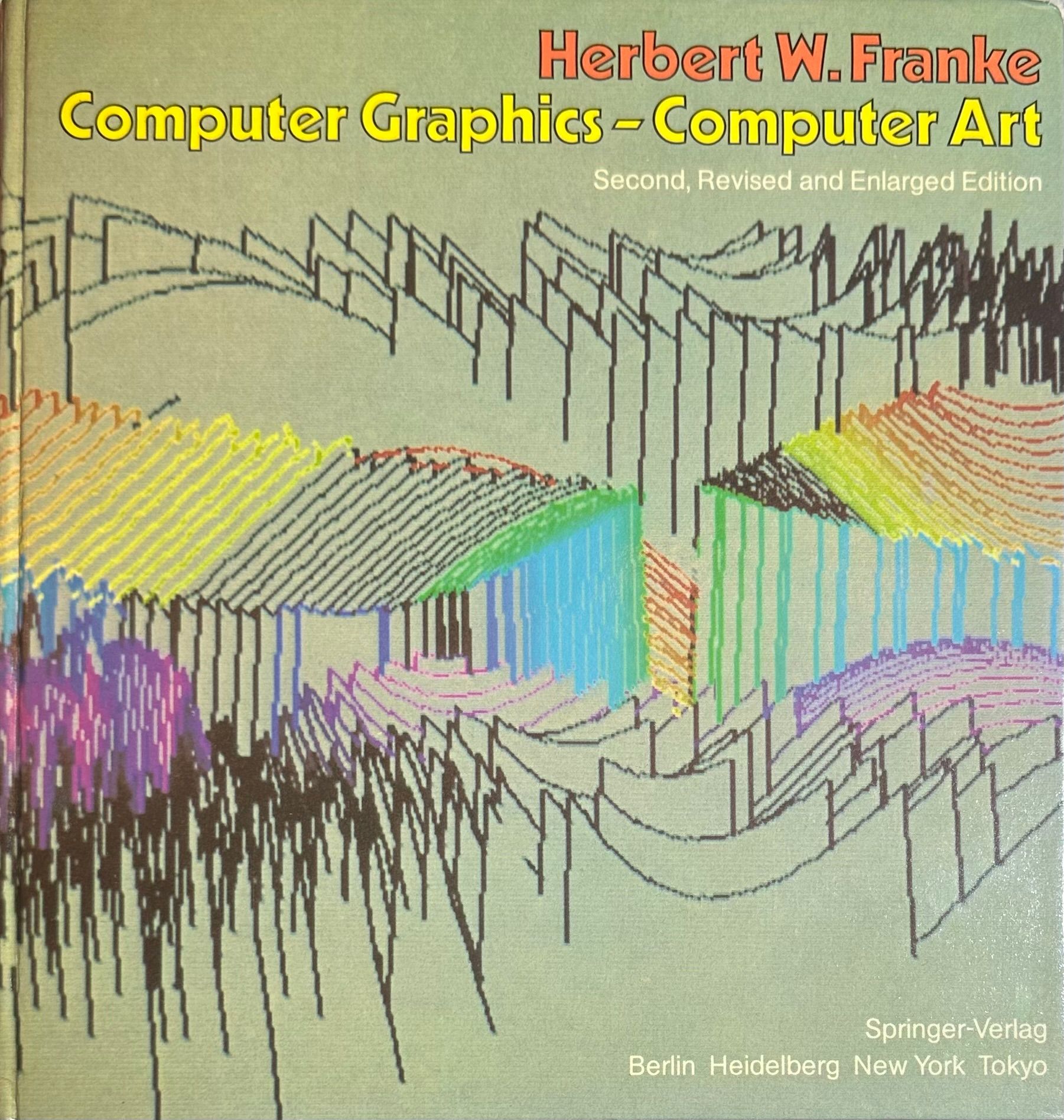
01 / 07Front cover of Herbert W. Franke, Computer Graphics – Computer Art. Cover graphic: Mathematical Landscape, created by Franke and Horst Helbig.
Open full-size image ↗Book
Computer Graphics – Computer Art
1985Waldemar Cordeiro ↗Charles Csuri ↗Computer Technique Group (CTG) ↗William Fetter ↗Miguel Ángel Vidal ↗
The expanded 1985 edition of Herbert W. Franke’s survey of computer graphics and computer art, combining explanations of technologies and working methods with reproductions of early computer-generated art, scientific imaging, animation and computer-aided design.
- Author / editor
- Herbert W. Franke
- Publisher
- Springer-Verlag
Berlin, Heidelberg, New York and Tokyo - Pages
- 177
- Language
- English
- Edition
- Second edition
Related in the collection
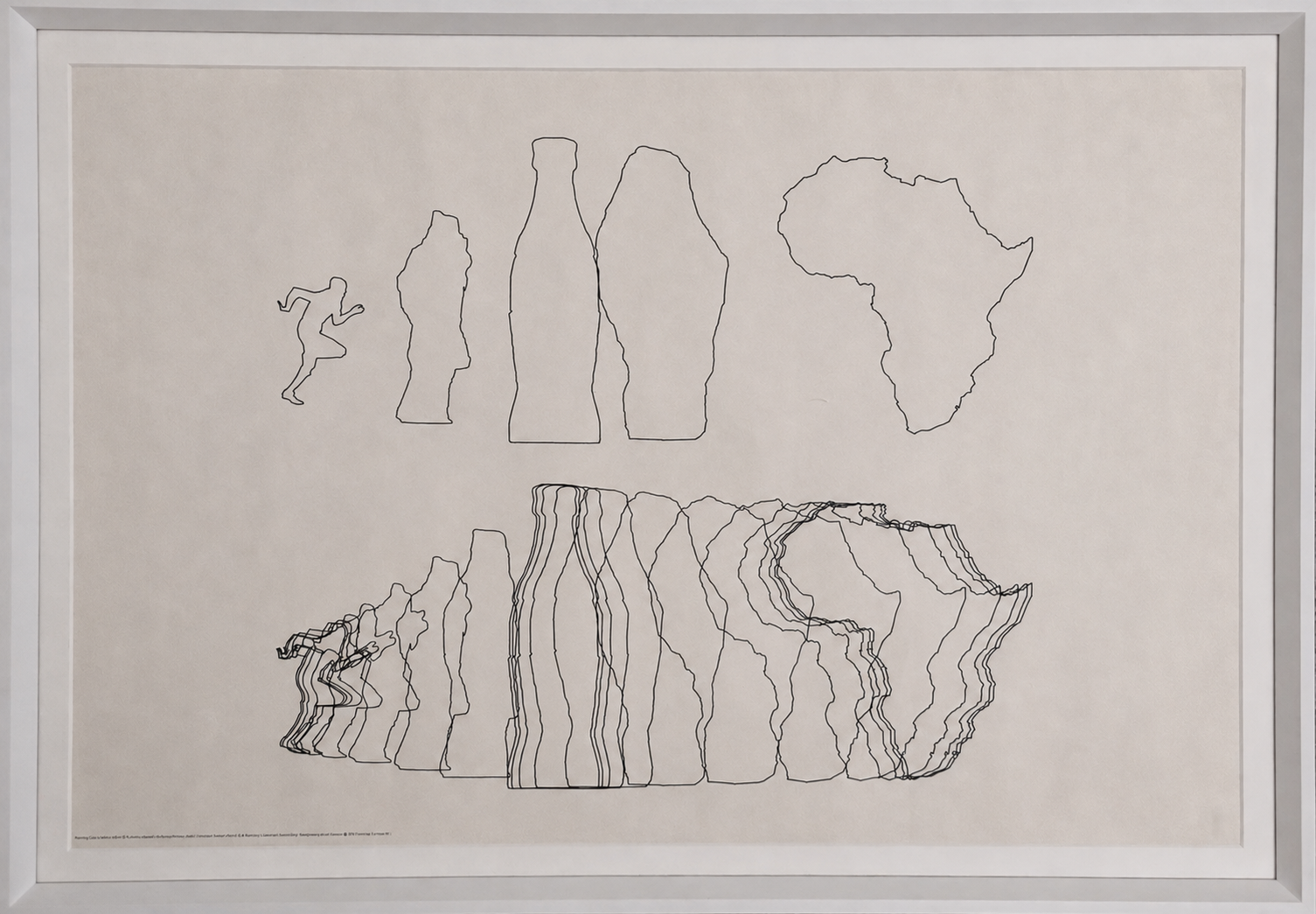
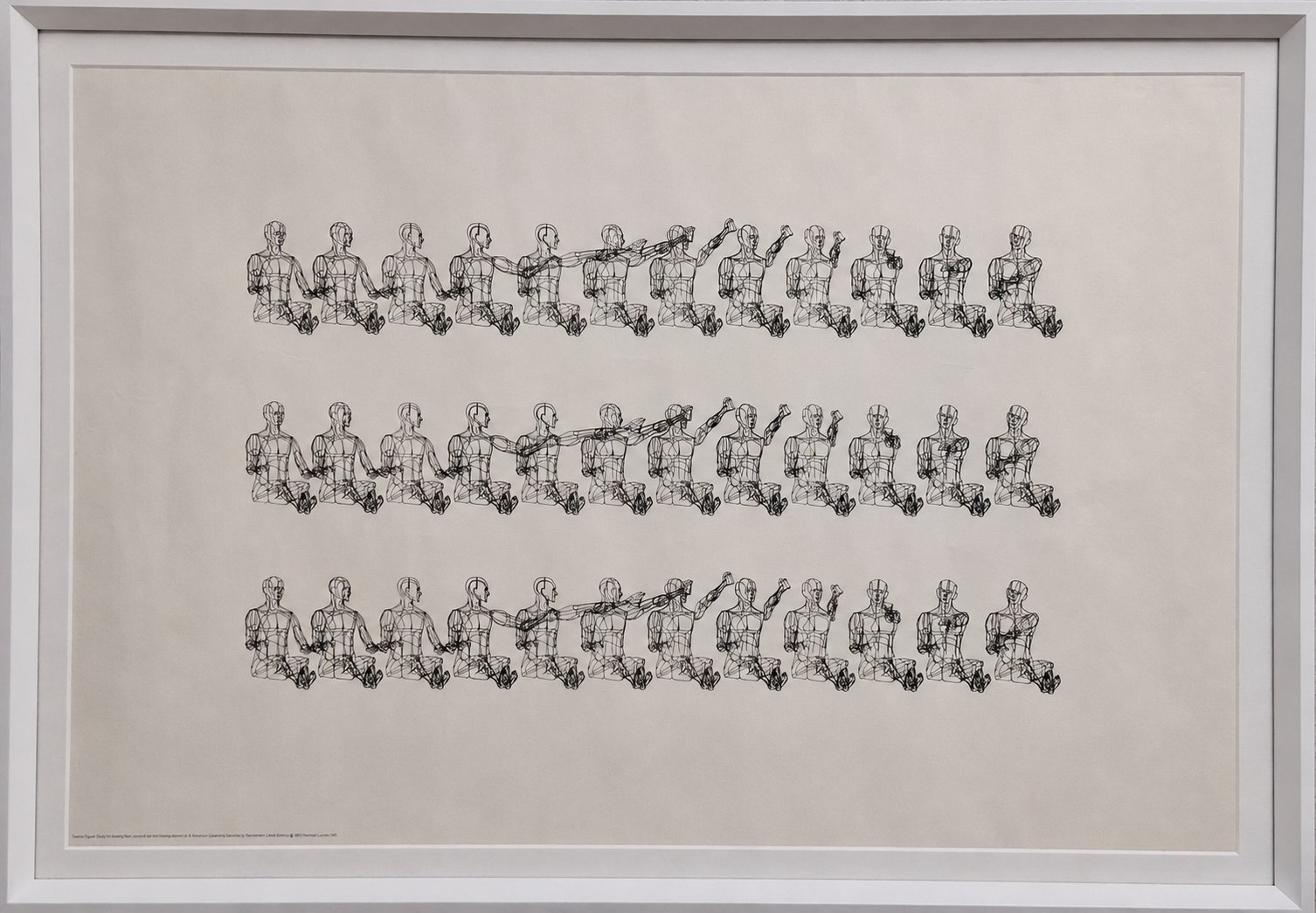
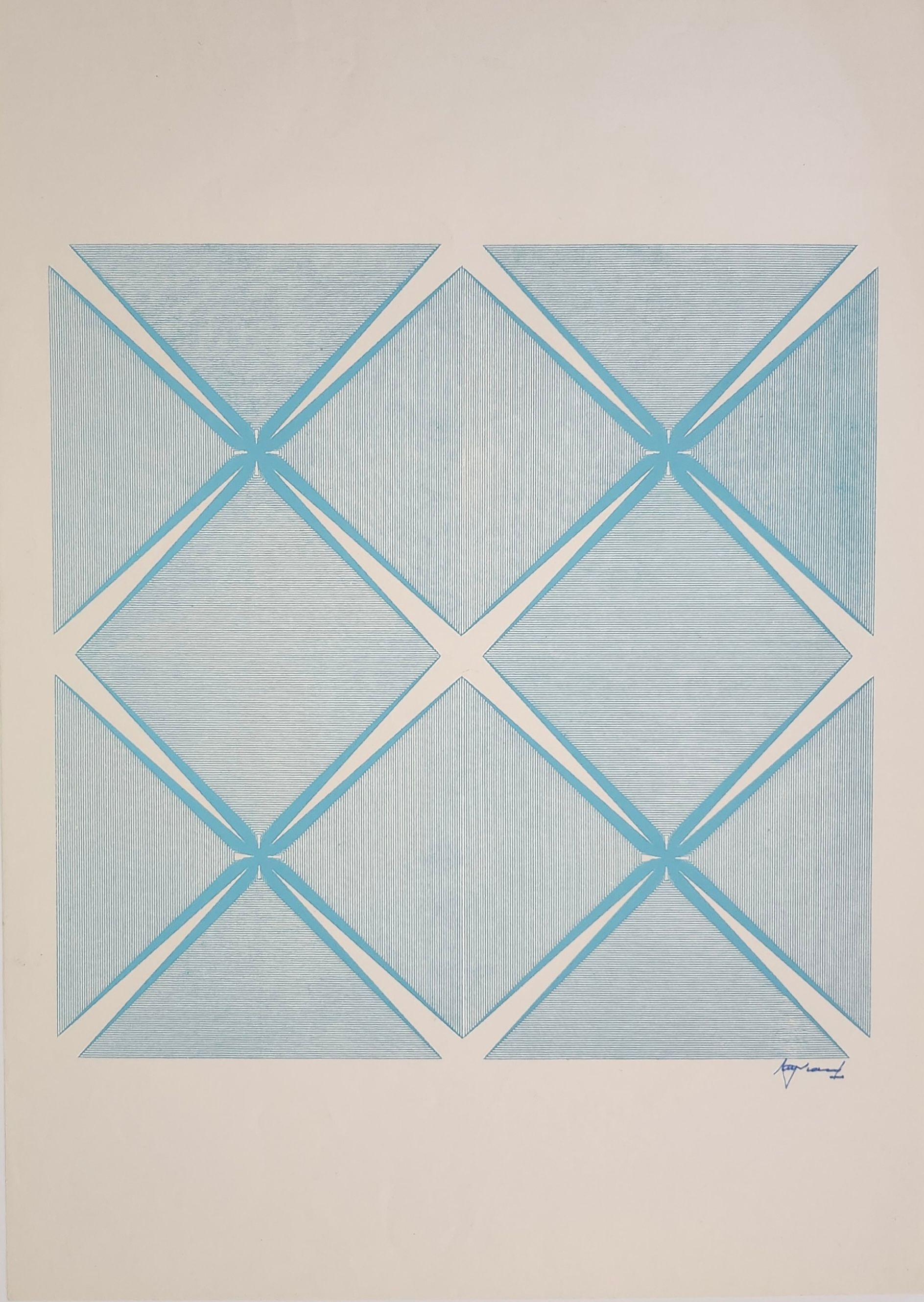
First published in German and English in 1971, Computer Graphics – Computer Art was revised and enlarged for this second edition. Franke wrote from the dual position of artist and technical observer, surveying a field that still encompassed fine art, scientific visualization, industrial design, animation, music, architecture and other applications of computation.
The book moves from equipment and working methods to representational imagery, picture processing and computer-aided design, followed by sections on the history, theoretical foundations and anticipated future of computer art. Its organization is topical rather than strictly chronological, and its illustrations place artistic experiments beside scientific research and industrial graphics. The selection records how an active participant understood the boundaries of computer art during its early development and subsequent expansion.
Franke’s treatment of Charles Csuri is particularly significant. Introducing “Representational Pictures in Computer Graphics,” he observes that computer graphics remained largely aligned with Constructivist abstraction and that producing recognizable figures was technically difficult. He then describes the artists who nevertheless pursued representational imagery as pioneers, leading with Csuri and James Shaffer’s Flies in a Circle and later calling their Transformation “another impressive example.” The book therefore documents contemporary recognition of Csuri not simply as an early computer artist, but specifically as a pioneer of computer-generated figuration.
The photographed passages also establish several connections across the collection. Franke reproduces CTG’s Return to Square and Running Cola is Africa, presenting both as examples of progressive computational transformation. He describes CTG’s membership and its influence on the artist-technologist collaboration organized by CAyC in Buenos Aires. His account of the October 1969 Arte y Cibernética exhibition specifically names Luis Fernando Benedit and Miguel Ángel Vidal among the participating Argentine artists. Elsewhere, William A. Fetter’s cockpit visualization represents the parallel development of three-dimensional computer graphics within industrial research and aircraft design.
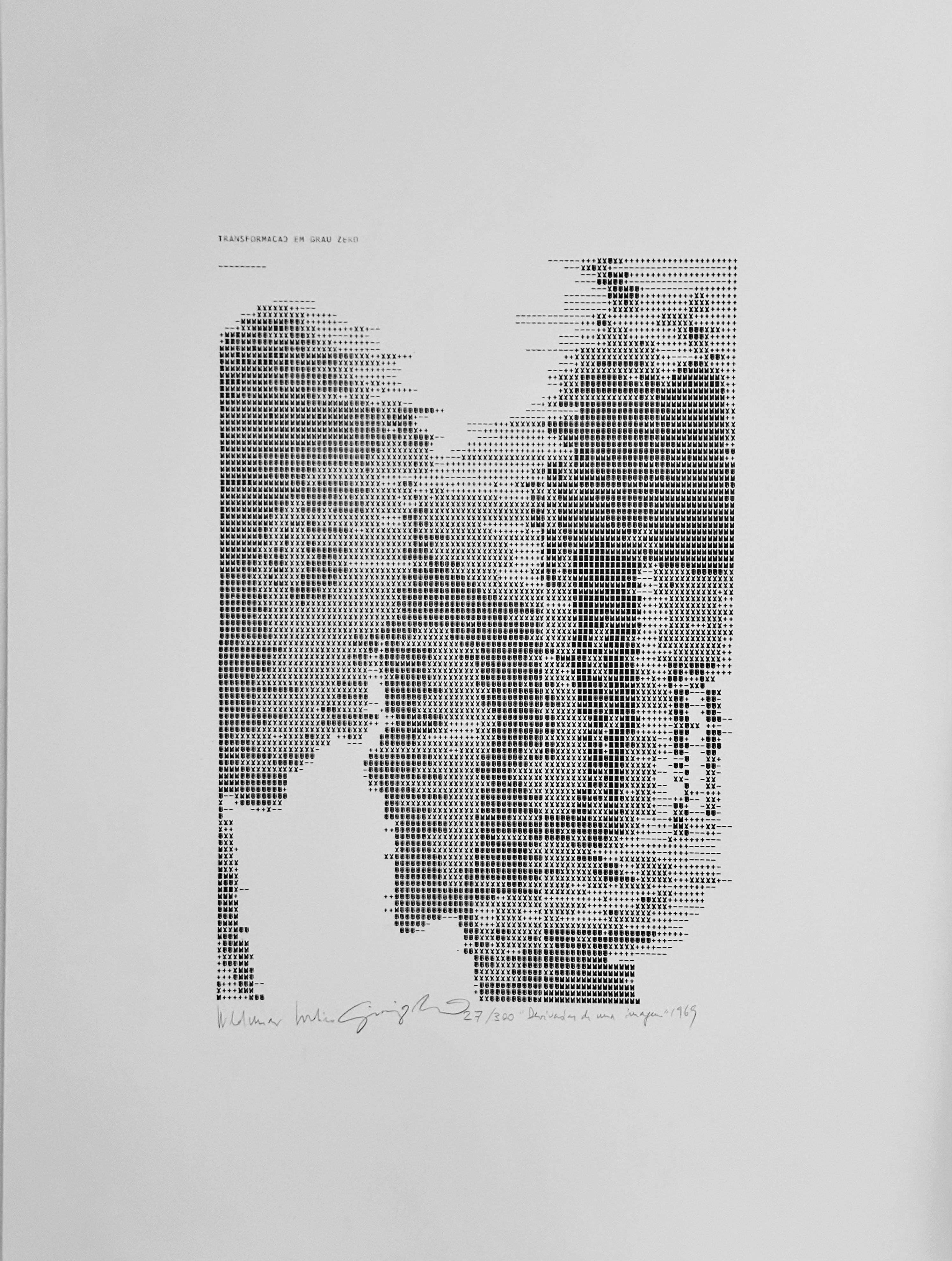
Page 117 reproduces the four successive stages of Waldemar Cordeiro and Giorgio Moscati’s Derivadas de uma imagem. Beginning with a photograph of a young couple taken from a Valentine’s Day poster, Cordeiro and Moscati digitized the image at seven tonal levels and used an IBM 360/44 at the University of São Paulo to locate and transform its horizontal and vertical discontinuities. Each output was derived from the preceding image, progressively moving from photographic legibility toward abstraction. The sequence provides a direct visual connection between Franke’s earlier discussion of computer picture processing and Cordeiro’s use of rasterization, numerical differentiation and progressive loss of photographic information as an artistic process.
Many of the book’s captions identify a maker, subject or computational procedure without supplying a date. On the rare occasion when dates are mentioned, they are often not accurate. Individual works are therefore best cross-referenced with artist and museum records. The volume is most useful as a contemporary visual and conceptual survey and as evidence of which practitioners, works and technical lineages Franke considered representative.