
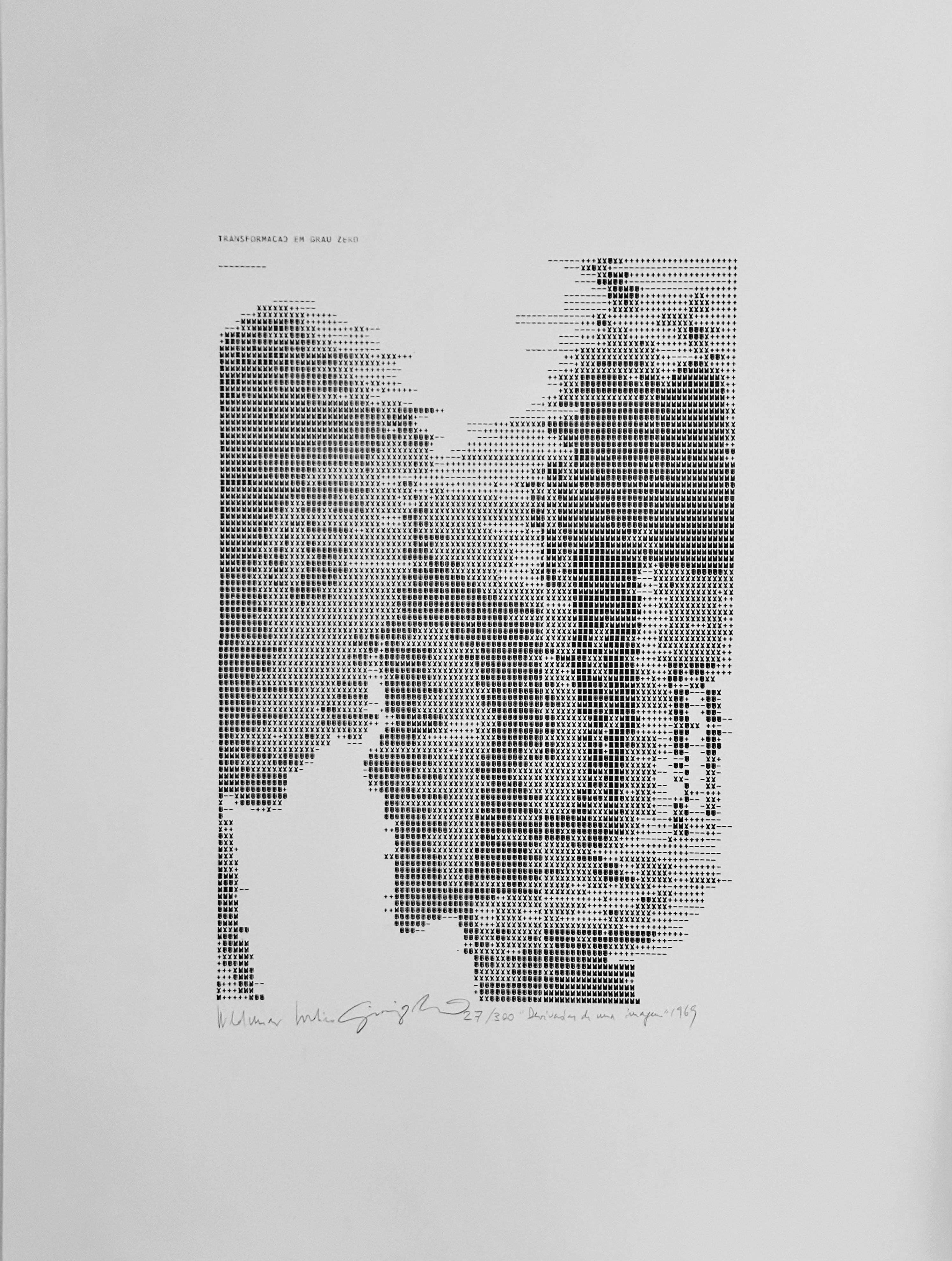
Created in 1969 by Waldemar Cordeiro with physicist Giorgio Moscati at the University of São Paulo, Derivadas de uma imagem: Transformação em Grau 0 is a foundational work of computer art in Brazil. A photographic image was manually digitized and processed on an IBM 360/44 mainframe, translating tonal information into a field of printed characters. The project brought digital image processing into Brazilian art at a moment when comparable experiments were only beginning to emerge internationally.
Provenance
From the estate of Giorgio Moscati
Exhibitions
- 1970 - Computer Plotter Art, Minigaleria da Biblioteca do USIS, São Paulo. This is particularly important. Moscati says Derivadas was included in what was billed as the first computer-art exhibition in Latin America. Contemporary/research bibliographies date the show to March 1970.
- 1971 - Arteônica, Museu de Arte Brasileira, Fundação Armando Alvares Penteado (FAAP), São Paulo. Organized by Cordeiro.
- 1985 - Arte Novos Meios/Multimeios, FAAP, São Paulo.
- 1986 - Waldemar Cordeiro: Uma aventura da razão, MAC USP, São Paulo.
- 1993 - Arteônica, VI Simpósio Brasileiro de Computação Gráfica e Processamento de Imagens (SIBGRAPI), Recife. Moscati prepared his important retrospective account of the collaboration for this event.
- 2002 - Waldemar Cordeiro e a fotografia, Centro Universitário Maria Antônia, São Paulo.
- 2005 - Visualidades / Técnicas, Instituto Cervantes, São Paulo.
- 2009 - Anos 70: Arte Como Questão, Instituto Tomie Ohtake, São Paulo.
- 2013–14 - Waldemar Cordeiro: Fantasia Exata, Itaú Cultural, São Paulo / Paço Imperial, Rio de Janeiro.
- 2018 - Writing New Codes: Cordeiro / Mallary / Molnar, The Mayor Gallery, London. Degree 0 illustrated in the catalogue.
- 2018 - The Matter of Photography in the Americas, Cantor Arts Center, Stanford University.
- 2018 - Chance and Control: Art in the Age of Computers, Victoria and Albert Museum, London. The V&A label identifies its example as one of the first computer artworks made in Brazil.
- 2024 - Waldemar Cordeiro: A Singular Constellation, The Mayor Gallery, London. Degree 0 appears on p. 45 of the catalogue.
- 2024 - Arteônica: Art, Science and Technology in Latin America Today, Museum of Latin American Art, Long Beach.
- 2025 - TEFAF New York, presented by The Mayor Gallery in partnership with Luciana Brito Galeria. Degree 0 was among the works shown.
- 2026 - Antagonistas: Resistências Algorítmicas, MAC USP, São Paulo. USP highlighted its original Derivadas de uma imagem alongside Analívia Cordeiro's M3 x 3.
References
Major Museum Holdings:
- Museo Nacional Centro de Arte Reina Sofía, Madrid, Spain - Derivadas de uma imagem: Transformação em Grau 0, 1969, offset print, 31/300, 61.2 × 44.5 cm. Long-term loan of Fundación Museo Reina Sofía. https://www.museoreinasofia.es/en/collections/artwork/derivadas-de-uma-imagem-transformacao-em-grau-0-derivatives-image-degree-0/
- Museu de Arte Contemporânea da Universidade de São Paulo (MAC USP), São Paulo, Brazil - Derivadas de uma imagem, 1969, by Waldemar Cordeiro and Giorgio Moscati. This is the important original matrix/line-printer work of all 3 transformations of the image rather than an impression of the later offset edition: 167.5 × 34.5 cm, donated by Giorgio Moscati, accession 1987.7. https://acervo.mac.usp.br/acervo/index.php/Detail/objects/21018
- Victoria and Albert Museum, London, UK - Derivatives of an Image: Transformation in Degree Zero, museum no. E.202-2018, 61 × 44.5 cm. The V&A catalogs its impression (perhaps incorrectly) as a 1971 lithograph after the 1969 computer-generated impact print; donated by Thomas Cordeiro Guedes and Grégoire Cordeiro Belhassen through the Mayor Gallery. https://collections.vam.ac.uk/item/O1426284/
Derivadas de uma imagem marks a decisive moment in the history of Brazilian computer art. Waldemar Cordeiro began working with computers in 1968 in collaboration with Giorgio Moscati, a physicist and professor at the University of São Paulo. Their earlier Beabá used computation to generate permutations of language; with Derivadas, they turned instead to the computational processing of a photographic image. The project is widely regarded as inaugurating computer-generated image-making in Brazil.
The source was a photographic image of a young couple. At a time when Cordeiro and Moscati did not have access to a digital scanner or interactive graphics display, Cordeiro manually divided the photograph into a grid of 98 by 112 points (10,976 individual values) and assigned each point one of seven levels from light to dark. The data were transferred to punched cards and processed on an IBM 360/44 at the University of São Paulo. Characters and combinations of characters produced different densities on the line printer, converting photographic tonality into numerical information and then back into a visible image.
The title refers literally to a mathematical derivative. Grau 0 is the computer transcription of the source photograph. Moscati's program then compared neighboring tonal values to calculate successive derivatives, progressively suppressing areas of relatively uniform tone and emphasizing changes in intensity. The resulting sequence moved from recognizable photographic information toward edges and contours. What was initially conceived as an artistic transformation of an image can consequently also be understood as an early form of digital edge detection.
The procedure places Derivadas de uma imagem in dialogue with some of the earliest experiments in digital image processing elsewhere. At Bell Laboratories in the United States, Kenneth Knowlton and Leon Harmon began processing photographs as grids of discrete tonal values. Their celebrated Studies in Perception experiments, including the image commonly known as Computer Nude, translated photographic brightness into numerical values and reconstructed the image as patterned cells of varying density.
Cordeiro and Moscati began from a strikingly related premise in São Paulo in 1969, but under very different technical conditions. Where Bell Labs possessed specialized scanning and graphics equipment, Cordeiro manually encoded nearly eleven thousand points before the information could be entered into the computer. More importantly, Derivadas did not stop at the rasterization and reconstruction of a photograph. The program subjected the digitized image to successive mathematical transformations, making the decomposition of visual information itself the subject of the work. If Harmon and Knowlton demonstrated how a photograph could be computationally sampled and reconstructed, Cordeiro and Moscati used that decomposition as the starting point for an algorithmic transformation of perception.
Its historical importance therefore extends beyond technical novelty. By 1969 Cordeiro was already one of the defining theorists and practitioners of Brazilian Concrete art. As a founder and principal theorist of Grupo Ruptura in São Paulo in the early 1950s, he had spent nearly two decades investigating rational structure, seriality, perception and the communication of visual information. His move into computation was not an abrupt technological detour but a continuation and radical extension of those concerns.
Cordeiro had also moved well beyond the formal purity of early Concrete art during the 1960s. Through intuitive geometry, assemblage, photographic imagery and popcreto, he increasingly introduced mass culture, semantics, participation and political experience into his work. The computer offered another means of reconsidering how images are constructed, transmitted and perceived. His term arteônica, art made through electronic means, described a practice in which technology could transform not only artistic form but also the production and circulation of art.
This distinguishes Cordeiro's approach from much early computer graphics concerned principally with geometry, permutation or technical demonstration. In Derivadas, the computer operates on an image taken from photographic culture and exposes the informational structure beneath its appearance. Later works such as A Mulher que Não É B.B. and the Gente series would push this relationship between computation, mass-media imagery and social meaning still further. For Cordeiro, digital abstraction did not remove the human subject; it became a means of asking what information about a person or event survives when an image is processed, degraded and recoded.
The original computer process survives institutionally at the Museu de Arte Contemporânea da Universidade de São Paulo. MAC USP preserves a 1969 matrix-printer work from Derivadas de uma imagem, jointly attributed to Waldemar Cordeiro and Giorgio Moscati and donated by Moscati.
The present example belongs to the subsequent offset print edition. It is numbered 27/300 and signed in pencil by both Cordeiro and Moscati, with the title and date inscribed along the lower margin. Although the sheets were numbered as an edition of 300, a certificate of authenticity signed by Giorgio Moscati states that the planned edition was never completed and that production was interrupted before even half of the intended number had been made.
Other examples have entered major institutional collections. The Museo Nacional Centro de Arte Reina Sofía holds number 31/300, while the Victoria and Albert Museum preserves another example. Most surviving impressions, e.g. the example in the private Kanbas Collection, are unsigned. Together with the original material at MAC USP, these holdings reflect the growing recognition of Derivadas de uma imagem as one of Cordeiro's central works and as a landmark in the early history of computational image-making.
Within Cordeiro's short but unusually consequential career, Derivadas de uma imagem stands at the point where Brazilian Concrete art, photography, information theory and computation converge. Its importance lies not in claiming global priority over earlier experiments at Bell Laboratories, but in the particular transformation Cordeiro and Moscati achieved: they brought digital image processing into an established avant-garde artistic practice in Brazil and used the computer not simply to reproduce an image, but to investigate how an image becomes information and how information becomes visible again.