

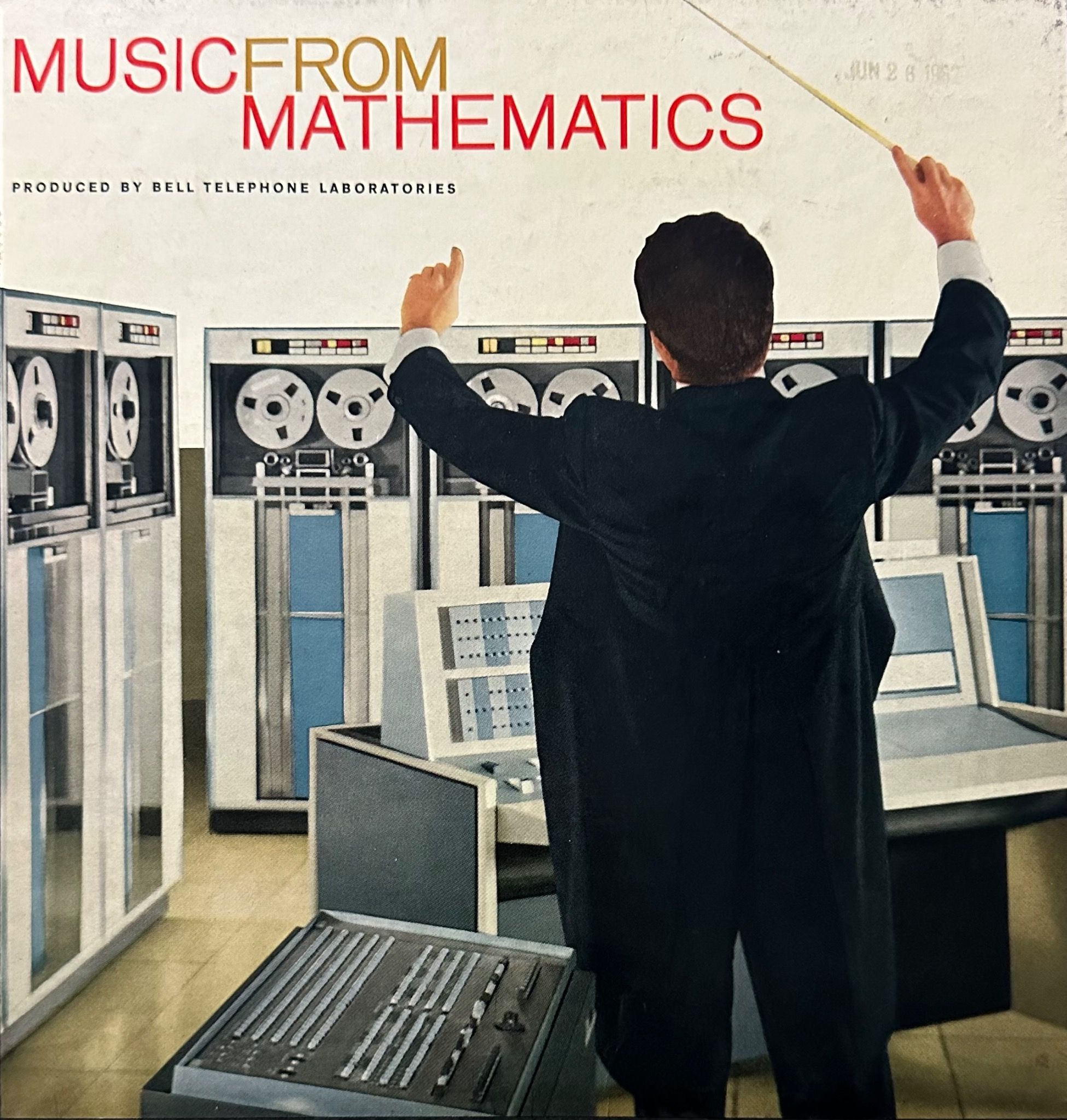
01 / 18Music from Mathematics: front of the Bell Telephone Laboratories box, showing a conductor facing computer equipment
LP or sound recording
Music from Mathematics
1960–1961Regarded as the first publicly issued LP of computer-generated music, Music from Mathematics brought algorithmic composition and digital sound synthesis to listeners in 1960–1961. It pairs an excerpt from Hiller and Isaacson’s Illiac Suite, performed by a human string quartet, with music synthesized by IBM computers at Bell Labs.
- Author / editor
- Bell Telephone Laboratories; Lejaren Hiller, Max V. Mathews, John R. Pierce, Newman Guttman, David Lewin, Leonard Isaacson and others
- Publisher
- Bell Telephone Laboratories, Inc.
United States - Format
- LP Vinyl Record
- Language
- English
Why It Matters
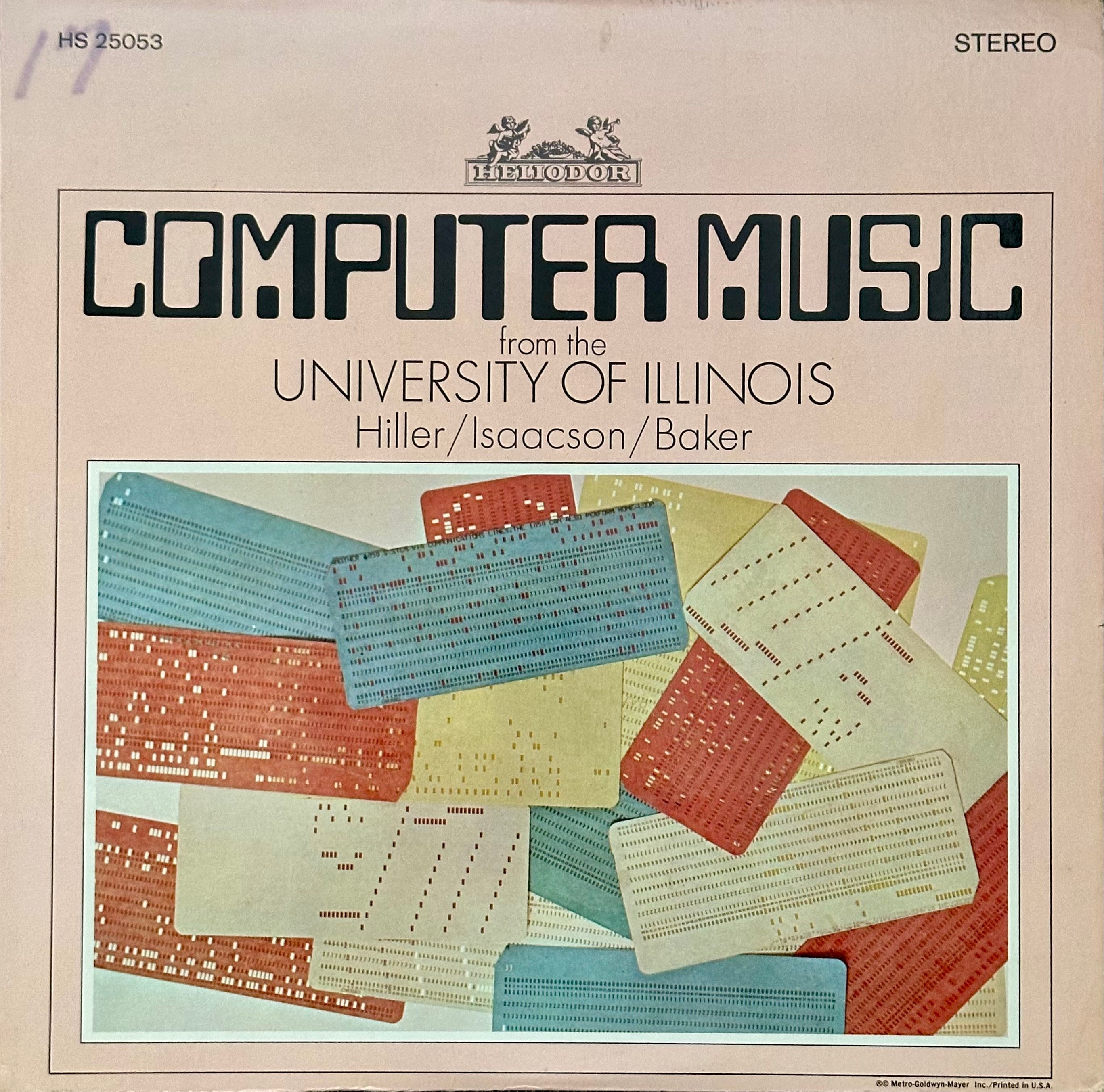
Regarded as the first publicly issued LP of computer-generated music, Music from Mathematics brought the experiments of Bell Labs and the University of Illinois to listeners outside the laboratory. Its 1960–1961 release preceded Computer Music from the University of Illinois by six or seven years. It documents two foundational possibilities for computational art: a program could generate a composition through rules and probabilities, or create its sounds through numerical synthesis. The computer was becoming both a compositional tool and a programmable instrument.
The accompanying booklet also addresses a question that remains central to generative art: does working with a machine diminish the artist’s role? Bruce E. Strasser places authorship in the composer’s ideas and judgment, asking: “What is a piano but a piece of machinery? What is a trumpet but a precise piece of plumbing?” (p. 19).
How It Was Made
The computer as instrument: Side One presents seven human-composed pieces synthesized on IBM 704 and 7090 computers using Max Mathews’s software. Composers could define their own instruments and control pitch, timbre, rhythm and dynamics. Works such as Numerology explore sounds and transitions beyond the capabilities of conventional instruments. The music was calculated in advance: the booklet estimates twenty minutes of IBM 704 processing for one minute of sound.
The computer as composer: Side Two includes an excerpt from the fourth movement and coda of Hiller and Isaacson’s Illiac Suite (1955–1957). The ILLIAC generated musical material by testing random choices against compositional rules and using Markov chains, where preceding notes influence the probabilities of subsequent ones. Human musicians performed the resulting score.
Chance procedures: Music by Chance uses dice and random-number tables to select chords. Improvisations on a Random Piano was composed collectively, each participant adding half a measure while part of the preceding score remained concealed. Both demonstrate that generative methods can operate without computers.
The record closes with a computer saying “thanks for listening,” synthesized by John Kelly and Louis Gerstman. This brief demonstration connects the musical experiments to Bell Labs’ research into the production and transmission of speech.
Edition and Dating
Bell Telephone Laboratories, catalogue 122227: a boxed 10-inch, 33⅓ rpm microgroove LP with an illustrated booklet. Both record labels and the box text carry a 1960 copyright. The booklet is catalogued in research libraries as 1961, and this copy cites Mathews’s May 1961 paper on p. 17. The date is therefore shown as 1960–1961 to distinguish the recording’s copyright from the accompanying publication. This is the original eleven-band Bell Labs program, distinct from the later Decca release, which has a different selection of recordings.
Tracklist
Side One: Compositions on a Well-Tempered Computer
1. Stochatta – John R. Pierce 2. Three Against Four – Max V. Mathews 3. Beat Canon – John R. Pierce 4. Pitch Variations – Newman Guttman 5. Numerology – Max V. Mathews 6. Variations in Timbre and Attack – John R. Pierce 7. Study One – David Lewin
Side Two
8. Excerpt from Illiac Suite for String Quartet – Lejaren Hiller and Leonard Isaacson; performed by the WQXR String Quartet 9. Music by Chance – John R. Pierce and M. E. Shannon 10. Improvisations on a Random Piano: Romantic, Classic, Chorale – David Slepian and colleagues, as credited on the box 11. The Voice of the Computer – speech synthesis by John Kelly and Louis Gerstman
Sources and Further Reading
The original box, record labels and accompanying booklet are the principal sources for this entry. Photographed booklet pages include the account of the Illiac experiments (pp. 7–9), the Side One composition notes (pp. 12–13), the score, waveform and punched-card diagrams (pp. 14–17), the closing discussion of authorship (p. 19), and the speech-synthesis and electronic-music addenda (pp. 20–21).
Max V. Mathews, “An Acoustic Compiler for Music and Psychological Stimuli,” Bell System Technical Journal 40, no. 3 (May 1961), pp. 677–694
A. Michael Noll, Memories: A Personal History of Bell Telephone Laboratories (2015), p. 42: the boxed record and booklet
A. Michael Noll, Timeline of Early Computer Music at Bell Telephone Laboratories (Engineering and Technology History Wiki)
Le Random, Generative Art Timeline: Music from Mathematics, the First Computer Music Issued on Record