

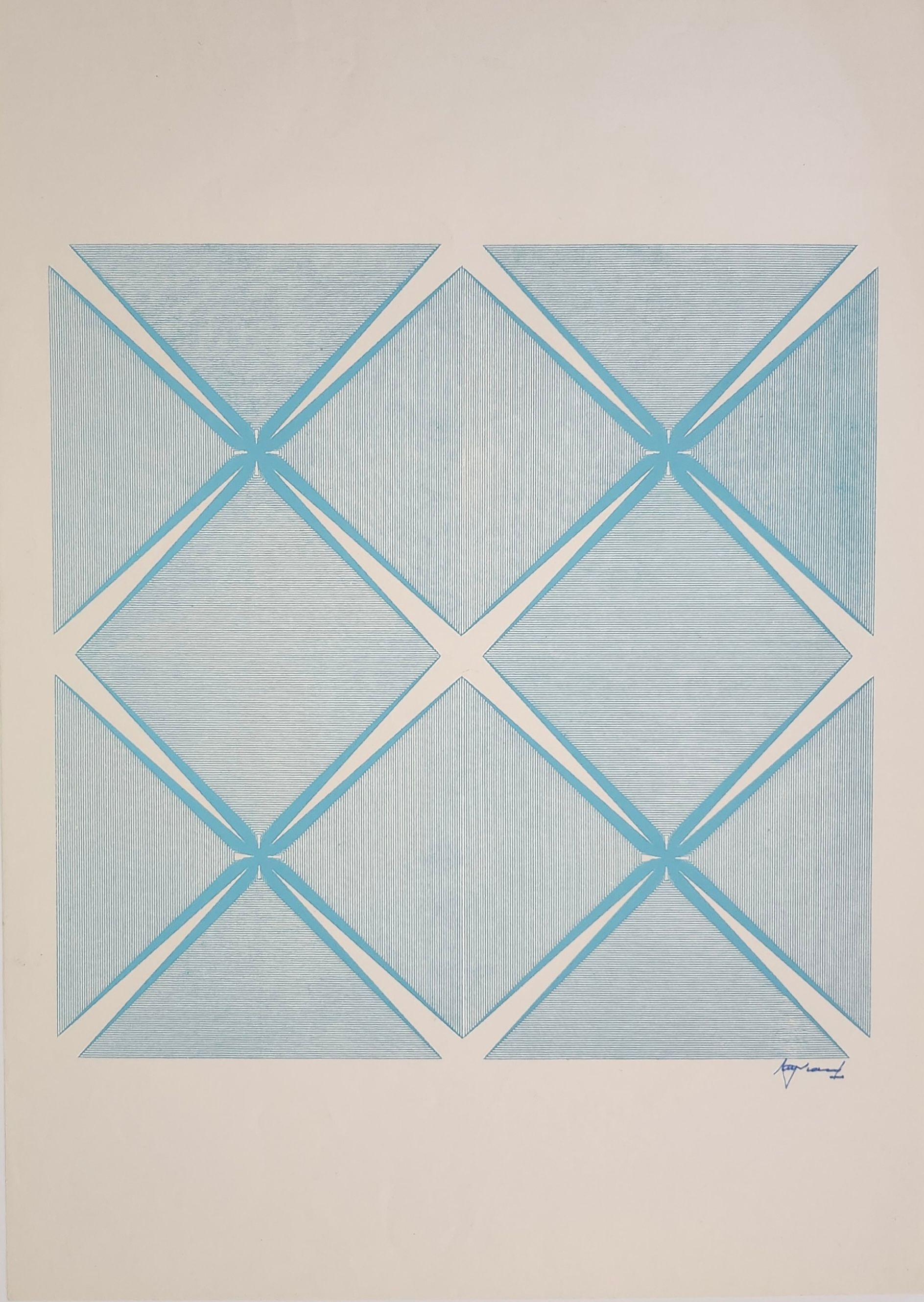
Miguel Ángel Vidal, co-founder of Arte Generativo and a founding artist of CAyC’s Grupo de Arte y Cibernética, made this signed 1969 screenprint in the context of Argentina’s first computer-art exhibition. An impression of the same composition was shown in Tate Modern’s Electric Dreams in 2024–25, and examples are held by Tate and the Victoria and Albert Museum. This signed impression comes from the artist’s estate.
Provenance
Miguel Ángel Vidal Estate, Buenos Aires Acquired in 2026
Exhibitions
1969 - Arte y Cibernética, Galería Bonino, Buenos Aires. Vidal was one of the Argentine artists whose computer-assisted works were produced for and presented within this project. The present impression is documented as having been produced in the Arte y Cibernética / CAyC context; whether this specific sheet was individually exhibited at Galería Bonino has not been established.
2024–25 - Electric Dreams: Art and Technology Before the Internet, Tate Modern, London. Another impression of the same composition, Tate P15468, was exhibited. The present impression was not the Tate loan.
References
- Eduardo Mac Entyre and Miguel Ángel Vidal, “Arte generativo,” 1960. Manifesto defining the principles of Arte Generativo, published for the artists’ exhibition at Galería Peuser, Buenos Aires.
- Rafael Squirru, “El prólogo de Mac Entyre y Vidal requiere una explicación…,” in Arte generativo: Eduardo Mac Entyre – Miguel Ángel Vidal, Galería Peuser, Buenos Aires, 1960.
- Miguel Ángel Vidal and Eduardo Mac Entyre, “Manifiesto de Arte Generativo,” 1960. Full text preserved by the Miguel Ángel Vidal archive.
- Centro de Arte y Comunicación (CAyC), archival records relating to Grupo de Arte y Cibernética and Arte y Cibernética, in the ICAA/MFAH Documents of Latin American and Latino Art. The Grupo de Arte y Cibernética was established in Buenos Aires in 1969 to facilitate artistic experimentation with computers.
- Ella Ravilious, “Centro de Arte y Comunicación (CAyC),” Victoria and Albert Museum, 2016. Includes the V&A’s impression of Miguel Ángel Vidal’s Untitled, 1969, described as a screenprint made from a computer-generated drawing.
- Valentina Ravaglia, ed., Electric Dreams: Art and Technology Before the Internet, Tate Publishing, 2024. Exhibition catalogue accompanying the Tate Modern exhibition in which another impression of Vidal’s 1969 composition was shown.
- Tate Modern, “Electric Dreams: Art and Technology Before the Internet,” 28 November 2024–1 June 2025. Major survey of optical, kinetic, programmed and early digital art, including Miguel Ángel Vidal.
- Fondo Nacional de las Artes, “Eduardo Mac Entyre y Miguel Ángel Vidal. Arte generativo: el futuro a crear,” 2025. Exhibition reconstructing the origins and historical context of Arte Generativo.
- Michael Bogan, “The Lost Computer Art of South America,” Ragnar Digital. Research on CAyC and early South American computer art, including Vidal’s 1969 computer-derived screenprints and the Arte y Cibernética exhibition.
- “Miguel Ángel Vidal and Luis Fernando Benedit — archival interview footage,” archival video documenting the artists and the Argentine experimental-art context.
Four modules form a square, each built from exceptionally fine blue parallel lines that narrow toward a central point before opening again into broad triangular fields. Seen from a distance, the density of the lines reads almost as translucent planes of pale blue; at close range the image resolves into the mechanical precision of individual marks. White diagonal channels cut through the structure, while the four compressed centers create a rhythmic pulse across the sheet.
The composition is closely related to the ideas Vidal and Eduardo Mac Entyre had articulated almost a decade earlier in their manifesto for Arte Generativo. Their “generative” art was based on forms that produce further visual sequences through repetition, displacement and transformation. The term predates contemporary computational generative art, but the relationship is more than linguistic: Vidal's 1969 computer work placed an already systematic visual practice into an environment where sequences and variations could be translated into machine operations.
The work emerged from Grupo de Arte y Cibernética Buenos Aires, established in March 1969 through Jorge Glusberg's CEAC/CAyC following contact with Japan's Computer Technique Group (CTG). At the computation center of the ORT technical schools, artists worked alongside programmers, engineers and systems analysts, with the technical team led by Julio Guibourg and Ricardo Ferraro. Vidal was one of six Argentine artists whose computer-assisted experiments formed the core of Arte y Cibernética at Galería Bonino later that year.
This context is historically important. Computing equipment was still expensive and largely concentrated in corporate, scientific and university settings in Europe and North America. CAyC created an unusual Latin American site where artists could gain access to such machinery, while simultaneously connecting the experiment to an international network of computer art. Arte y Cibernética included work from Argentina alongside artists from Japan, Britain and the United States and is now regarded as the first computer-art exhibition in Argentina.
Other impressions establish an unusually strong institutional context for the composition. The Victoria and Albert Museum holds the same design as museum no. E.193-2008, catalogued as an untitled 1969 screenprint made from a computer-generated drawing. Tate holds another impression, P15468, presented by the Miguel Ángel Vidal Estate and Ungallery in 2020. Tate describes Vidal's use of transparency and arrays of lines as a means of creating patterns and an illusion of depth, and exhibited its impression in Electric Dreams: Art and Technology Before the Internet at Tate Modern in 2024–25.
The work therefore occupies a particularly clear point in Vidal's development: it is at once a product of CAyC's pioneering computer experiment and a technological continuation of the geometric language he had been developing since the foundation of Arte Generativo.