Artist · 1928–2009
Miguel Ángel Vidal
Argentine
Buenos Aires, Argentina
Miguel Ángel Vidal (1928–2009) was an Argentine geometric artist who, with Eduardo Mac Entyre, founded Arte Generativo in Buenos Aires in 1959. A decade before working with computers, Vidal had developed an art of repeated lines and geometric forms designed to generate optical movement; in 1969 he extended that logic into computer-assisted drawing through CAyC's Grupo de Arte y Cibernética. His career connects Argentina's concrete and optical traditions to one of Latin America's earliest organized experiments in computer art.
Miguel Ángel Vidal was an Argentine painter, draftsman, designer and educator whose work joined geometric abstraction, optical movement and, briefly but significantly, computer-generated imagery. Born in Buenos Aires in 1928, he trained at the Escuela Nacional de Bellas Artes Prilidiano Pueyrredón, graduating in 1952 as a professor of visual arts. His teachers included Lino Enea Spilimbergo and Eugenio Daneri. After early investigations in naturalism and post-Cubism, Vidal increasingly reduced his vocabulary to line, geometry, rhythm and light.
In 1959 Vidal and Eduardo Mac Entyre founded the Buenos Aires movement Arte Generativo, encouraged by collector and theorist Ignacio Pirovano and critic Rafael Squirru. Their manifesto, drafted in 1959 and published for their first exhibition at Galería Peuser in 1960, described an art in which points, lines and geometric forms generate sequences of movement through repetition, displacement and transformation. “Generative” did not yet mean software-generated in the contemporary sense: it described forms that engender other forms and create optical movement. The Fondo Nacional de las Artes has subsequently identified the manifesto as the first Latin American document to propose an optical art.
This distinction makes Vidal's later engagement with computing particularly significant. For him, the computer did not introduce an unrelated aesthetic. It offered a new mechanism for extending a visual system he had already pursued by hand for a decade. Repetition, variation, line density, serial structure and the production of virtual depth were already central to Arte Generativo before they could be translated into machine instructions.
That translation occurred in Buenos Aires in 1969. Jorge Glusberg's Centro de Estudios de Arte y Comunicación, soon renamed Centro de Arte y Comunicación (CAyC), established the Grupo de Arte y Cibernética after contact with Japan's Computer Technique Group. Artists including Vidal, Luis Fernando Benedit, Antonio Berni, Ernesto Deira, Eduardo Mac Entyre and Osvaldo Romberg worked with programmers, engineers and systems analysts at the computation center of the ORT technical schools. An IBM 1130 computer and plotter equipment enabled the artists' visual ideas to be expressed through computational procedures and machine drawing.
The resulting works were presented in Arte y Cibernética at Galería Bonino in Buenos Aires in 1969, an exhibition now regarded as a foundational moment in Argentine computer art. CAyC's program was markedly international: Japanese, British and American work appeared alongside the Argentine experiments, and subsequent exhibitions circulated through an international network. At a time when the expense of computing equipment concentrated most computer-art production in European and North American universities and laboratories, the Buenos Aires experiments constituted an important Latin American exception.
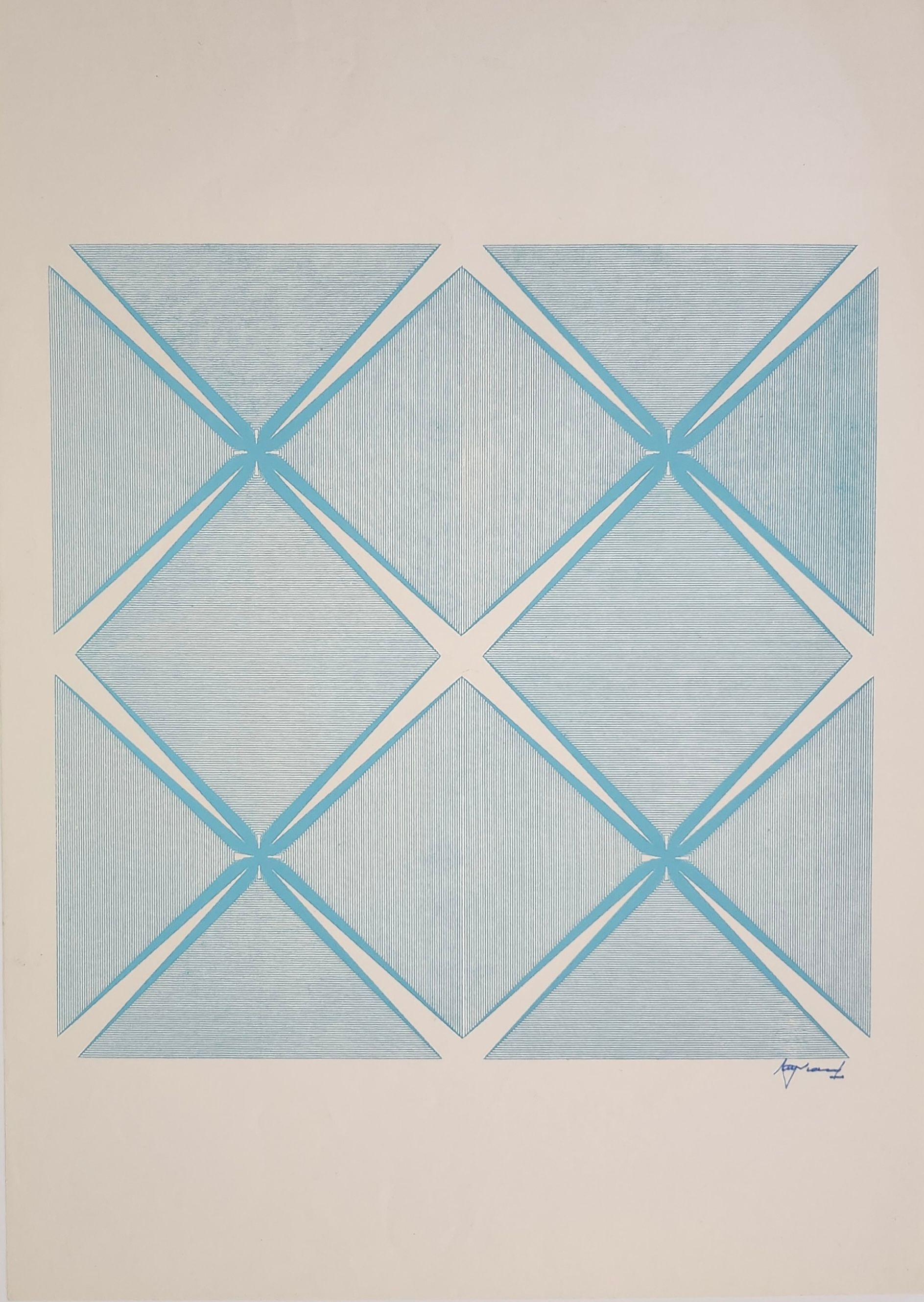
Vidal's computer-generated works are especially coherent within his wider practice because their arrays of precise lines, repeated structures and virtual spatial effects continue the concerns of Arte Generativo rather than interrupt them. After this period he pursued increasingly spatial and topological forms, working with acrylic, metal, concave and convex surfaces, and eventually making light itself a dominant element in his painting.
Vidal also had a substantial career as an educator. He taught painting and directed theses at the Escuela Superior de Bellas Artes Ernesto de la Cárcova and served as rector of the Escuela Nacional de Bellas Artes Prilidiano Pueyrredón from 1989 to 1991. He received a Konex Diploma of Merit for geometric painting in 1982.
Recent exhibitions have brought renewed attention to the historical continuity between Vidal's geometric and computational work. His 1969 computer-derived imagery was included in Tate Modern's Electric Dreams: Art and Technology Before the Internet in 2024–25, while the Fondo Nacional de las Artes devoted a major 2025 exhibition to Vidal and Mac Entyre's Arte Generativo, explicitly reassessing the movement as an important Argentine contribution to modern and digital-art history.
Exhibitions
- 1957 - Pintura Concreta, Museo Municipal de Arte Moderno, Buenos Aires
- 1960 - Arte Generativo: Eduardo Mac Entyre – Miguel Ángel Vidal, Galería Peuser, Buenos Aires, under the auspices of the Museo de Arte Moderno
- 1962 - Arte Generativo, Museu de Arte Moderna do Rio de Janeiro, Rio de Janeiro
- 1964 - New Art of Argentina, Walker Art Center, Minneapolis, and subsequent United States tour
- 1965 - VIII Bienal de São Paulo, São Paulo
- 1967 - Más allá de la Geometría, Centro de Artes Visuales, Instituto Torcuato Di Tella, Buenos Aires
- 1968 - Four Argentinian Painters, Galería Bonino, New York
- 1968 - Beyond Geometry, Center for Inter-American Relations, New York
- 1969 - Arte y Cibernética, Galería Bonino, Buenos Aires
- 1970–71 - Arte y Cibernética: San Francisco–Londres–Buenos Aires, CAyC and international circulation
- 1973 - Projection et Dynamisme, Musée d'Art Moderne de la Ville de Paris, Paris
- 1987 - Fifty Years of Collecting: An Anniversary Selection — Painting Since World War II, Solomon R. Guggenheim Foundation, New York
- 2012 - Real/Virtual: Arte cinético argentino en los años sesenta, Museo Nacional de Bellas Artes, Buenos Aires
- 2015 - Miguel Ángel Vidal: De la línea a la luz, Museo Nacional de Arte Decorativo, Buenos Aires
- 2024–25 - Electric Dreams: Art and Technology Before the Internet, Tate Modern, London
- 2025 - Eduardo Mac Entyre y Miguel Ángel Vidal. Arte generativo: el futuro a crear, Casa Victoria Ocampo, Fondo Nacional de las Artes, Buenos Aires
In the collection
1 work
In the library