
Research article
Drawing with Electricity: Who Really Made the First Oscilloscope Art?
Hy Hirsh, Norman McLaren, Mary Ellen Bute, Ben Laposky, and revising the prehistory of computer art
Before artists got access to digital computers, a small group of filmmakers, photographers, engineers, and physicists discovered that the cathode-ray oscilloscope, an electronic measuring instrument, could become an artistic medium.
The earliest surviving works in this chronology are Hy Hirsh’s chromogenic abstract photographs, dated circa 1950; Hirsh was also making oscilloscope-based film by 1951. Norman McLaren, et al. publicly screened the film Around Is Around in May 1951. Ben F. Laposky’s electronic abstractions first enter the published record in September 1952 and were publicly exhibited in 1953. Mary Ellen Bute began working with a CRT oscilloscope after meeting Bell Labs engineer Ralph Potter in late 1953; her film Abstronic was in production in 1954 and premiered in 1955. Works by Herbert W. Franke and other artists followed.
Why does this matter?
Oscilloscope art is part of the prehistory of computer art, even though a cathode-ray oscilloscope is not a computer. By converting electrical signals into luminous forms whose shape could be altered through frequency, phase, amplitude, and other parameters, it introduced ways of making images that would later become familiar in computer graphics and generative art. Yet for Hirsh, McLaren, and Bute, the oscilloscope was primarily a source of visual material for experimental film. They did not present their work as an early form of computer art. Only retrospectively did writers such as Herbert W. Franke incorporate these electronic experiments into a genealogy leading toward computer graphics. [1, pp. 11, 26–29]
Priority matters because museums, historians, and collectors use the earliest surviving works to determine where a genealogy begins and which artists and objects become foundational. For decades, the accepted story has begun with Laposky and the claim that he started producing electronic abstractions in 1950. Repetition has turned that date into consensus. The evidence examined here doesn’t support the consensus view. [1, pp. 27–28] [17, p. 60]
How to decide what “first” means
Claims of priority are only as good as the evidence behind them. A retrospective recollection is weaker than a contemporary letter. A modern-day art-fair caption is weaker than a dated object, laboratory record, exhibition catalogue, film-stock marking, or contemporary screening program.
For this history, the strongest evidence consists of surviving dated works and contemporary production records, followed by contemporary publications, exhibitions, screenings, and institutional provenance. Later recollections and subsequent historical or commercial attributions carry the lowest weight.
Using that standard changes the traditional chronology considerably.
Before 1950: the lost oscillographic prehistory
While preparing Around Is Around in December 1950, Norman McLaren wrote to British stereoscopic-film specialist Raymond Spottiswoode about building the new film from oscillographic material. The letter mentions a color workprint McLaren claimed he had made at the NFB “five or six years” earlier using the same method, placing the experiment around 1944–45. No such workprint is presently known to survive. [1, pp. 307–308]
There is a possibly related project by NFB animator James Mackay. A production request dated July 2, 1947 describes an Oscillographic Project: a black-and-white assembly of oscillographic patterns intended to be printed through a three-color process. [1, p. 308]
While there is no surviving artwork or documented public presentation, these records show that artistic experiments with oscillographic imagery were already underway at the NFB before 1950.
Hy Hirsh: the earliest surviving artworks
When the question changes from Who experimented first? to What is the earliest surviving artistic object?, Hy Hirsh becomes central.
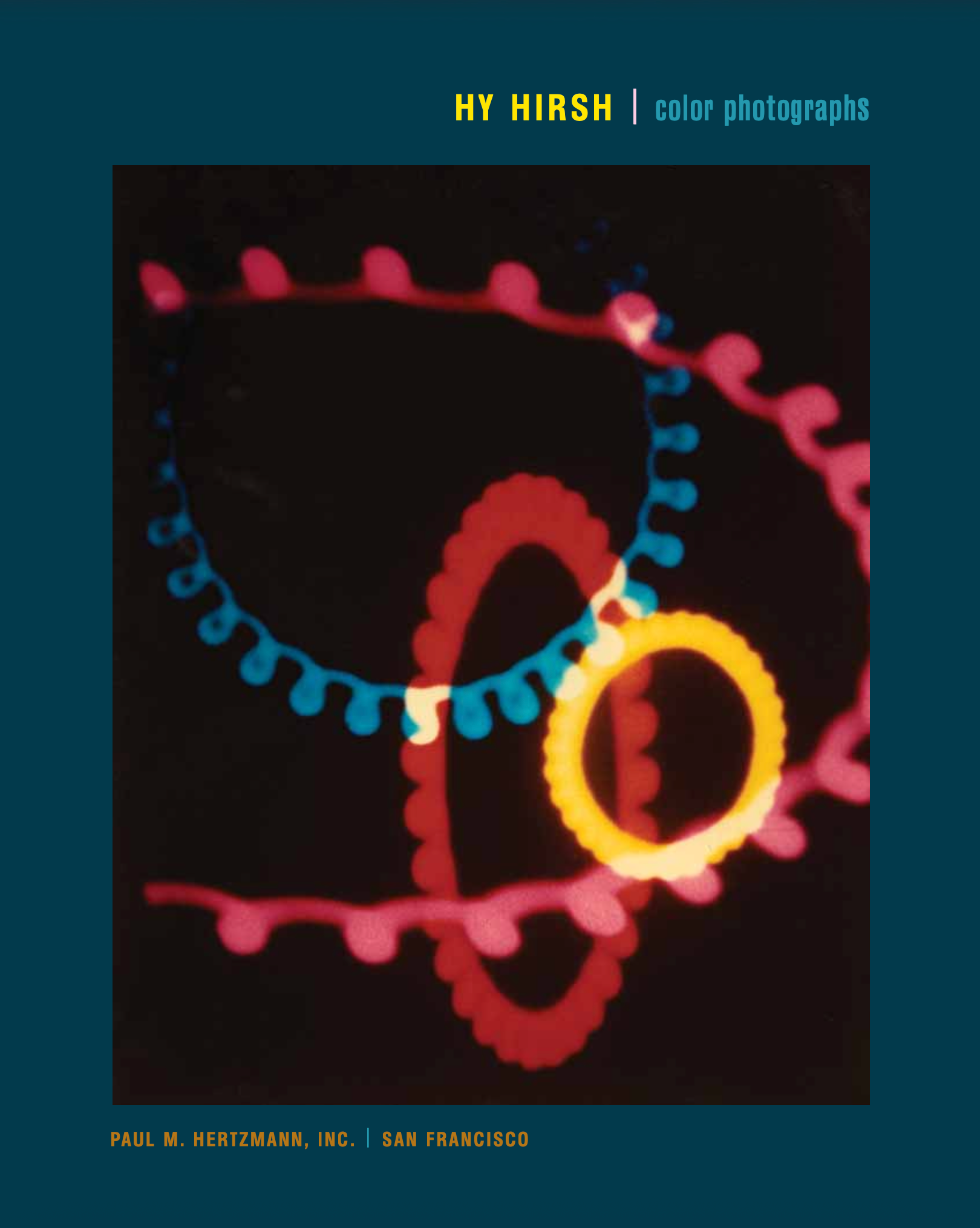
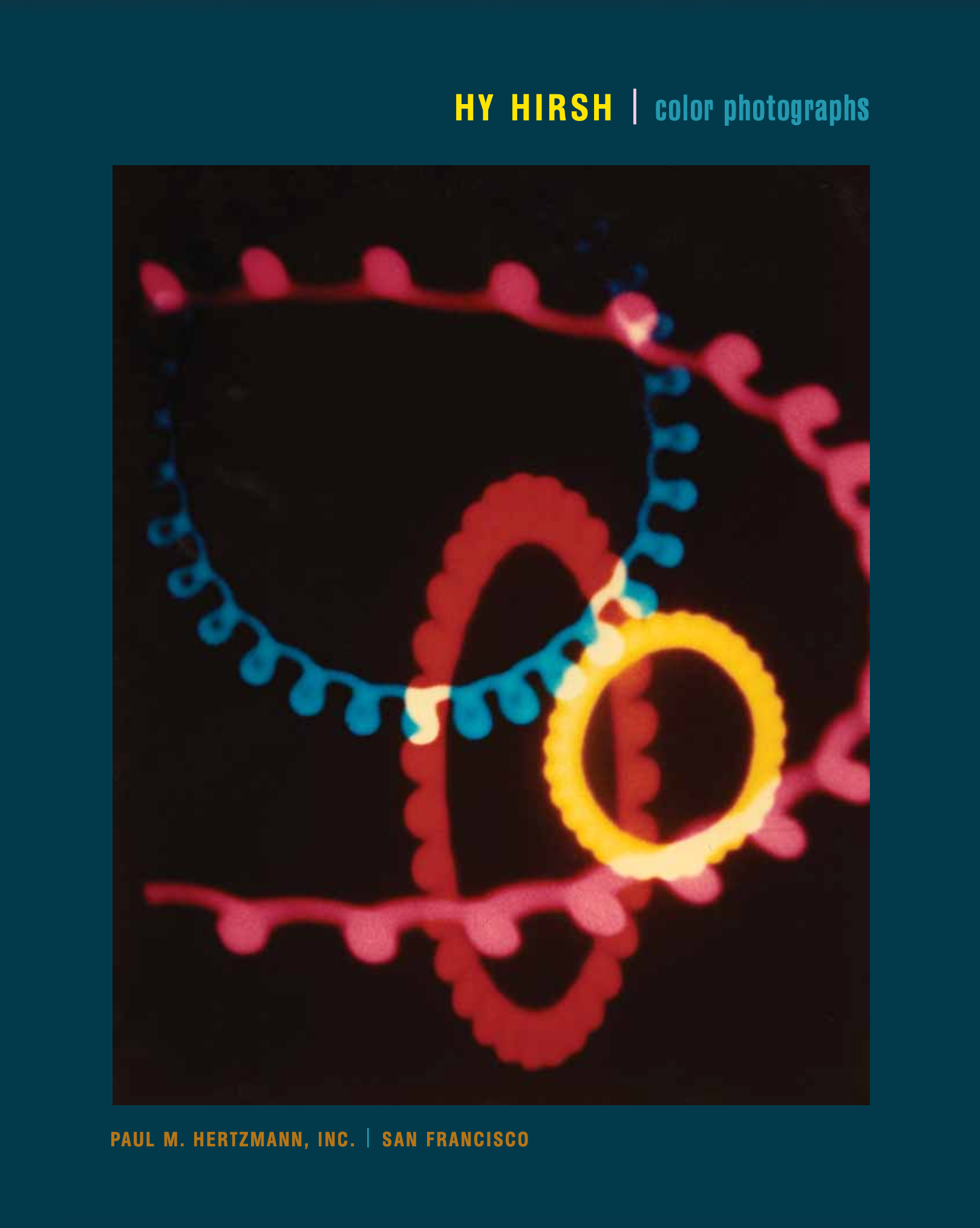
Several major museum collections preserve abstract color photographs by Hirsh dated circa 1950. The Princeton University Art Museum records an Untitled chromogenic print on cellulose diacetate as ca. 1950. [2] The J. Paul Getty Museum dates another Ansco Printon chromogenic abstraction to about 1950. [3] The Amon Carter Museum similarly dates its dye-coupler print to ca. 1950. [4] And the Rijksmuseum presents Untitled (Abstraction) as 1950. [5]
These datings are significant because several independent museum collections have adopted the same chronology.
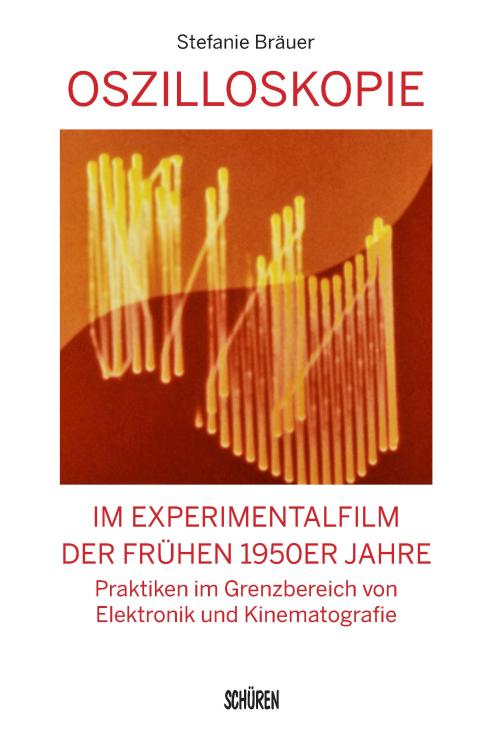
Hirsh was well equipped and positioned to create such works in 1950. He had accumulated many years of professional camera experience before WWII and was deeply embedded in San Francisco's postwar experimental-film community. He worked as a museum photographer for the M.H. de Young Memorial Museum and California Palace of the Legion of Honor and was valued within the Art in Cinema community for his technical abilities. [1, pp. 124–128] [6, pp. 1–2] He had his own darkroom at the museum, was exceptionally skilled with cameras, owned a motion-picture camera, and provided technical help to younger filmmakers. [9, pp. 68–69] He improvised lenses, manipulated exposures, constructed equipment, and later built his own optical printer. Stefanie Bräuer describes him as known locally for both technical knowledge and improvisational ingenuity. [1, pp. 124–128] [6, p. 3]
Hirsh was also part of a culture in which artistic experimentation, science, music, and unusual imaging technologies overlapped. He photographed and worked with filmmakers such as Sidney Peterson, Frank Stauffacher, Harry Smith, and Jordan Belson. [1, pp. 123–128] [6, pp. 2–3]
There is a link between this San Francisco network and one of the engineers most deeply interested in electronic visual music. In March 1949 Art in Cinema organizer Frank Stauffacher, whom Hirsh assisted, corresponded with Bell Laboratories engineer Ralph K. Potter about the relationship between visual images and sound. Four years later Potter helped Mary Ellen Bute develop her electronic oscilloscope apparatus. [10, pp. 195–196] [1, pp. 293–294] [30]
On the presently available evidence, Hirsh's ca. 1950 chromogenic abstractions are the earliest surviving artistic objects associated with the emerging artistic use of electronic oscilloscopy. [2] [3] [4] [5] [6, pp. 3–5]
Hirsh's sustained oscilloscope practice
Hirsh's first independent experimental film makes the record even clearer. His own curriculum vitae dates Divertissement Rococo to 1951, while Bräuer uses 1951–52 to account for its completion and circulation. [1, pp. 390–391] [7]
A 1955 Kinesis film-rental catalogue, preserved in the William Moritz Papers at the Center for Visual Music, describes Divertissement Rococo as an abstract film composed from oscilloscope and other artificially generated moving patterns. It also explains that Hirsh built a special optical printer allowing extensive experimentation with superimposed imagery and color. [1, p. 392] [7]
The film was not a private technical test. It was already circulating in 1952, including a documented June 7 screening by the Berkeley Film Society; Dennis Reed's chronology also records its appearance at the Sixth Edinburgh International Film Festival that year. [1, p. 391] [6, p. 23] [31]
Hirsh treated the oscilloscope not as the generator of the artwork but as a source of visual material. That distinction separates him from Laposky. Hirsh did much more than photograph traces from a screen. He treated them as raw artistic material, transforming them through color filtration, multiple exposure, optical printing and superimposition. He even used the oscilloscope's Z-axis intensity input to turn continuous curves into dotted and interrupted lines. [1, pp. 392–395] [6, p. 3]
In later films including Eneri and Come Closer in 1953, those electronic forms became increasingly complex and, in Come Closer, stereoscopic. [1, pp. 398–400] [7]
That sustained practice is what gives Hirsh's claim particular weight: the circa-1950 photographs are followed almost immediately by securely documented oscilloscope filmmaking.
Norman McLaren: the first public presentation
If Hirsh has the strongest surviving-object case, Norman McLaren's Around Is Around has the clearest claim to the first securely documented public presentation of electronic oscilloscope imagery as art. [1, pp. 355–369] [11]
The film was commissioned for the 1951 Festival of Britain and shown at London's Telecinema. McLaren directed it, Evelyn Lambart played a substantial role in animation and production, and NFB engineer Chester Beachell developed the electronic oscillographic patterns and apparatus. [11] [1, pp. 355–359]
The documentation is unusually strong. Lambart's calendar records work on the “Stereo Project” beginning in December 1950. By December 18, 1950, McLaren was reporting a large variety of successful oscillographic forms, and another production letter records roughly 6,000 feet of oscillograph film already shot and being edited. [1, pp. 367–369]
The purpose of the project was primarily stereoscopic cinema rather than the invention of a new autonomous art medium. Oscillographic lines proved particularly useful because they could be displaced between left- and right-eye images to appear suspended in three-dimensional space. [12, pp. 513–520] [1, pp. 366–369]
That distinction matters. Around Is Around put electronic abstract imagery before a large public audience in 1951, but McLaren did not continue using the oscilloscope within an independent artistic practice in the way Hirsh and Laposky did.
Ben Laposky: popularizer rather than first
The often-repeated statement that Laposky began making electronic oscilloscope art in 1950 rests entirely on retrospective accounts. Herbert W. Franke later used the date while incorporating Laposky into a genealogy of computer graphics, and Laposky himself subsequently described his experimentation as having begun “about 1950.” [17, p. 60] [18, p. 340]
Applying the evidentiary standard used elsewhere in this article, that cannot establish priority in the absence of a securely dated 1950 photograph, contemporary letter, notebook, publication, or exhibition record.
Laposky's electronic oscilloscope abstractions first appear in the journal Scripta Mathematica in the September-December 1952 issue. He had already published a mechanically generated “Pendulum Pattern” in Scripta Mathematica in the March-June 1951 issue. That publication documents his pre-existing interest in mathematical and harmonic image-making, but provides no evidence of CRT imagery at that earlier date. [1, pp. 213–214] [19, p. 132] [20, pp. 305–308]
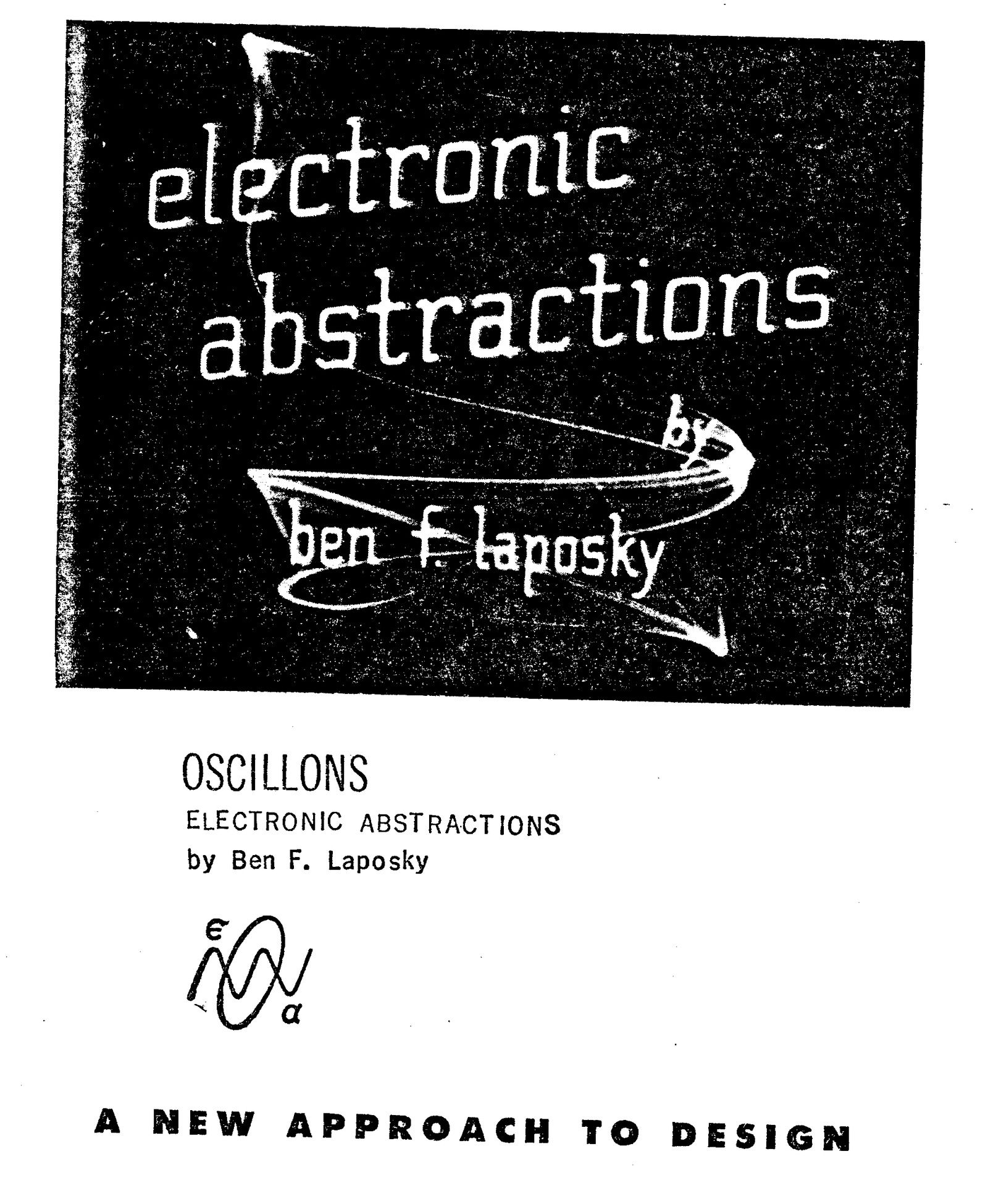
In 1953 Laposky published Electronic Abstractions and launched the exhibition for which he became famous. The 1953 catalogue describes fifty photographs made from cathode-ray oscilloscope patterns and documents a substantial museum tour beginning that year. Illinois Institute of Technology, which later reconstructed the exhibition from Laposky's archive, likewise identifies 1953 as his first exhibition. [21, pp. 1, 16]
Most strikingly, the original Sanford Museum gallery notes reproduced in Laposky’s own publication explicitly state that he was “not originating the idea” of using oscilloscopes and electronic circuits to create art. Instead, they argued that he had developed the practice further than anything yet revealed through publication or exhibition. [21, gallery notes]
That contemporary characterization is more persuasive than the later inventor narrative. The surviving documentary record places Laposky’s electronic abstractions securely in 1952, with their transformation into a named and publicly exhibited body of work in 1953. His achievement was substantial, but the evidence does not presently support the conventional claim that oscilloscope art began with him in 1950. Laposky was the artist who made oscilloscope art into a recognizable category. That achievement is substantial enough without attaching an unsupported 1950 priority to it.
Mary Ellen Bute: reassessing another early claim
The most consequential early-date claim for Mary Ellen Bute concerns two Bute/Ted Nemeth photographs presented at Art Basel in 2026 as Oscilloscope Test(s), 1950/1951. Those dates have since been repeated in fair coverage. [14] For purposes of establishing CRT oscilloscope priority, however, they remain problematic. No known primary source securely establishes the 1950/51 dates. Bute had experimented with oscillographic images, including work with Leon Theremin in 1931–32, but those experiments used an electro-mechanical vibrating-wire and mirror system rather than a cathode-ray tube and are not part of the CRT priority question. [1, pp. 99–100]
In March 1954, Mary Ellen Bute described the origin of her oscilloscope work with unusual precision. Writing in Films in Review, she recalled: “I first met Mr. Potter last fall and he was so cosmically generous as to take out his pencil and design ‘a circuit’ which, when wired into an oscilloscope, converts that device into a creative instrument for the translation of sound waves into visual images and allows the artist a high degree of control of line and form. James Townsend developed Mr. Potter’s design, Edgar Schuller built it, and it is fabulous! […] Mr. Potter can therefore be credited with introducing electronic abstractions into the motion picture.” [30]
Because the letter appeared in March 1954, Bute’s “last fall” clearly refers to fall 1953. Her own account establishes a straightforward sequence: she first met Bell Labs engineer Ralph K. Potter in late 1953; Potter then designed the circuit, Townsend developed it, and Schuller constructed the apparatus that enabled her to use the CRT oscilloscope as a controllable image-making instrument. She credits Potter with “introducing electronic abstractions into the motion picture” which is difficult to reconcile with subsequent claims that she had already been producing such CRT imagery in 1950, 1951 or 1952. On Bute’s own contemporary account, her CRT oscilloscope work therefore began no earlier than late 1953, leading to the material subsequently assembled into Abstronic.
The dating of Abstronic itself has also shifted. Although older filmographies frequently call it a 1952 film, Bräuer dates it 1954–55 on the basis of a surviving Yale workprint carrying a 1954 film-stock marking and a public premiere in 1955. [1, pp. 22–24] [15, pp. 263–266]
This chronology places Bute after Hy Hirsh’s oscilloscope photographs circa 1950, McLaren and Beachell’s documented oscilloscope filmmaking of 1950–51, and Ben Laposky’s first documented CRT abstractions of 1952. Among these early pioneers, Bute appears to have come last, beginning her CRT work only in late 1953.
An evidence-weighted timeline
c. 1944-45 - Norman McLaren, lost NFB oscillographic workprint. In a December 1950 letter, McLaren mentions making a color workprint from oscillographic material at the National Film Board five or six years earlier. The work itself is not known to survive. [1, pp. 307–308]
1947 - James Mackay, NFB Oscillographic Project. A surviving production request describes black-and-white oscillographic patterns intended for three-color printing. The resulting film material appears to be lost. [1, p. 308]
c. 1950 - Hy Hirsh, abstract chromogenic photographs. Princeton, Getty, Amon Carter, and the Rijksmuseum date surviving Hirsh abstractions to around 1950. These are the earliest surviving artistic objects presently known from the emerging practice of electronic oscilloscope art. [2] [3] [4] [5]
May 1951 - Norman McLaren, Evelyn Lambart, and Chester Beachell, Around Is Around. Shown at the Festival of Britain, this is the earliest securely documented public presentation of artistic imagery photographed from an electronic oscilloscope. [11] [12, pp. 513–520] [1, pp. 355–369]
1951 - Hy Hirsh, Divertissement Rococo. Hirsh's first independent experimental film incorporates oscilloscope imagery transformed through color, multiple exposure, and optical printing. It was shown on June 7, 1952 in Berkeley, CA, and at the 1952 International Edinburgh Film Festival. [1, pp. 390–392] [6, p. 23] [7]
September 1952 - Ben F. Laposky, electronic abstractions published in Scripta Mathematica. This is the earliest securely dated publication of Laposky's electronic oscilloscope imagery found in the documentary record. [19, p. 132] [20, pp. 305–308]
March 1953 - Ben F. Laposky, Electronic Abstractions. Laposky's landmark traveling exhibition presented fifty oscilloscope photographs as autonomous artworks. His own exhibition literature acknowledged that he was not originating the idea; his major contribution was to systematize, name, exhibit, and popularize the medium. [21, pp. 1, 16; gallery notes]
1953 - Hy Hirsh, Eneri and Come Closer. Hirsh expanded his oscilloscope vocabulary through increasingly complex optical processing and, in Come Closer, stereoscopic 3-D. [1, pp. 398–400] [7]
1954-55 - Mary Ellen Bute, Abstronic. Surviving Yale film material carries a 1954 stock marking, and the completed film premiered in 1955. Bute combined electronic oscilloscope imagery with animation, optical effects, color, and music. [1, pp. 22–24] [15, pp. 263–266]
December 1955 - Herbert W. Franke and Franz Raimann, Oscillograms. An analog calculating system was used to mathematically transform signals displayed on a cathode-ray oscillograph, bringing computation directly into the image-generating process. [22]
1959 - Franke, Experimentelle Ästhetik; Hirsh imagery in Vortex V. Franke exhibited computational oscillograms at Vienna's Museum of Applied Arts, while Jordan Belson incorporated Hirsh's oscilloscope footage into immersive projections at San Francisco's Morrison Planetarium. [23] [7]
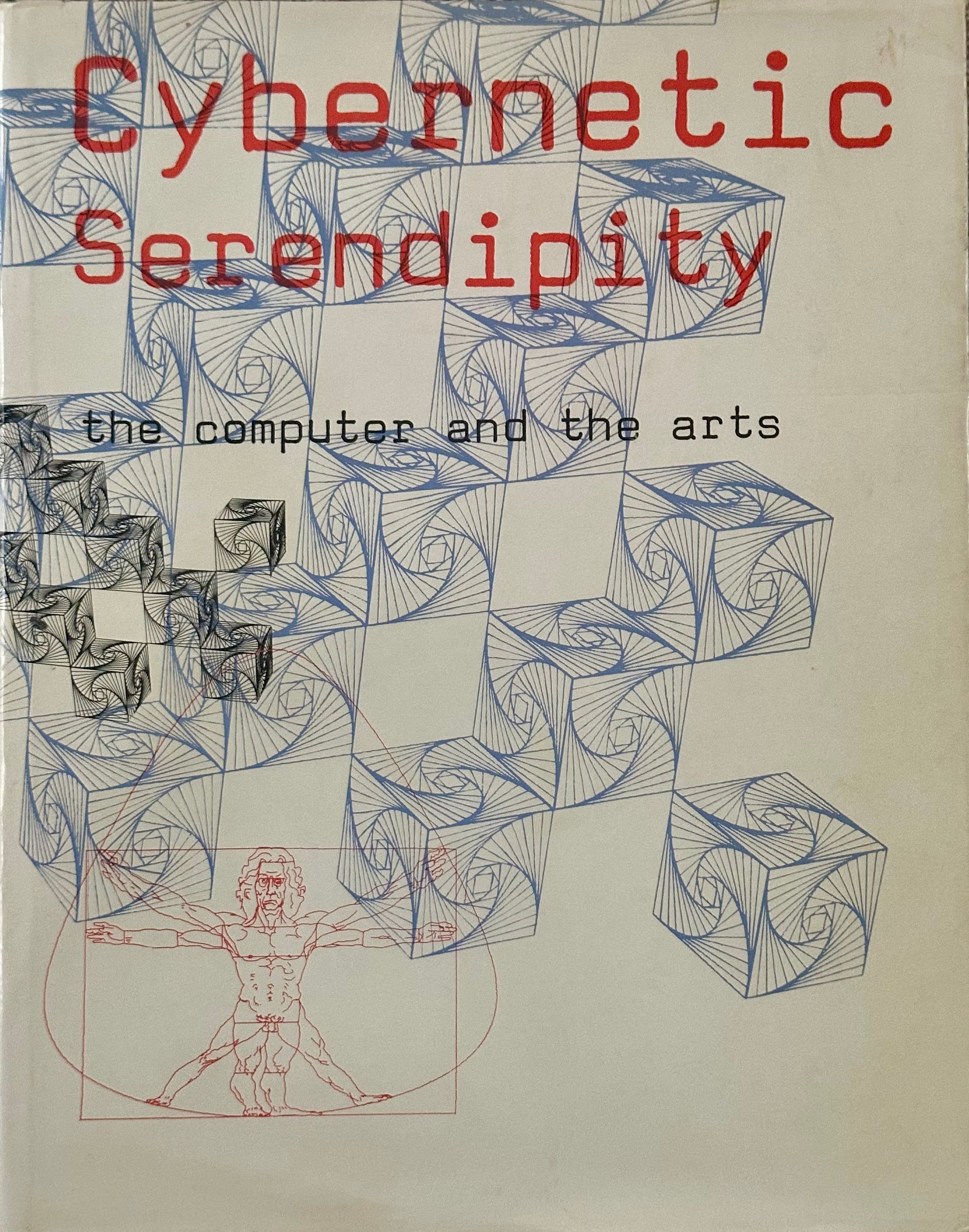
1961-68 - Alexandre Vitkine, Stephen Beck, and John C. Mott-Smith. Oscilloscope imagery continued into generative photography, electronic video synthesis, and finally computer graphics; by 1968 Mott-Smith was photographing an oscilloscope directly connected to a computer for imagery reproduced in Cybernetic Serendipity. [24] [25] [26]
2013-present - Oscilloscope Music and 0xDEAFBEEF. Jerobeam Fenderson and Hansi3D revived the physical X-Y oscilloscope as a simultaneous sound-and-image instrument, while 0xDEAFBEEF's Synth Poems reconstruct its logic in software and, by 2026, rematerialized it as hand-forged sculpture. [27] [28] [29]
How Laposky became “the pioneer”
If Laposky was not the first artist to work with electronic oscilloscope imagery, why did he become the name most closely associated with its beginnings?
The answer lies in visibility and presentation. Hirsh primarily worked in experimental film. His photographic work was poorly known for decades, his film materials were dispersed, and he died in 1961. McLaren's oscillographic work belonged to a collaborative institutional project remembered principally for animation and stereoscopy. Bute incorporated electronic imagery into a much broader practice of visual music. None of them made the oscilloscope the central identity of their work. [1, pp. 27–30]
Laposky did the opposite. He made the electronic trace the sole subject. He photographed it repeatedly, invented the memorable name Oscillon, wrote about the technique, supplied reproductions to publications, issued catalogues, and sent touring exhibitions through dozens of institutions. [18, pp. 340–347] [21, pp. 1–16]
That sustained campaign made oscilloscope art legible as a distinct category. By the time later histories of electronic and computer art were being written, Laposky had left behind the record that canon formation favors: named works, photographs, technical descriptions, catalogues, exhibitions, and an easily repeated origin story.
In Computergraphik – Computerkunst, Franke placed Laposky near the beginning of the emerging history of computer graphics and repeated the 1950 starting date. [17, p. 60] This framing also connected Franke’s own artistic practices. As Stefanie Bräuer observes, Laposky’s work had inspired Franke’s engagement with the oscilloscope, and Franke retrospectively linked his own experiments with oscilloscopes to his later computer art. His publications established a genealogy that incorporated both Laposky’s work and his own into the beginnings of computer graphics. [1, p. 27]
Bräuer identifies a revealing change in Franke's terminology: in 1971, he described his collaborator Franz Raimann’s signal-modulation circuitry as an analog computer, a classification he had not made in that form in his 1957 account of his photographic experiments. [1, p. 213] By then, Franke had begun making digital computer images himself, with his first such experiments dating to the late 1960s. [32] His retrospective framing thus connected his earlier oscilloscope work to his later digital practice. It also helped stabilize “Laposky, 1950” as conventional wisdom while giving Franke’s own earlier electronic imagery a place in the same history.
The connection was not without substance: parameter-controlled electronic imagery shared characteristics with later computer graphics. But organizing these experiments around their relationship to computing pushed into the background the experimental-film context in which Hirsh, McLaren, and Bute had approached the oscilloscope primarily as an image-making instrument.
So who made the first oscilloscope art?
The conventional answer — Ben Laposky in 1950 — is no longer convincing. His electronic abstractions are securely documented beginning in 1952, followed by the publication and exhibition campaign that made him synonymous with oscilloscope art from 1953 onward.
Before Laposky, the record becomes more complicated. The National Film Board of Canada has the earliest documentary trail, reaching into the 1940s, although the material itself appears to be lost. McLaren, Lambart, and Beachell's Around Is Around supplies the strongest evidence for a public presentation of electronic oscilloscope imagery in 1951.
Among surviving artworks, Hy Hirsh has the strongest claim to priority. His chromogenic abstractions are consistently dated circa 1950 by major museum collections, and visibly employ the electronic curves characteristic of oscilloscope imagery. By 1951, Divertissement Rococo places that imagery within a sophisticated artistic practice of photography, film, color, optical printing, and superimposition.
There may never be a single document identifying the instant at which an artist first looked at an oscilloscope and decided that its glowing line was art. That is not necessary to correct the historical record. On the surviving evidence we have today, Hy Hirsh belongs at the start of the story.
References and bibliography
[1] Stefanie Bräuer. Oszilloskopie im Experimentalfilm der frühen 1950er-Jahre: Praktiken im Grenzbereich von Elektronik und Kinematografie. Schüren Verlag, 2024.
Open-access PDF: https://www.schueren-verlag.de/index.php?file=9783741001871.pdf&option=com_verlag&task=openaccess.download
[2] Princeton University Art Museum. Hy Hirsh, Untitled, ca. 1950.
https://artmuseum.princeton.edu/art/collections/objects/55279
[3] J. Paul Getty Museum. Hy Hirsh, Untitled, about 1950. Ansco Printon chromogenic print.
https://www.getty.edu/art/collection/object/109JRX
[4] Amon Carter Museum of American Art. Hy Hirsh, Untitled, ca. 1950.
https://www.cartermuseum.org/collection/untitled-p20082
[5] Rijksmuseum. Hy Hirsh, Untitled (Abstraction), 1950.
https://www.rijksmuseum.nl/en/stories/10-things/story/10-things-about-american-photography
[6] Dennis Reed. “Hy Hirsh: Experiments in Filmmaking and Photography,” in Hy Hirsh: Color Photographs. Paul M. Hertzmann, Inc., 2008.
https://pub-62c8e5799da54f1db4c4a46b137efe61.r2.dev/catalogs/79.pdf
[7] Center for Visual Music. “Hy Hirsh Filmography.”
https://centerforvisualmusic.org/Hirsh/CVM-HirshFilmography.htm
[8] Center for Visual Music. “Hy Hirsh Collection.” Special Collections.
https://www.centerforvisualmusic.org/CVMSpecialColl.htm
[9] Scott MacDonald. A Critical Cinema 3: Interviews with Independent Filmmakers. University of California Press, 1998. See “Jordan Belson (and collaborator Stephen Beck),” pp. 68–69.
https://www.ucpress.edu/books/a-critical-cinema-3/paper
[10] Scott MacDonald, ed. Art in Cinema: Documents Toward a History of the Film Society. Temple University Press, 2006, pp. 195–196.
https://bibliovault.org/BV.book.epl?ISBN=9781592134250
[11] National Film Board of Canada. Norman McLaren, Around Is Around, 1951.
https://collection.nfb.ca/film/id/154171
[12] Norman McLaren and Chester E. Beachell. “Stereographic Animation: The Synthesis of Stereoscopic Depth from Flat Drawings and Art Work.” Journal of the Society of Motion Picture and Television Engineers 57, no. 6, December 1951, pp. 513–520.
[13] Center for Visual Music. “Mary Ellen Bute / Ted Nemeth Oscilloscope Photography.”
https://www.centerforvisualmusic.org/ButePhotography.htm
[14] Observer. “Art Basel's Zero 10 Contextualized Digital Art in Art History.” June 22, 2026. Documents the works offered as Mary Ellen Bute / Ted Nemeth, Oscilloscope Test(s), 1950/1951.
https://observer.com/2026/06/art-basel-zero-10-digital-art-eli-sheinman-trevor-paglen/
[15] Mary Ellen Bute. “Abstronics: An Experimental Filmaker Photographs the Esthetics of the Oscillograph.” Films in Review 5, no. 6, June–July 1954, pp. 263–266.
https://centerforvisualmusic.org/ABSTRONICS.pdf
[16] Center for Visual Music. “Mary Ellen Bute.”
https://www.centerforvisualmusic.org/Bute.htm
[17] Herbert W. Franke. Computergraphik — Computerkunst. Bruckmann, Munich, 1971, especially p. 60.
Original-edition bibliographic record: https://search.worldcat.org/de/title/10531253
Springer record for the revised German edition, noting original publication by Bruckmann in 1971: https://link.springer.com/book/10.1007/978-3-662-06388-0
[18] Ben F. Laposky. “Electronic Abstracts — Art for the Space Age.” Proceedings of the Iowa Academy of Science 65, no. 1, 1958, pp. 340–347. Laposky retrospectively states on p. 340 that his oscilloscope experimentation began “about 1950.”
https://scholarworks.uni.edu/pias/vol65/iss1/50/
[19] “A Pendulum Pattern by B. F. Laposky.” Scripta Mathematica 17, 1951, p. 132.
https://babel.hathitrust.org/cgi/pt?id=mdp.39015046578442
[20] “‘Electronic Abstractions’ by Ben F. Laposky.” Scripta Mathematica 18, 1952, pp. 305–308.
https://books.google.com/books?id=3ENPrmvzoyMC
[21] Ben F. Laposky. Electronic Abstractions: A New Approach to Design. Cherokee, Iowa, 1953. Primary exhibition publication containing the technical description, exhibition chronology, and Sanford Museum gallery notes.
https://www.vasulka.org/archive/Artists3/Laposky,BenF/ElectronicAbstractions.pdf
[22] Herbert W. Franke Foundation / Art Meets Science. “Art Historical Classification.”
https://art-meets-science.io/en/art-historical-classification/
[23] Herbert W. Franke Foundation / Art Meets Science. “Experimental Aesthetics: The Exhibition.”
https://art-meets-science.io/en/herbert-w-franke-1959-experimental-aesthetics-exhibition/
[24] Centre Pompidou. Alexandre Vitkine, Photographie à partir d'un oscilloscope, 1961–65.
https://www.centrepompidou.fr/fr/ressources/oeuvre/cGBeAKA
[25] Smithsonian American Art Museum. “Interview of Artist Stephen (Steve) Beck.”
https://americanart.si.edu/research/paik/resources/beck
[26] Jasia Reichardt, ed. Cybernetic Serendipity: The Computer and the Arts. Studio International special issue, 1968.
https://archive.studiointernational.com/SICS1968/StudioInternationalCyberneticSerendipity-1968.html
[27] Jerobeam Fenderson and Hansi3D. “About Oscilloscope Music.”
https://oscilloscopemusic.com/info/about/
[28] 0xDEAFBEEF. Synth Poems.
https://www.deafbeef.com/poems.htm
[29] Asprey Studio. Matter and Signal, Art Basel Basel 2026.
https://aspreystudio.com/pages/asprey-studio-at-art-basel-in-basel-2026
[30] Mary Ellen Bute, “Electronic Abstractions,” Films in Review 5, no. 3 (March 1954): 157.
[31] “Film Society Show Tonight in Berkeley.” San Francisco Chronicle, June 7, 1952.
https://www.newspapers.com/image/1239470793/
[32] Tepe, Peter. “Herbert W. Franke: Grenzgänger zwischen Wissenschaft und Kunst.” Interview with Herbert W. Franke. w/k – Zwischen Wissenschaft & Kunst, April 15, 2020.
Related in the collection
![Hy Hirsh, Untitled [Color Abstraction], circa 1950: turquoise loops, a blue disk, magenta bands and a white diagonal waveform against black.](https://cdn.sanity.io/images/0diin6kb/production/430d24c5338fbcb22ac4285797381a40897073f9-579x730.jpg)
Hy Hirsh, c. 1950
![Hy Hirsh, Untitled [Color Abstraction], circa 1950: pale pink rounded forms crossed by red bands above undulating blue-violet waves on a dark field.](https://cdn.sanity.io/images/0diin6kb/production/84342189be6e0cd314b21d123858274de908fe0b-2275x1805.jpg)
Hy Hirsh, c. 1950
Fritz Wilhelm Winckel, 1930
Ben F. Laposky, 1953
Jasia Reichardt, editor. Franciszka Themerson, design & layout., 1968
Paul M. Hertzmann, 2008
Stefanie Bräuer, 2024