
Artist · 1937–2011
Luis Fernando Benedit
Argentine
Buenos Aires, Argentina
Luis Fernando Benedit (1937–2011) was an Argentine artist, architect and designer whose work connected computer art, cybernetics, biological systems and conceptual art. In 1969, as a founding member of Buenos Aires’s Grupo de Arte y Cibernética, he collaborated with technical specialists to translate his imagery, including bees, into computer-assisted graphics. He subsequently created controlled habitats for plants and animals, including Biotrón for the 1970 Venice Biennale and Fitotrón for his 1972 solo exhibition at the Museum of Modern Art in New York. His later work examined rural culture, natural history and the construction of Argentine national identity.
Formation and Early Work
Luis Fernando Benedit was an Argentine artist, architect and designer whose practice moved between painting, computer graphics, biological sculpture, interactive environments, drawing and the design of buildings and objects. Born in Buenos Aires in 1937, he studied architecture at the University of Buenos Aires, graduating in 1963, while developing a largely self-taught practice as a painter.
Benedit’s early work passed through Informalism, Art Brut, New Figuration and Pop-inflected imagery. His paintings combined animals, human figures, architectural structures and mechanical forms, often with a deliberately schematic or cartoon-like quality. Animals were present in his work well before he began placing living organisms inside constructed environments.
In 1967 Benedit received a fellowship to study landscape architecture in Rome. His concern with landscape, habitats and the ways environments condition life soon displaced painting as the principal focus of his experimentation. After returning to Buenos Aires in 1968, he presented Tuttovetro y los pescados, an environment containing live fish, in Materiales. Nuevas técnicas. Nuevas expresiones at the Museo Nacional de Bellas Artes. Later that year, his solo exhibition Microzoo at Galería Rubbers incorporated fish, turtles, lizards, ants, bees and germinating plants into structures designed by the artist.
Computer Art and CAyC
In 1969 Benedit became a founding member of the Grupo de Arte y Cibernética Buenos Aires, organized by Jorge Glusberg through the institution that became the Centro de Arte y Comunicación, or CAyC. Benedit joined Antonio Berni, Ernesto Deira, Eduardo Mac Entyre, Osvaldo Romberg and Miguel Ángel Vidal in working with programmers, engineers and systems analysts associated with the computer center of the ORT technical schools.
Using an IBM 1130 computer and plotter equipment, the technical team translated the artists’ visual propositions into computational procedures and machine-drawn images. The results were shown in Arte y Cibernética at Galería Bonino in Buenos Aires in 1969, alongside work by international computer-art practitioners, including Japan’s Computer Technique Group. The exhibition was among the earliest organized presentations of computer-assisted art in Latin America.
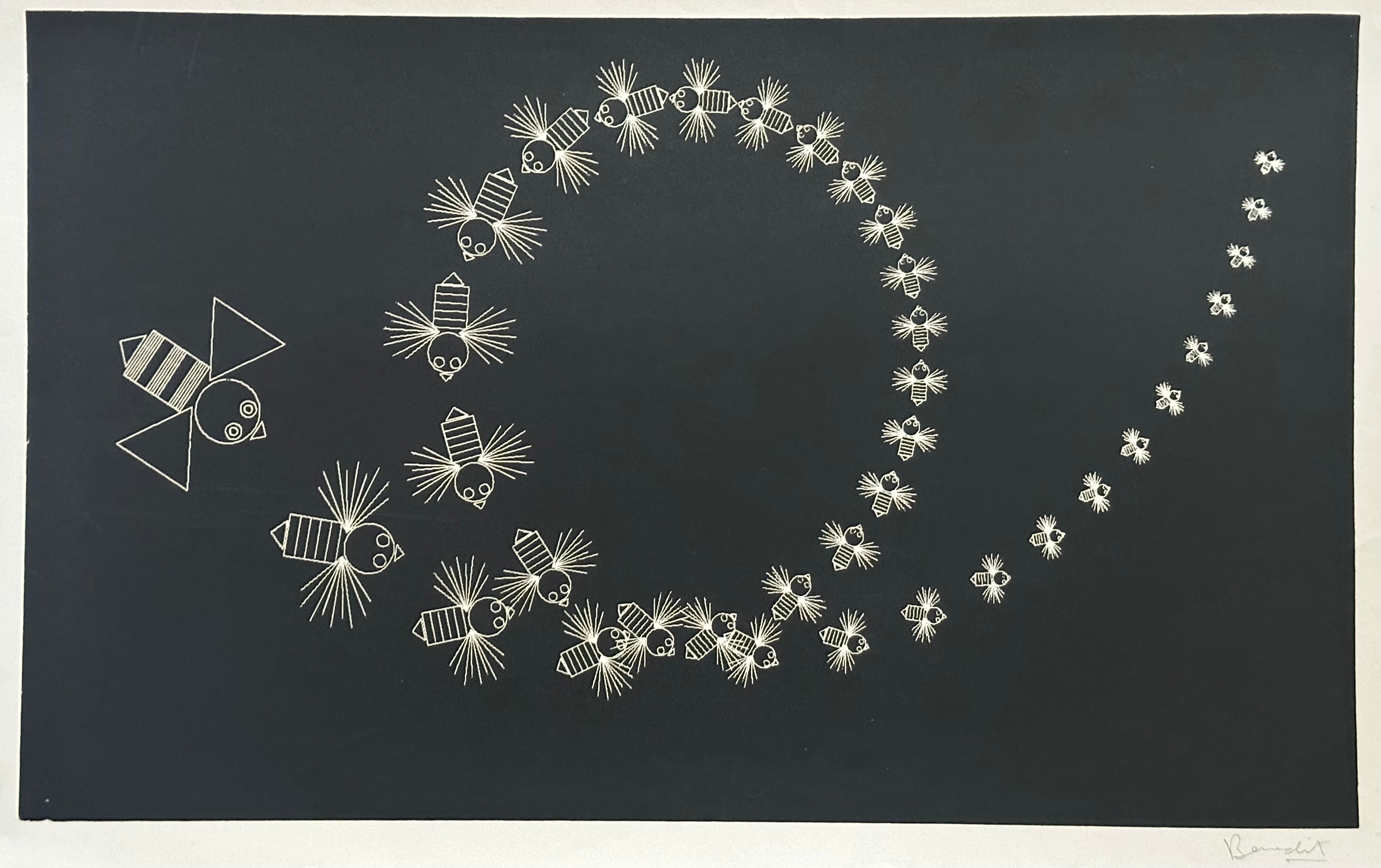
Benedit’s computer-generated work was a brief episode rather than the foundation of his career, but it was closely aligned with his wider practice. One of his compositions depicted repeated bees and was circulated as a plotter-derived screenprint. Instead of adopting the geometric abstraction associated with much early computer art, Benedit carried an existing biological subject into the computer laboratory. His graphics participated in CAyC’s subsequent international presentations, including exhibitions associated with the Association for Computing Machinery in Chicago and the Musée d’art contemporain de Montréal.
Living Systems and Cybernetics
The bee image also anticipated Benedit’s best-known biological environment. For the Argentine pavilion at the 35th Venice Biennale in 1970, he created Biotrón, an aluminium and Plexiglas habitat containing approximately four thousand living bees. Developed with experimental psychologist Antonio M. Battro and ethologist Josué Núñez, the installation allowed the bees to move between natural flowers outside the pavilion and artificial flowers that released a sugar solution under computer control.
The progression from a computer-drawn field of bees in 1969 to a computer-regulated habitat for living bees in 1970 shows the underlying continuity in Benedit’s work. In both, the subject is not technology by itself but the movement of living organisms through designed systems. Information, stimulus, response, adaptation and control became artistic materials.
Benedit extended these ideas through habitats and labyrinths for ants, snails, fish, cockroaches and white rats. The transparent structures resembled laboratory equipment, making otherwise hidden patterns of movement and behavior available for observation. At the same time, they raised questions about who constructs an environment, who controls its inhabitants and whether supposedly natural behavior can be separated from the artificial conditions within which it occurs.
In Laberinto invisible (1971), Benedit turned the system toward the human viewer. Mirrors, photoelectric sensors, lights and an alarm created an environment whose invisible controls were revealed only when a visitor activated them. The work connected cybernetics to the experience of surveillance and made the participant, rather than an animal, the observed subject.
Benedit’s 1972 exhibition in the Projects Gallery at the Museum of Modern Art in New York included Fitotrón, a functional hydroponic environment for plants, and a habitat for white rats. Fitotrón automatically supplied plants with artificial light and chemical nutrients, placing biological growth inside a visibly technological system. Benedit was the first Latin American artist to receive a solo exhibition in MoMA’s Projects Gallery.
CAyC and Argentine Identity
Benedit was also a founding member of CAyC’s Grupo de los Trece and remained associated with the group throughout its history. In 1977 the group presented Signos en ecosistemas artificiales at the 14th São Paulo Biennial and received the Grande Prêmio Itamaraty. The installation treated individual artworks as interdependent elements within a larger semiotic and social system.
By the middle of the 1970s, Benedit had begun shifting his attention from laboratory habitats toward the animals, tools, rituals and material culture of rural Argentina. Works involving the hornero, the country’s national bird, agricultural implements, cattle brands, fences, seeds and livestock examined how a national identity is constructed from representations of the land and the countryside. Nature remained central, but it now appeared as something organized culturally and politically as well as technologically.
Later drawings, objects and installations invoked nineteenth-century naturalists, the voyages of Darwin and FitzRoy, the exploration of Patagonia and the violence directed against Indigenous peoples. In his final years, Benedit used cow and horse bones to construct objects and reliefs whose geometric organization contrasted with the raw physicality of their materials. His 2009 MALBA exhibition Equinus Equestris brought together more than sixty works concerned with the horse and its place in Argentine and Río de la Plata history.
Alongside his art, Benedit continued to practice architecture and design. With Jacques Bedel and Clorindo Testa, he won the 1979 competition to transform a former convent and institutional complex into the Centro Cultural Recoleta in Buenos Aires. He later designed spaces including Galería Ruth Benzacar and Fundación Munar.
Historical Position
Benedit is now recognized as a pioneer of biological sculpture and bioart, as well as an important participant in the development of Conceptualism and systems art in Latin America. His work replaced the autonomous art object with changing environments in which plants, animals and people acted within designed networks of matter, energy and information.
His historical significance for computer art is more concentrated but still substantial. Through Arte y Cibernética, he participated in one of Latin America’s earliest organized computer-art initiatives; through Biotrón, he moved from computer-generated representation to a cybernetic environment in which computation helped regulate the behavior of living organisms. That continuity distinguishes his work from artists for whom the plotter was merely a short-lived graphic tool.
Benedit died in Buenos Aires in 2011. His work is held by institutions including the Museum of Modern Art, MALBA, the Museo de Arte Moderno de Buenos Aires, the Museum of Fine Arts, Houston, the Daros Latinamerica Collection and the Institute for Studies on Latin American Art. The 2024–25 exhibition Luis Fernando Benedit: Invisible Labyrinths at ISLAA was his first major New York presentation since the 1972 MoMA exhibition and renewed attention to his contributions to bioart, cybernetics and systems art.
Exhibitions
- 1961 – Nuevos rostros, Galería Lirolay, Buenos Aires
- 1965 – Recent Acquisitions: Painting and Sculpture, Museum of Modern Art, New York
- 1968 – Materiales. Nuevas técnicas. Nuevas expresiones, Museo Nacional de Bellas Artes, Buenos Aires
- 1968 – Microzoo, Galería Rubbers, Buenos Aires
- 1969 – Arte y Cibernética, Galería Bonino, Buenos Aires
- 1970 – 35th Venice Biennale, Argentine Pavilion, Venice; presentation of Biotrón
- 1971 – Grupo Buenos Aires presentation at the Association for Computing Machinery National Conference, Chicago; computer-assisted works originating with Arte y Cibernética
- 1971 – Arte de Sistemas, Museo de Arte Moderno, Buenos Aires; presentation of Laberinto invisible
- 1972–73 – Projects: Luis Fernando Benedit, Museum of Modern Art, New York
- 1974 – Le Musée Cybernétique, Musée d’art contemporain de Montréal; computer-assisted graphics originating with Arte y Cibernética
- 1974 – Art Systems in Latin America, Institute of Contemporary Arts, London
- 1976 – Luis F. Benedit: Plant- en Dierhabitaten, Internationaal Cultureel Centrum, Antwerp
- 1977 – Signos en ecosistemas artificiales, Grupo de los Trece–CAyC, 14th São Paulo Biennial; recipient of the Grande Prêmio Itamaraty
- 1993 – Latin American Artists of the Twentieth Century, Museum of Modern Art, New York
- 1996 – Luis F. Benedit en el Museo Nacional de Bellas Artes: Obras 1960–1996, Museo Nacional de Bellas Artes, Buenos Aires
- 2009 – Luis F. Benedit: Equinus Equestris, MALBA, Buenos Aires
- 2010 – The Modern Myth: Drawing Mythologies in Modern Times, Museum of Modern Art, New York
- 2024–25 – Luis Fernando Benedit: Invisible Labyrinths, Institute for Studies on Latin American Art, New York
In the collection