

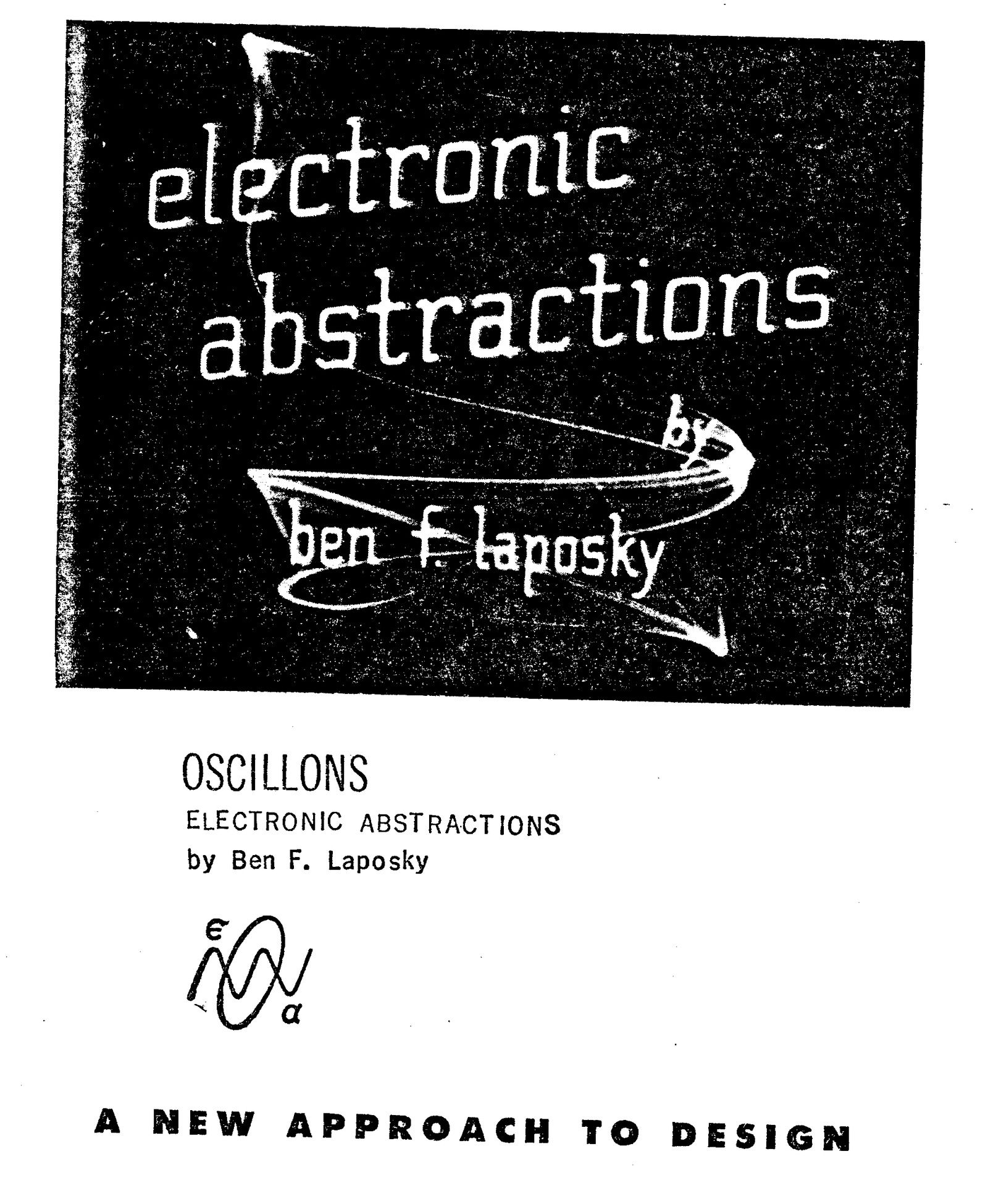
01 / 01Ben F. Laposky, Oscillons: Electronic Abstractions—A New Approach to Design, 1953. Front cover.
Open full-size image ↗Exhibition catalogue
Oscillons: Electronic Abstractions—A New Approach to Design
1953One of the earliest artist publications devoted entirely to electronic image-making, this self-published catalogue documented and helped popularize Ben F. Laposky’s oscilloscope abstractions through the widely circulated Electronic Abstractions exhibition.
- Author / editor
- Ben F. Laposky
- Publisher
- Ben F. Laposky (self-published)
Cherokee, Iowa, USA - Format
- Illustrated exhibition catalogue
- Pages
- 16
- Language
- English
PDF document
Composite archival dossier containing Laposky’s complete 1953 self-published catalogue together with an exhibition announcement, later exhibition history, Sanford Museum gallery notes, a Scripta Mathematica plate, a 1975 letter from Laposky to Woody Vasulka, and a contemporary newspaper clipping. The original catalogue consists of 16 numbered pages plus its cover and copyright page; the remaining material was preserved with it in the Vasulka Archive.
Related in the collection
Fritz Wilhelm Winckel, 1930
Jasia Reichardt, editor. Franciszka Themerson, design & layout., 1968
Cynthia Goodman, 1987
Margit Rosen, 2024
Published by Ben F. Laposky in Cherokee, Iowa, in 1953, Electronic Abstractions: A New Approach to Design explains how Laposky composed luminous abstract forms by combining electrical waveforms, specially constructed or modified circuits, a cathode-ray oscilloscope, and photography. The catalogue reproduces 56 monochrome “oscillons,” including the 50 photographs assembled for the traveling exhibition organized with W. D. Frankforter of the Sanford Museum.
Laposky emphasized that the images were deliberately composed rather than discovered as accidental scientific traces. He connected 37 electronic instruments in different combinations, adjusting the resulting waveforms for visual balance before photographing them from the oscilloscope screen. The 56 published designs were selected from nearly 6,000 photographs made by that point.
The catalogue’s historical importance lies less in proving that Laposky invented oscilloscope art than in showing how effectively he developed, named, explained, reproduced, and circulated the technique. A gallery-note sheet preserved with the catalogue in the Vasulka Archive explicitly acknowledged that Laposky had not originated the idea of using oscilloscopes and electronic circuits to create art, while arguing that he had developed it further than any source then known through publication or exhibition. His achievement was therefore one of sustained development and public dissemination: he transformed an existing technical possibility into a recognizable body of photographic work and a widely touring electronic-art exhibition.