

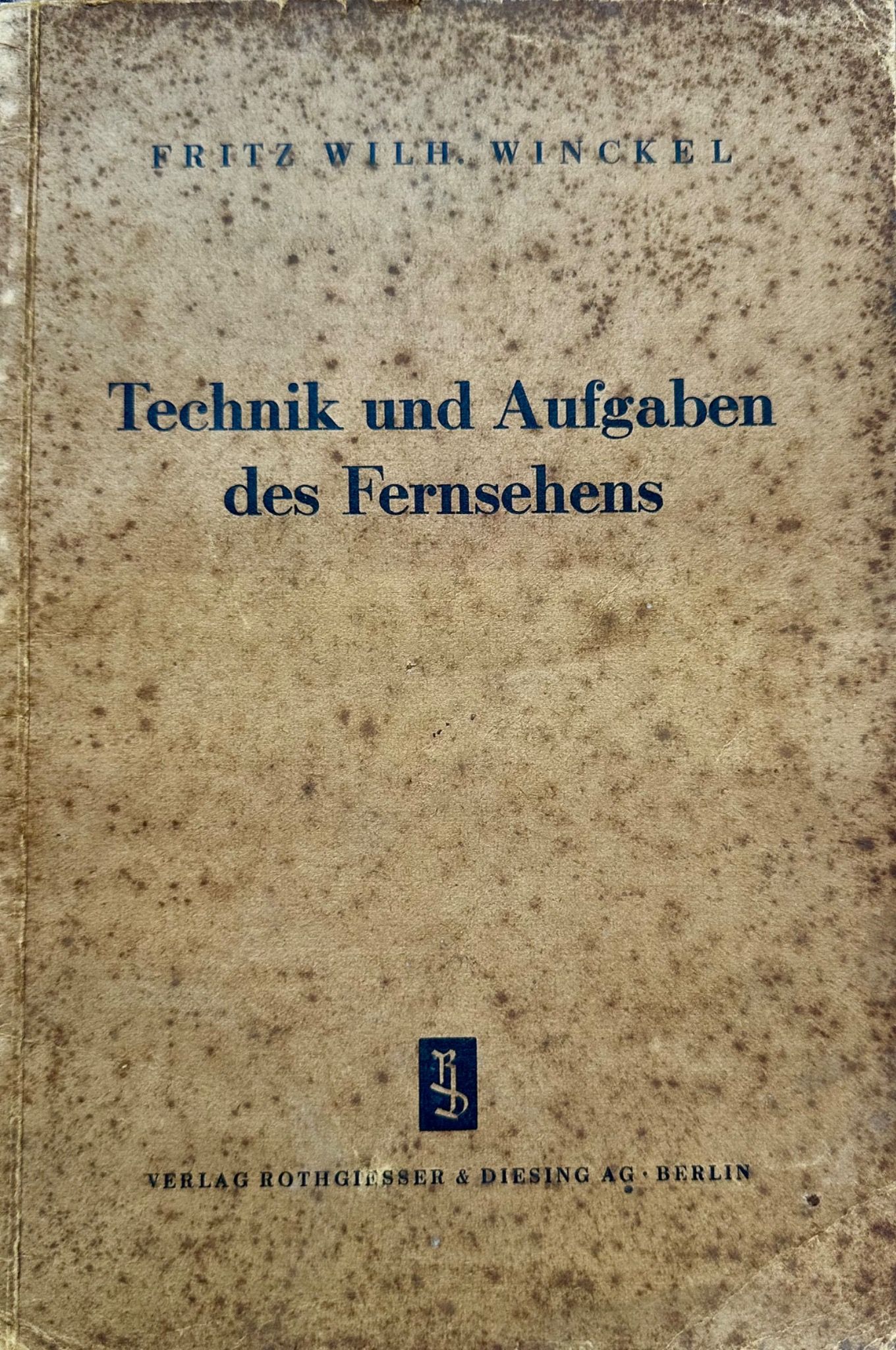
01 / 06Fritz Wilhelm Winckel, Technik und Aufgaben des Fernsehens (Berlin: Rothgiesser & Diesing AG, 1930). Front cover.
Open full-size image ↗Book
Technik und Aufgaben des Fernsehens
1930Winckel’s illustrated 1930 introduction to television includes a remarkable discussion of its artistic possibilities. Describing the conversion of music into moving abstract patterns, he proposes electrical oscillations as a common basis for the arts and imagines new forms of composition, perception and aesthetic analysis.
- Author / editor
- Fritz Wilhelm Winckel
- Publisher
- Rothgiesser & Diesing AG
Berlin, Germany - Format
- Illustrated book in original printed wrappers; 65 illustrations
- Pages
- 74
- Language
- German
- Edition
- 1930 edition
Related in the collection
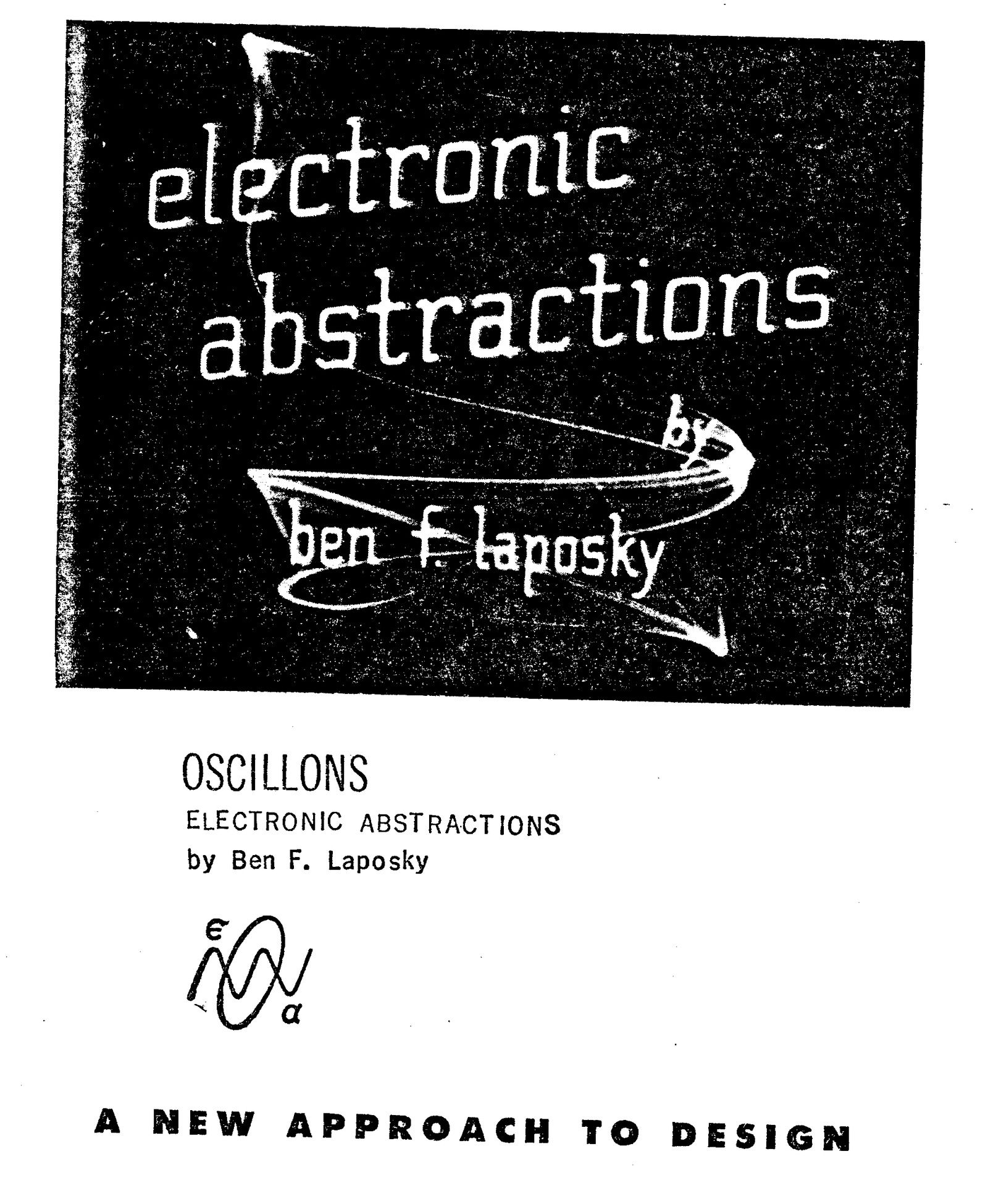
Ben F. Laposky, 1953
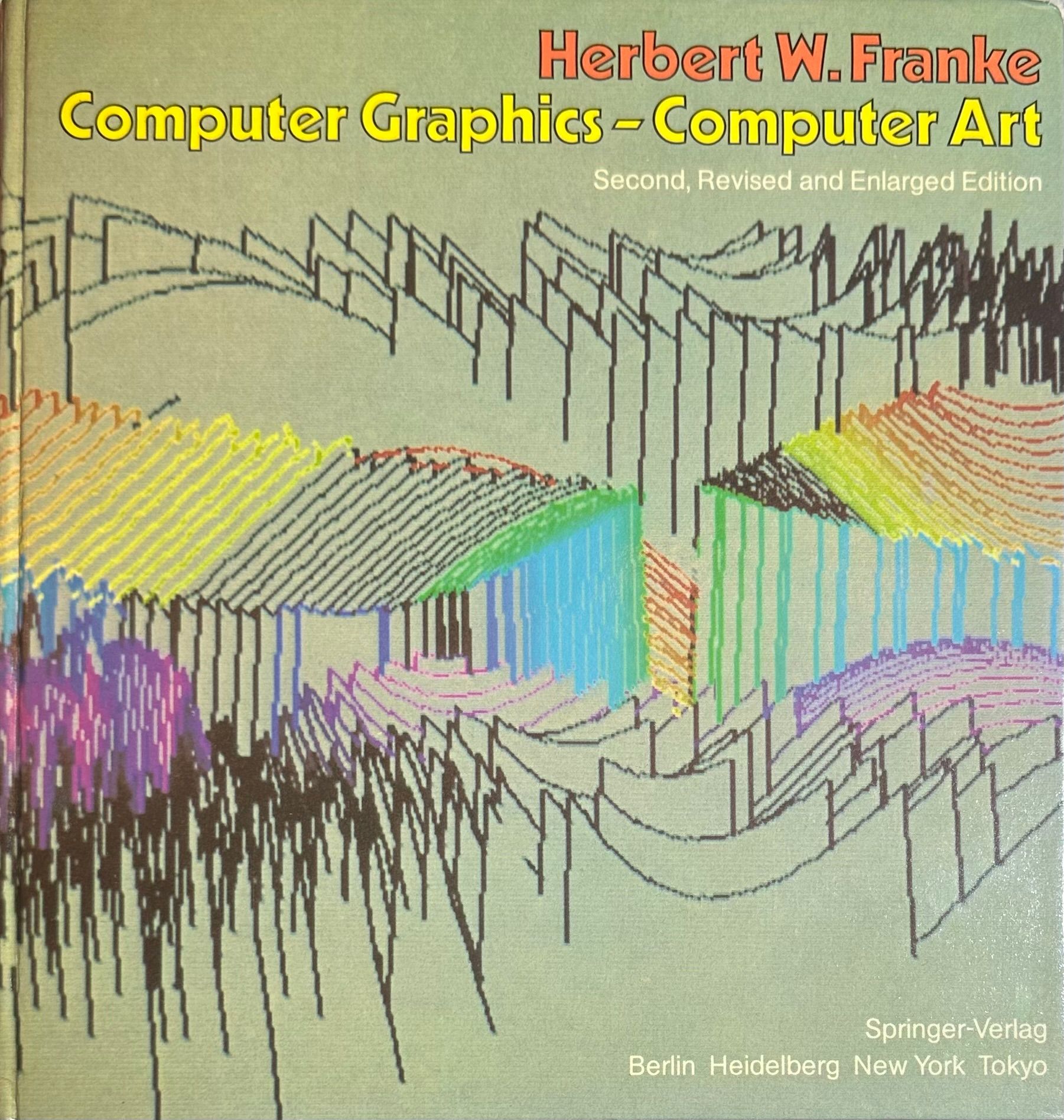
Herbert W. Franke, 1985
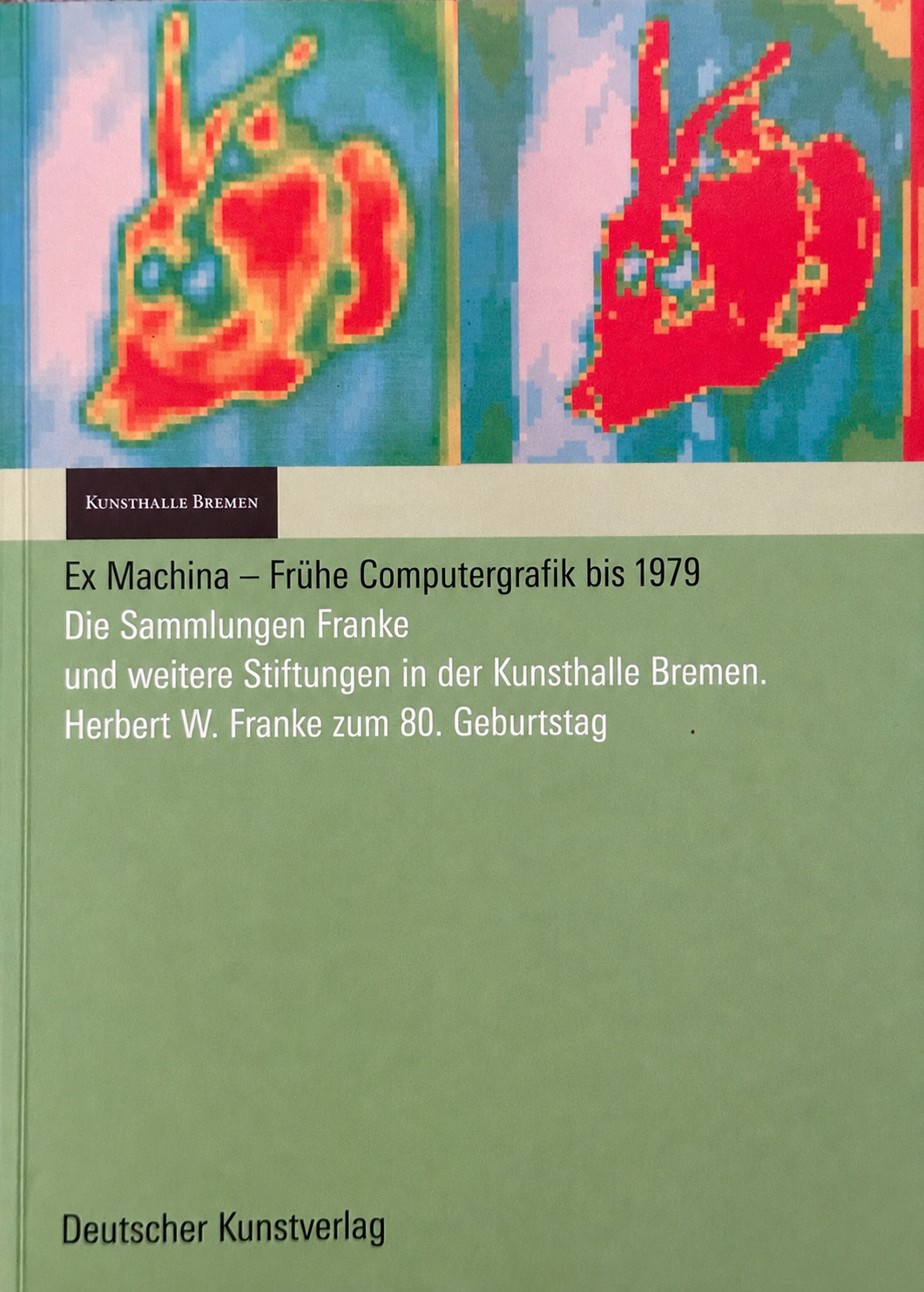
Wulf Herzogenrath and Barbara Nierhoff-Wielk, editors, 2007
Margit Rosen, 2024
Published in Berlin in 1930, Fritz Wilhelm Winckel’s Technik und Aufgaben des Fernsehens introduces television’s operation and possible applications to a general readership. Its section “In der Kunst” (“In Art”), on pages 59–61, treats the television apparatus as an instrument for transforming sound into visible form. Winckel describes the pleasure of watching music generate an ever-changing weave of abstract patterns, with differences in rhythm, dynamics and instrumental timbre appearing as differences in the image.
His argument extends beyond visualization. If music and painting can both be converted into electrical oscillations, he suggests, they share a physical basis through which artistic expression can pass from one sense to another. He imagines the theremin’s oscillations becoming images, artists composing directly by punching rolls, and sound–image transformations supporting new forms of perception. He also makes the more speculative claim that these transformations could provide an objective means of assessing artistic quality.
The passage is an early published statement of the aesthetic possibilities of electrically generated imagery. Its examples belong to the context of mechanical television: Winckel describes changing the motor speed to shift the scanning lines and produce new combinations of patterns. The book separately illustrates a cathode-ray tube from Manfred von Ardenne’s laboratory on page 37. Keeping these contexts distinct places the art passage within the broader history of visual music and electrical image-making without identifying Figures 51–55 as CRT oscilloscope images. For further historical context, see Dieter Daniels’s discussion of Winckel’s experiments in “An der Schnittstelle von Sound & Vision”, especially PDF pages 18–19.
English translation: pages 59–61
Translated from the photographed German pages of the copy in the Güerita Art collection. Page boundaries are marked in brackets where they interrupt a sentence. Figure numbers follow the original. The final paragraph on page 61 begins the next subsection and is included separately for completeness.
Page 59 — 7. The Application of Television
A. In Art
“If the optic and auditory nerves were cross-connected, we would, if the experiment were possible, hear lightning with the eye as a bang and see thunder with the ear as a sequence of impressions of light.”
Du Bois Reymond (Ignorabimus), 1891. [Attribution as printed by Winckel.]
For a long time now, the doctrine of “we shall not know” has been invoked only with great caution. For, in fact, the experiment cited by Du Bois Reymond, for example, has now become possible. In the fourth chapter we became acquainted with the analogy between the eye and the ear, as well as with the artificial organs that replace them. Should it not be possible to interchange these organs or, in practical terms, to exchange the loudspeaker for the television receiver? If an optical transmission, using any method of scanning and with an interval of one-tenth of a second between images, is received through a loudspeaker, one literally hears the expression of an image. A trained ear will be able to infer the character of the image from the sound and determine whether it is a photograph, a black-and-white drawing, handwriting or a fingerprint. Less can be inferred, however, from the sound of current German television broadcasts, which produce a gurgling hum resembling alternating current in the loudspeaker, because the synchronizing pulses that occur line by line drown it out.
Conversely, the music and spoken performances broadcast on the radio can be made visible on the viewing screen. One then sees a moiré-like formation in black and reddish contrasts, changing its appearance with the rhythm of the music and even with the slightest changes in the dynamics of a tone (see Figs. 51–55). It is an artistic pleasure to observe on the screen the visual shaping of a composition in sound as a perpetual weaving of mosaic patterns that arise of themselves and are characteristic of the sound. The fanfare blasts of a symphony, for example, appear in syncopated rhythm as half-oval shadows, interrupted by kettledrums recognizable as jagged contours. Then comes an Andante cantabile, the unfolding of a melody in all its variations by string instruments; accordingly, finely distributed patterns appear on the screen in infinite variety. During a diminuendo they fade increasingly, until they become the indistinct, misty figures of pianissimo. When one considers that 1,200 light and dark picture elements are available—
[Page 60 continues]
—one will understand that there are 1,200 × 1,200 different possibilities for creating a pattern, quite apart from intermediate shades. The formations produced by music have a unified and harmonious structure, since they are nothing other than mathematical curves represented in two dimensions. The richer an instrument’s timbre, the more overtones its sound contains, and the more complicated the corresponding pattern becomes. An entire orchestra, through the many overlapping tones, will produce a highly subdivided formation. If the rotational speed of the motor is also changed, the lines, as we know, shift relative to one another, and entirely new combinations of patterns are obtained; within a particular rotational speed, however, they stand in a particular musical relationship to one another.
[Figures 51 and 52 appear within the preceding paragraph in the original; Figures 53 and 54 follow it. The figures carry numbers without descriptive captions.]
Following these considerations, we are in a position to give an entirely new definition of the concept of “art.” Every mode of representation, whether through music or painting, can in its fundamental form be interpreted as a succession of oscillations which, after their electrical conversion, have the same physical character. They are to be regarded as a modulated alternating current that can be brought to consciousness through the human senses in different ways: through hearing and sight (and, after the invention of the corresponding artificial organs, through touch and smell as well). Imprinted on this alternating current are—
[Page 61 continues]
—the elements of music—melody, harmony, rhythm and dynamics—or the corresponding elements of painting. During reproduction, they appear in their characteristic form, so that individual artistic expression is fully preserved. The connection between the individual branches of art has long been recognized, but it has not been possible to grasp it in concrete form. One often speaks of “color compositions”; in fact, every artist is a composer, regardless of the way in which he seeks to express himself. For all means of expression can be traced back to the common foundation of electrical oscillations. The Russian physicist Theremin composes directly by electrical means with his ether-wave instrument, which contains components similar to those of a radio receiver. The oscillations produced could just as readily be made visible as a pictorial motif in the television receiver as they are made audible through loudspeakers. There are a whole series of other means of expression, such as artists directly punching rolls in whatever individual arrangement they choose. This should not be understood as transferring notes to the roll by means of a pianola, but as direct, original creation on the roll itself.
[Figure 55 appears within the preceding paragraph in the original, without a descriptive caption.]
The synthesis of art by electrical means also leads us to analysis: to an unambiguous, objective assessment of a work of art as a supplement and a check on personal taste, which swings back and forth. How indefinite is the conception of art held by so many people, who always allow themselves to be guided by the fashion of the moment—even when it is impractical and unattractive—and cannot judge the absolute value of a work of art. How worthless is many a piece of music that manages to bluff with superficial effects and a great deal of noise; on the viewing screen it can make a very different impression and perhaps expose all the weaknesses that have been “drowned out.”
Establishing a common basis for visual and acoustic reproduction will also make it possible in the future for blind people to see again through hearing and, conversely, for deaf people to hear again through sight. It is merely a matter of practice to learn a new means of expression, much as one learns a language: namely, to recognize particular sound effects in images or, conversely, to discern writing or an image from the character of a sound.
B. In Science and Technology — opening paragraph, page 61
Television, in conjunction with wireless telephony, may bring about a revolution in the whole of art. At the same time, the new invention will exert a decisive influence on the most varied areas of life that have nothing to do with broadcasting, but in many cases are at least as important.
Translation notes
“Picture elements” translates Bildpunkte which are precursors to digital pixels. The numerical claim “1,200 × 1,200” is reproduced as printed. “Ether-wave instrument” preserves Winckel’s period term Aetherwelleninstrument for Theremin’s instrument. His claims about objective aesthetic judgment and restoring perception are translated as historical propositions, not presented as established results. The opening paragraph uses the printed word Ignorabismus, rendered here as the doctrine of “we shall not know”; the epigraph’s attribution and date have been retained rather than independently corrected.