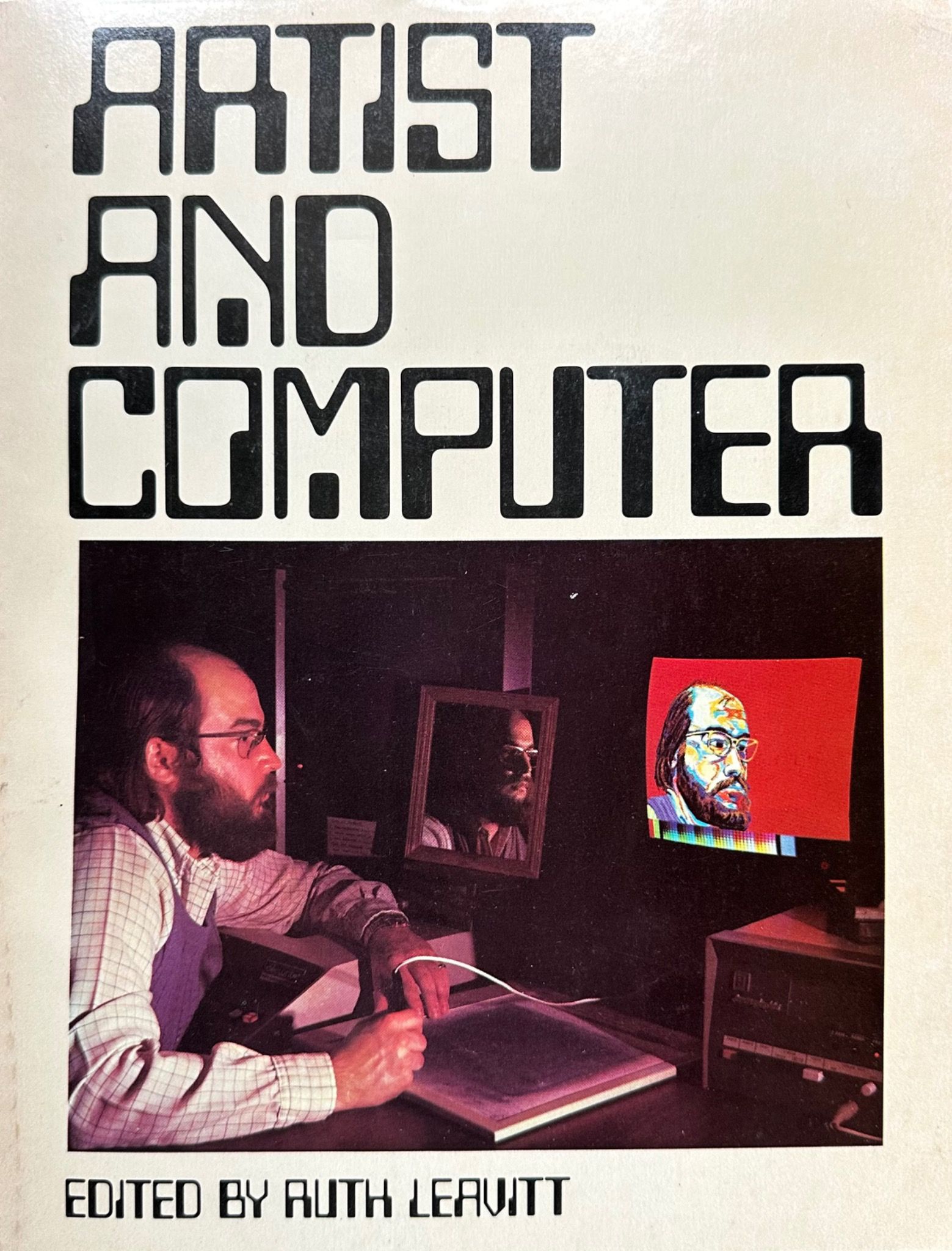
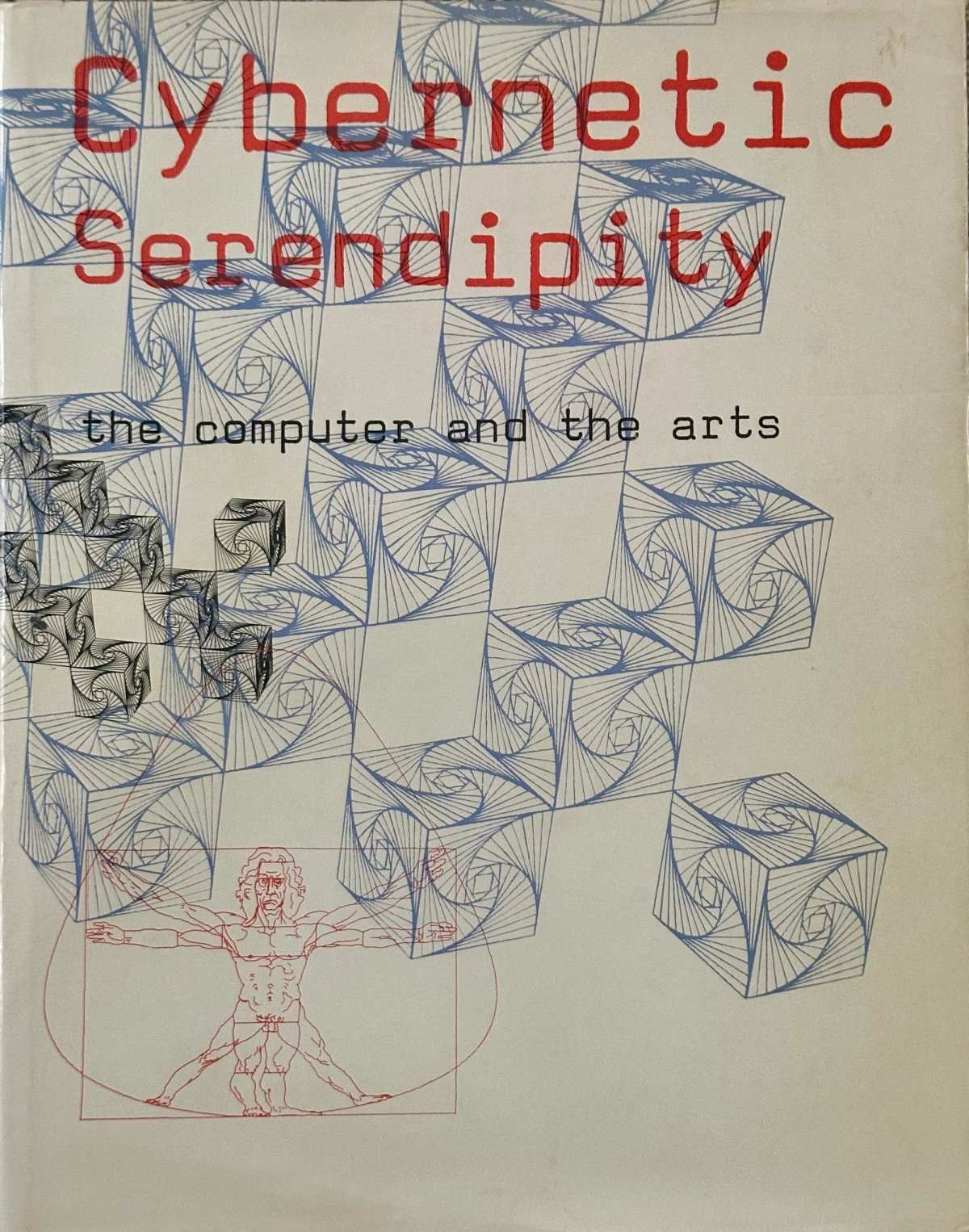
01 / 11Front cover: Duane M. Palyka’s Self Portrait.
Book
Artist and Computer
1976Artists describe their own methods and ideas in Ruth Leavitt’s 1976 anthology, including Laposky on oscillons, Molnár on systematic variation, and Csuri on real-time graphics and participation.
- Author / editor
- Ruth Leavitt, editor
- Publisher
- Harmony Books
New York, USA - Format
- Illustrated paperback; ix, 121 pp., with colour plates
- Pages
- 121
- Language
- English
Related in the collection
Edited by the artist Ruth Leavitt, Artist and Computer brings together firsthand accounts of how artists were working with computers and electronic systems in the mid-1970s. Its back cover introduces 35 computer artists and more than 160 illustrations. The contributors explain their methods, motivations and artistic decisions in their own voices, making the volume a primary source for a field that encompassed plotter drawings, electronic imagery, animation, sculpture and interactive systems.
The contributors include Ben F. Laposky, Vera Molnár, Charles Csuri, Herbert W. Franke, Manfred Mohr, Hiroshi Kawano, Kenneth Knowlton, Lillian Schwartz, John Whitney and Leslie Mezei. The volume also contains accounts by Ruth Leavitt, Ann H. Murray, Robert Mallary, Aldo Giorgini, Aaron Marcus, Colette Bangert, Charles Bangert, Tony Longson, Peter Struycken, Edward Ihnatowicz, Laurence Press, Manuel Barbadillo, Patsy Scala, William J. Kolomyjec, Edward Zajec, Edward Manning, Duane M. Palyka, Joseph Scala, Karen E. Huff, Miljenko Horvat, Christopher William Tyler, Kurt F. Lauckner, Vicky Meyer Chaet, Larry Elin, Roger Vilder and Jacques Palumbo.
Charles Csuri: statistics as an interactive art object
Csuri’s chapter, “Statistics as an Interactive Art Object” (pp. 85–87), is dated September 1975. It documents a direction in his work beyond the early plotter drawings: real-time graphics that allow a participant to explore and transform numerical information. Social statistics become material for an aesthetic experience, while interaction helps reveal relationships that are difficult to grasp from numbers alone.
Charles Csuri, p. 86.
Csuri describes an implemented simulation based on the Automatic Interaction Detector (AID), running on a PDP-11/45 with a Vector General display. A joystick lets the participant move forward and backward through time, inspect changing tree structures and rotate three-dimensional representations. He credits Ronald Hackathorn and Allan Myers with programming the interactive AID simulation. The chapter also reproduces shaded images of an apple and intersecting violins, illustrating a visible-surface algorithm for concave polyhedra, and a photograph of the interactive graphics station.
Laposky and Molnár in their own words
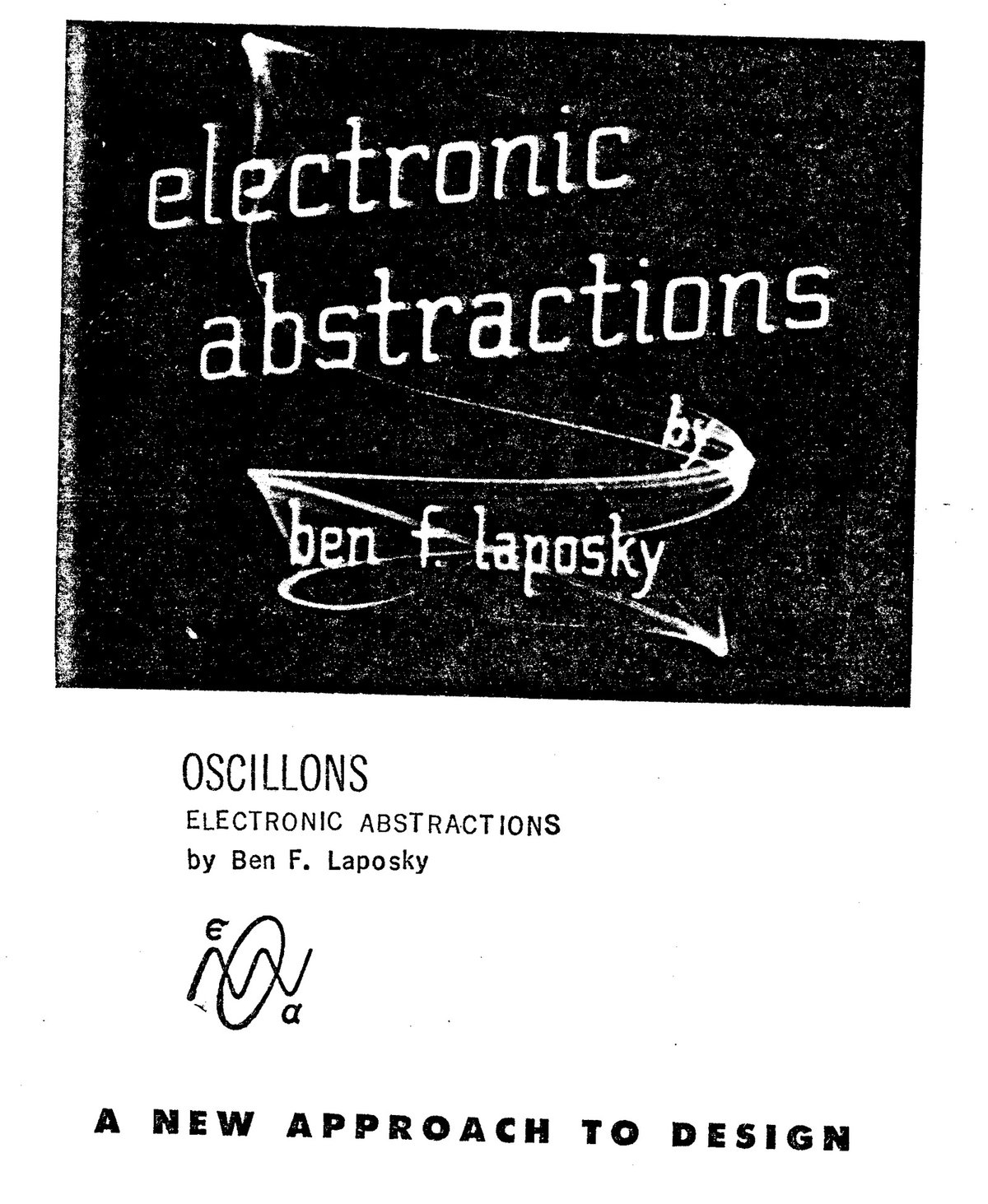
On p. 21, Laposky explains how he composed and photographed oscillons using selected waveforms, modified oscilloscopes and specially designed circuitry. He explicitly notes that these images can be made without an analogue or digital computer. Writing in August 1975, he states that his oscillons had been exhibited and published in America and abroad since 1952, citing more than 216 exhibitions and 160 publications. The date is given in his own account of the work’s public presentation.
In his closing paragraph, Laposky responds to the idea of “machine art” as cold or impersonal by emphasizing human imagination, planning and judgment:
Ben F. Laposky, p. 21.
Molnár’s contribution (pp. 35–36) describes a method of small, systematic changes guided by perception and aesthetic judgment. The computer makes it practical to explore many more alternatives than hand execution would allow. She discusses her RESEAU-TO program, interactive work on a CRT, and variations derived from arrays of concentric squares. Five images from her 1975 “196 squares” series accompany the text. Her emphasis is on reinforcing intuition through deliberate comparison and experimentation.
Read Artist and Computer online — Atari Archives
Charles Csuri’s chapter — Atari Archives
Bibliographic record — Open Library