
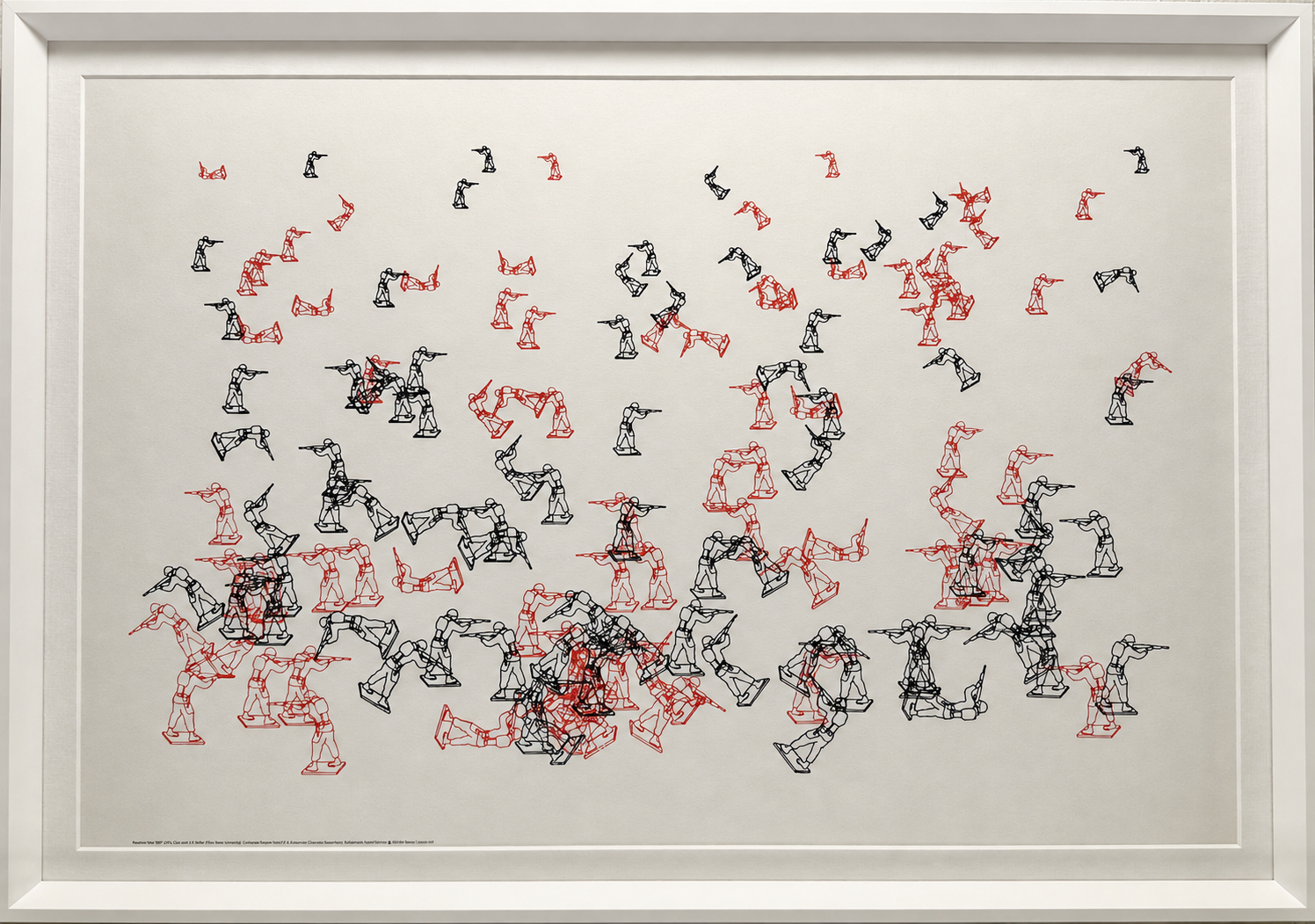
Random War is one of the earliest computer artworks to use an algorithm as a political and narrative system rather than merely to generate abstract form. Csuri and Shaffer’s program distributed toy soldiers across a battlefield and calculated their fates, turning Csuri’s personal experience of war into a stark meditation on chance, automation and death.
Provenance
Copies of the same edition in museum holdings:
- ZKM Center for Art and Media, Karlsruhe
- Buffalo AKG Art Museum, Buffalo
- Asheville Art Museum, Asheville
Exhibitions
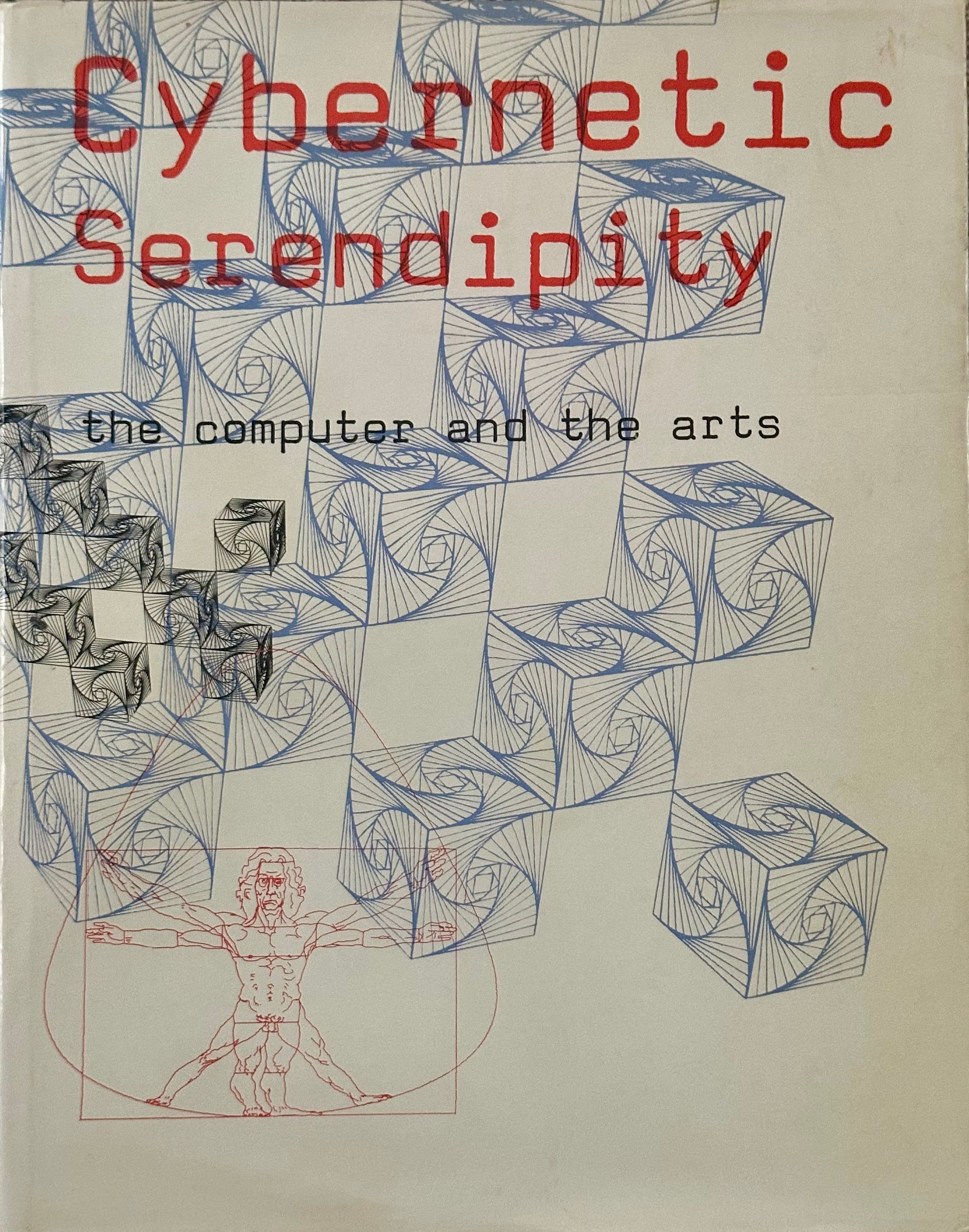
- Cybernetic Serendipity: The Computer and the Arts, Institute of Contemporary Arts, London, 1968. The present Motif Editions lithograph was published in association with this landmark exhibition.
- Tendencies 4: Computers and Visual Research, Gallery of Contemporary Art, Zagreb, 1969. A contemporary version of Random War was exhibited; the precise format has not been identified.
- Charles A. Csuri: Beyond Boundaries, 1963–Present, SIGGRAPH, Boston, 2006; Kaohsiung Museum of Fine Arts, Taiwan, 2008; and Urban Arts Space, The Ohio State University, Columbus, 2010. These presentations included an authorized reconstruction made in 2006 from Csuri’s rediscovered original large-format negatives.
- Feedback, LABoral Centro de Arte y Creación Industrial, Gijón, Spain, 2007. The exhibition presented the monumental 2006 reconstruction of Random War, printed by dye sublimation on aluminium.
- Digital Pioneers, Victoria and Albert Museum, London, 2009–10. The display included the red-and-black Motif Editions lithograph from the V&A’s computer-art collection.
- Dislocations, Media Facade, Museum of Contemporary Art Zagreb, 2011; presented in connection with ISEA2011 Istanbul and the official parallel program of the 12th Istanbul Biennial. Csuri created a new, Facebook-based moving-image adaptation of Random War for the museum’s 400-square-metre facade; this was a transmediation of the original concept rather than an exhibition of the 1968 print.
- Ficções Radicais (Radical Fictions): IV Mostra 3M de Arte Digital, Instituto Tomie Ohtake, São Paulo, 2013.
- Chance and Control: Art in the Age of Computers, Victoria and Albert Museum, London, 2018. Organized to mark the fiftieth anniversary of Cybernetic Serendipity, the exhibition again presented the V&A’s Motif Editions lithograph.
- Coded: Art Enters the Computer Age, 1952–1982, Los Angeles County Museum of Art, Los Angeles, 2023. The exhibition presented a later version catalogued as Random War, 1967/2021.
- Charles Csuri: Art & Research, a Memorial Exhibition in Three Acts, Hopkins Hall Gallery, The Ohio State University, Columbus, 2023.
- Digital Masterpieces: From Code to Canon, presented by ArtMeta at Zero 10, Art Basel, Basel, 2026. The presentation included and sold a distinct red-and-black 1967 plotter version of Random War.
References
- Charles Csuri Studio, “Random War” https://www.charlescsuri.com/historic/random-war
- Charles A. Csuri Project, The Ohio State University, “Random War” https://csuriproject.osu.edu/Detail/objects/539
- ZKM | Center for Art and Media, “Random War” https://zkm.de/en/artworks/random-war
- Buffalo AKG Art Museum, “Random War from the portfolio Cybernetic Serendipity” https://buffaloakg.org/artworks/p2023466-random-war-portfolio-cybernetic-serendipity
- Asheville Art Museum, “Random War” https://collection.ashevilleart.org/objects-1/info/3518
- Jasia Reichardt, ed., Cybernetic Serendipity: The Computer and the Arts, 1968 https://archive.org/details/cybernetic-serendipity
- Caroline Csuri, Elaine O’Hanrahan, Leslie Jones and Douglas Dodds, “Our Fathers: Chuck Csuri and D. P. Henry,” Right Click Save, 2023 https://www.rightclicksave.com/article/our-fathers-chuck-csuri-and-d-p-henry
- Leslie Jones, interview on Coded: Art Enters the Computer Age, 1952–1982, Studio International, 2023 https://www.studiointernational.com/index.php/leslie-jones-interview-coded-art-enters-the-computer-age-1952-1982-lacma-los-angeles
Random War is one of the earliest works of generative, conceptual and simulation art. Instead of asking the computer to produce a geometric pattern, Charles Csuri and James Shaffer constructed a miniature social system: software positioned two armies, assigned identities and ranks, determined casualties and survivors, and calculated the results of an imaginary battle.
The work began with Csuri’s drawing of a single toy soldier. After the figure was encoded as computer data, a pseudorandom-number generator multiplied and transformed it across the battlefield. Some soldiers stand and aim; others bend, fall or lie horizontally as casualties.
This use of recognizable figures was itself a breakthrough. Early computer graphics consisted mostly of abstract mathematical structures or engineering visualizations. Csuri instead brought the human figure, already central to his work as a painter, into an algorithmic process. The soldiers remain immediately legible, but their positions, relationships and implied fates have been delegated to code.
The imagery was also personal. Csuri served in the U.S. Army during the Second World War, fought in the Battle of the Bulge and received a Bronze Star for heroism. In Random War, the arbitrary loss he witnessed is expressed as a computational structure. The original program used the names of real people, including public figures and Csuri’s acquaintances, making the machine’s apparently impartial decisions disturbingly specific. As his daughter Caroline Csuri explained in a February 6, 2023 interview in Right Click Save, the work also responded ironically to contemporary fears that computers were dangerous or inhuman: Csuri allowed the computer to decide who would live, die, disappear or receive a medal.
Csuri developed Random War over more than a year, producing numerous plotter variants, many monochromatic, with differing numbers and arrangements of soldiers, before arriving at this red-and-black composition, the work’s most fully resolved and mature presentation for the landmark Cybernetic Serendipity exhibition in 1968.
The Motif Editions lithograph was published for the exhibition. It is not a later reconstruction but a period multiple through which Csuri’s work reached an international audience at the moment computer art was first entering public consciousness.