

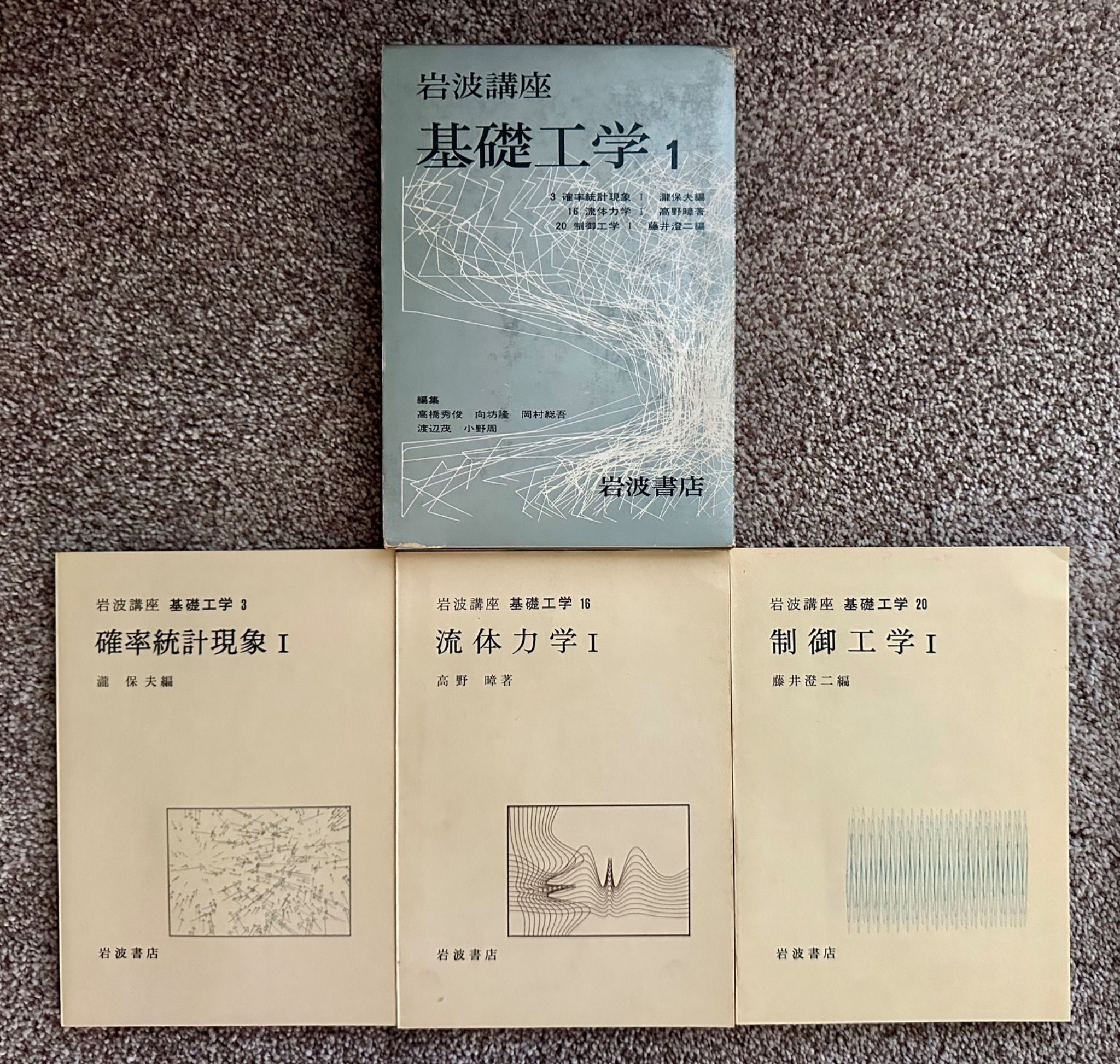
01 / 22Portfolio 1, containing Probability and Statistical Phenomena I (確率統計現象 I), Fluid Mechanics I (流体力学 I), and Control Engineering I (制御工学 I).
Open full-size image ↗Book
Iwanami Lecture Series on Fundamental Engineering (岩波講座 基礎工学)
1967–1971; General Index 1974Complete first-distribution set of Iwanami’s 57-fascicle, 19-portfolio Fundamental Engineering series, with IBM 7090/plotter cover graphics by Shigeru Watanabe and CTG members Haruki Tsuchiya, Koji Fujino, and Masao Komura. Watanabe was Tsuchiya’s University of Tokyo mentor and led the 1966 Computer Based Art group, which also included computer-art pioneer Hiroshi Kawano and formed an important precursor to CTG.
- Author / editor
- Cover designs by Shigeru Watanabe, Haruki Tsuchiya, Kōji Fujino and Masao Kōmura
- Publisher
- Iwanami Shoten
Tokyo, Japan - Format
- 57 fascicles in 19 card portfolios, with General Index supplement and publisher’s letter
- Language
- Japanese
- Edition
- First distribution
Iwanami Lecture Series on Fundamental Engineering was itself an ambitious project in postwar Japanese engineering. Beginning in 1963, five leading scholars, Takashi Mukaibo, Shigeru Watanabe, Sogo Okamura, Shu Ono, and Hidetoshi Takahashi, spent four years developing a new cross-disciplinary framework for “fundamental engineering” before publication began in 1967. Issued through 1971, the original series comprised 57 individual fascicles delivered three at a time in 19 gray portfolios, organized into 22 numbered subjects. Watanabe was not merely associated with the project: he was one of its five principal architects and wrote the series’ three-part Theory of Design, published from 1968 to 1970. A later history of Japanese engineering describes the series as influential among scholars, researchers, and students of the period.
The series was given a systematic computer-generated visual identity. Each of its 22 subjects has its own geometric cover vignette, repeated when a subject continues across multiple fascicles; an additional tree-like composition appears on the gray portfolios and, later, the General Index. The printed credit inside the books names Shigeru Watanabe, Haruki Tsuchiya, Koji Fujino, and Masao Komura as the makers of the cover vignettes and specifies that they were produced using an IBM 7090 and plotter installed at the IBM Data Center. Tsuchiya, Fujino, and Komura were members of Computer Technique Group (CTG); Watanabe was not. CTG was using the same IBM 7090 and a CalComp 563 plotter at IBM Japan for its recognized computer artworks during this period.
Watanabe’s presence in that credit reveals a deeper history. Haruki Tsuchiya later described Watanabe explicitly as his mentor (onshi) and recalled moving between the University of Tokyo’s Institute of Industrial Science and Watanabe’s laboratory after he began programming in 1965. Watanabe’s mechanical-engineering laboratory specialized in control engineering and in applying computers to new domains. It was an unusually fertile environment for thinking beyond conventional scientific calculation: as early as 1963 the laboratory had experimented with computer-generated composition, producing music for a technical high school by analyzing existing melodies computationally.
In January 1966 Watanabe’s laboratory became the base for C.B.A. (Computer Based Art), a research group explicitly intended to bridge engineering and art. Its participants included Tsuchiya and Hiroshi Kawano, the philosopher and aesthetician who produced Japan’s earliest computer-generated artworks in 1964. The first C.B.A. meeting was held in Watanabe’s office on January 31, 1966 and considered computer-generated tanka poetry. Kawano subsequently led the theoretical work on probabilistic language generation, while the group used a HITAC 5020 to generate poems computationally. C.B.A. therefore brought together, before CTG existed, Watanabe’s engineering laboratory, Tsuchiya’s emerging programming practice, and Kawano’s pioneering information-aesthetic approach to computer art. The last meeting of CBA was on February 13, 1967, one year after the initial meeting.
C.B.A. was an important precursor to CTG, but not its sole origin. In 1966, Tsuchiya met Tama Art University product-design student Masao Komura when both applied for Fujita-gumi’s sixth Student Executive Board. After one of the board’s regular meetings, Komura proposed that they make pictures with computers. That idea, combined with Tsuchiya’s programming background and their subsequent connection to IBM Japan through a student essay competition, led to the formation of CTG in December 1966; the group soon brought together engineering and art students including Koji Fujino. The ties to Watanabe and Kawano remained active. At CTG’s October 1967 symposium Electronic Computer and Art, Watanabe spoke on the present and future of computers, while Kawano addressed experimental aesthetics and the relationship between art and computation. The Iwanami covers, which began appearing at about the same time, can therefore be understood as a material product of the overlapping University of Tokyo–CBA–CTG–IBM network from which early Japanese computer art emerged.
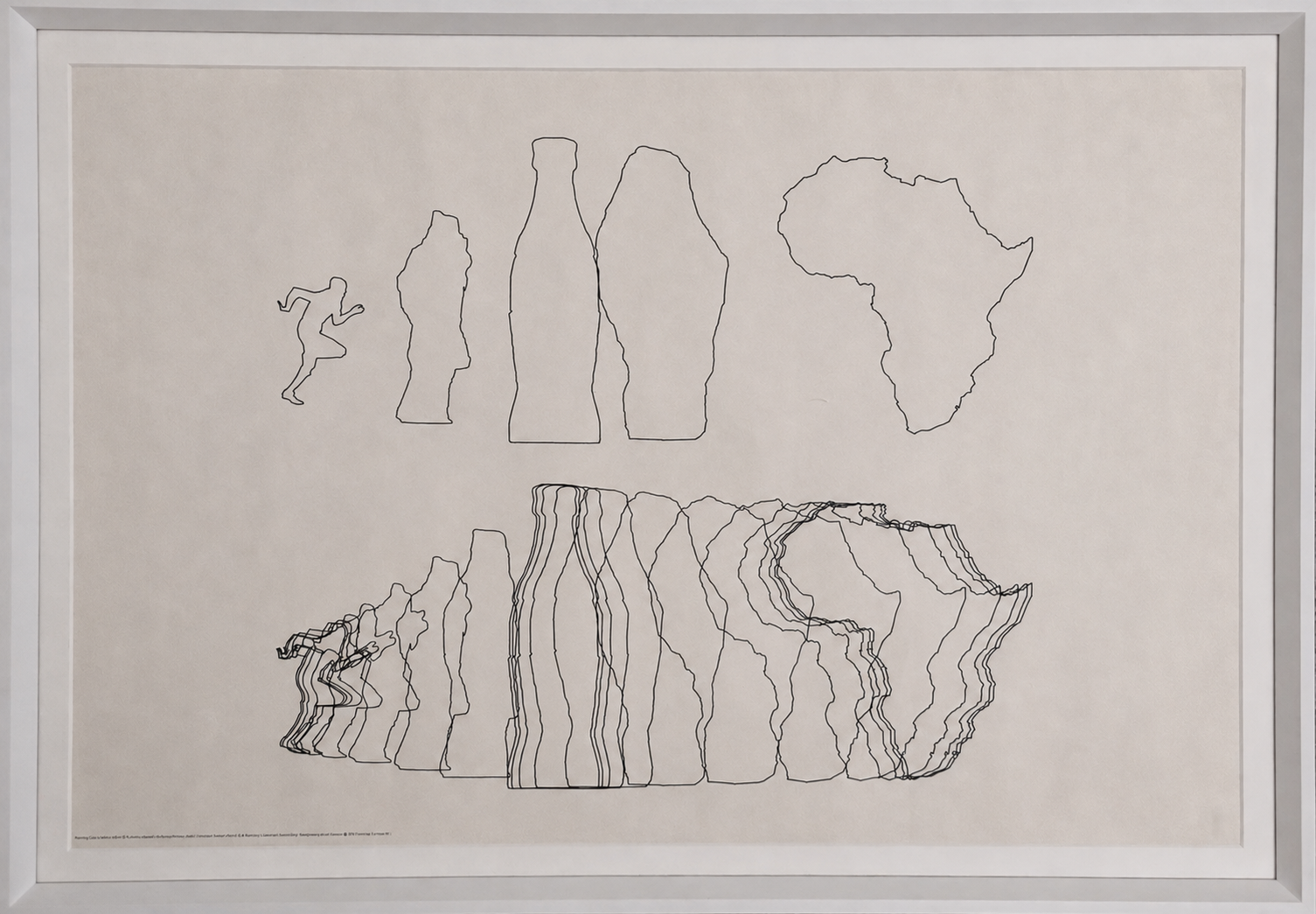
Visually, the commission also expands the familiar picture of CTG. The group is now best known for figurative and Pop-inflected transformations such as its Kennedy and Marilyn Monroe images and Running Cola is Africa. The Iwanami covers operate in a strikingly different register: geometric abstraction, often closer in appearance to the plotter-based work emerging from Europe at the same time. Yet these images were not conceived simply as autonomous prints. Each engineering subject receives a recurring computational motif, turning computer graphics into a coherent publication system across dozens of books. The series thus documents an unusually extensive early application of computer-generated imagery to graphic design and visual identity, alongside CTG’s better-known artistic practice.
This particular set also preserves evidence of how the series originally circulated. An Iwanami letter dated April 17, 1974 explains that readers of the first distribution had requested a comprehensive index, which could not be completed before the original series ended. Iwanami prepared the General Index during a later second distribution and mailed copies back to first-distribution readers; the letter notes that the second distribution was essentially unchanged apart from corrections and two pagination differences. The surviving letter, index, monthly bulletin, and other inserts therefore identify this set as an original first-distribution set subsequently supplemented by the publisher in 1974.